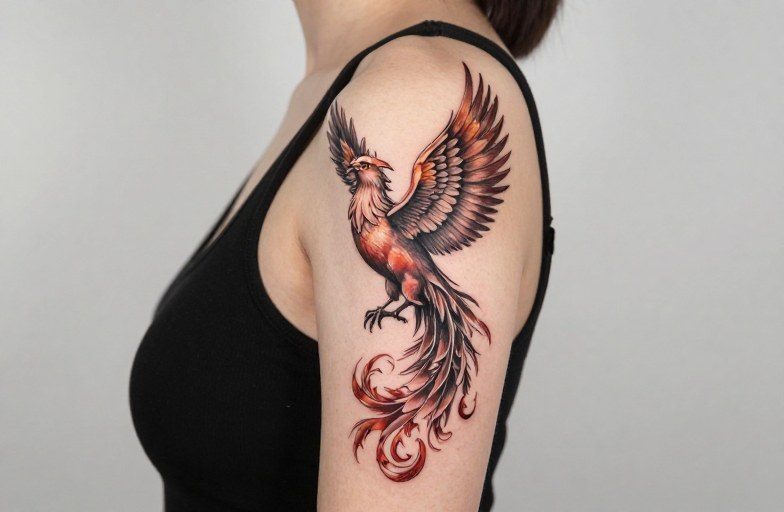
A phoenix tattoo for women most directly signals survival and deliberate reinvention. The bird’s cycle, burning, dying, rising from ash, maps onto lived experience: divorce, recovery, career pivots, coming out, surviving illness. Unlike some symbols that float in generic positivity, the phoenix carries weight because the transformation it depicts is violent and earned, not gentle. For many women, it marks a before and after they can point to on their own timeline.
History & Cultural Roots
The phoenix myth threads through multiple traditions, though details shift. Greek sources often linked it to Helios and solar cycles, with Herodotus and later Pliny describing a single bird living centuries, then self-immolating. Egyptian connections to the bennu bird are commonly associated with rebirth and the sun’s daily return, though scholars debate how directly these traditions merged. Chinese fenghuang imagery, sometimes conflated with the phoenix, originally paired male and female birds, with the female huang representing empress authority and virtue.
From Royal Emblem to Personal Symbol
Medieval European heraldry adopted the phoenix for queens and noble houses, signaling undying lineage. By the 20th century, the symbol migrated off coats of arms and onto bodies. The shift from public, inherited meaning to private, chosen marking is significant: a woman selecting this image controls its narrative rather than receiving it by birth. Tattooing reclaimed the phoenix from institutional power and made it available to anyone who’d lived through their own fire.
Modern Feminist Reclamation
Second-wave and later feminist movements sometimes deployed phoenix imagery for collective resurgence after suppression. On individual skin, that legacy persists more quietly. A woman might choose the bird without identifying as feminist, yet still benefit from the symbol’s accumulated association with refusal to stay down. The meaning layers: personal survival, possible political resonance, aesthetic choice, all present at once.
Color vs Black and Grey
Color phoenixes dominate visually, flame oranges, crimson reds, gold highlights. The palette practically demands itself. Saturated color reads immediately as fire, as energy, as forward motion. Watercolor techniques can soften the aggressive imagery for those who want the meaning without martial intensity. Traditional Japanese-inspired phoenixes (hou-ou) typically use bold, flat color areas with strong outlines, while neo-traditional work pushes the saturation further with magenta and electric blue accents.
When Black and Grey Works Better
Black and grey phoenixes carry different weight. Without color, the form becomes skeletal, architectural, more about structure than spectacle. This suits women who want the symbolism without announcing it across a room. Grey wash can suggest smoke and ash more than flame, emphasizing the death part of the cycle rather than the triumphant rise. On darker skin tones, black and grey with white highlights often ages more gracefully than color, which can muddy or disappear as melanin interacts with pigment over decades.
Color Longevity Reality
Reds and oranges, the phoenix’s natural palette, are notoriously fugitive. Cadmium-based reds especially tend to brown or pink out within five to ten years depending on sun exposure. Yellows fade fastest. A color phoenix requires commitment to touch-ups every few years if you want it to keep reading as fire rather than rust. Budget for that maintenance when choosing color, or design with darker anchor colors (deep burgundy, maroon, ochre) that shift more gracefully.
Similar & Related Symbols
Women sometimes pair phoenixes with complementary imagery or choose alternatives that occupy adjacent symbolic territory. Understanding the distinctions helps avoid muddy messaging.
- Lotus: Also rises from murky conditions, but emphasizes purity and spiritual awakening rather than destructive rebirth. Softer energy, less survivor narrative.
- Koi dragon transformation: Japanese koi swimming upstream become dragons, perseverance rewarded, but without the total annihilation prerequisite. Good for struggle without catastrophic loss.
- Ouroboros: Cyclical self-devouring, more about eternal return than upward progression. Can pair with phoenix to show both destruction and renewal as loops.
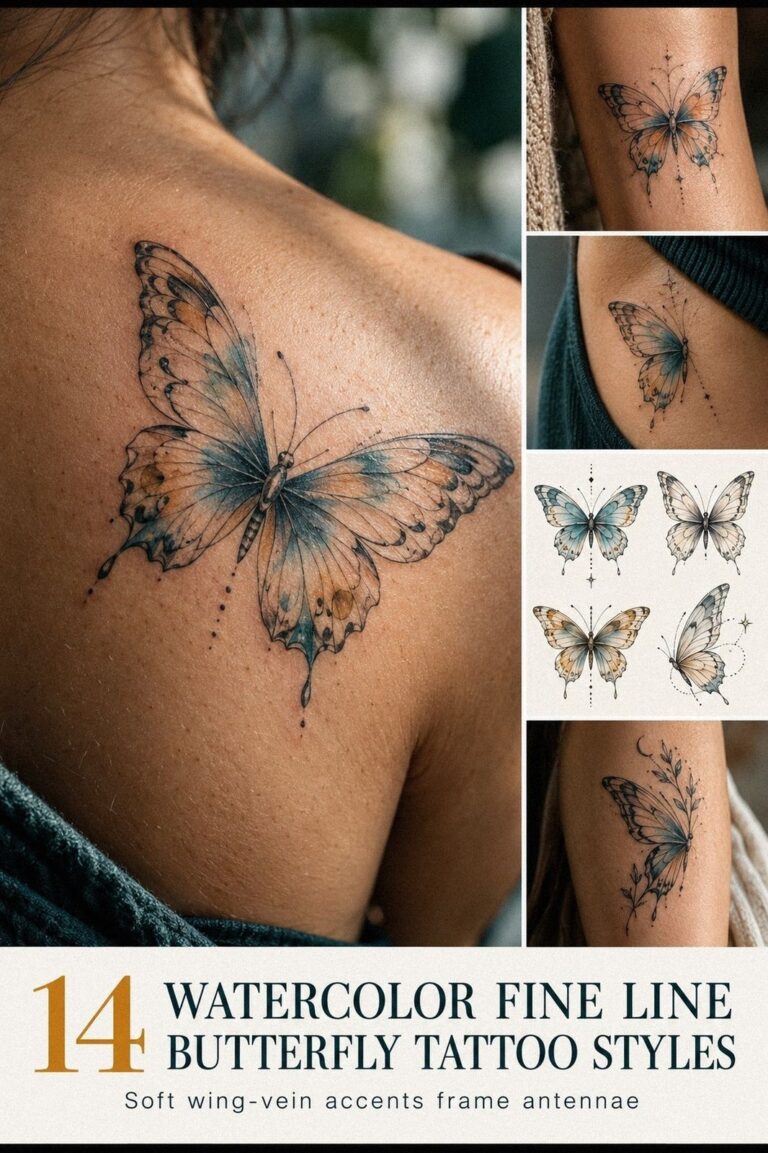
- Butterfly: Transformation through metamorphosis, but gentler, more gradual. No ash, no screaming. Often chosen for coming-of-age rather than crisis survival.
- Resurrection fern: Dries to brown dormancy, revives with water. Underused tattoo motif with similar biological rebirth mechanics, minus the fire.
Pairing phoenix with cherry blossoms tempers the intensity with impermanence; pairing with clock or hourglass adds urgency. Pairing with another phoenix (two birds, perhaps one rising, one burning) can represent partnership through mutual destruction and rebuilding, powerful for couples who’ve survived together, but risks cluttering the composition.
Design Tips & Pairings
The phoenix poses specific compositional challenges. Wings spread wide demand horizontal space; tail feathers trailing require vertical room. A cramped phoenix looks like a turkey. The bird’s anatomy also bends strangely if forced into circular or armband formats, feathers don’t wrap cleanly around cylinders.
Line Weight and Detail Density
Feather detailing determines how the tattoo reads at distance versus close. Heavy line weight with minimal interior detail photographs well and stays legible as skin ages and spreads. Hyper-detailed individual barbs and filaments look stunning fresh but blur into grey masses within a decade. For longevity, prioritize strong silhouette and major feather groupings over micro-detail. Stipple shading on feathers can suggest texture without relying on lines that will spread.
Text Integration
Script with phoenixes often fails because the bird’s flowing lines fight letterforms. If you want words, dates, names, phrases, consider placing them in negative space the bird frames rather than weaving through feathers. Banner formats work for traditional styling but constrain the bird’s natural movement. Dates of significant events can integrate as ash particles or ember-sparks, becoming part of the visual language rather than competing with it.
Best Placements
Phoenixes need room to breathe. The full wingspan composition works best across upper back (shoulder blade to shoulder blade), upper chest/sternum with wings curling toward collarbones, or outer thigh with tail extending toward knee. These placements offer flat, broad canvases where the bird’s geometry doesn’t distort over muscle movement.
- Upper back: Classic placement, concealable for professional contexts, maximum wingspan potential. Pain moderate; healing straightforward with loose clothing.
- Ribcage/side: Follows the body’s natural flame-shape, but extremely painful and the bird’s wings compress awkwardly when arms lower. Tail can extend toward hip with elegant flow.
- Thigh: Growing popularity for women; large flat area, less nerve density than torso. Can wrap slightly toward outer hip. Shows in shorts, hides in professional dress.
- Forearm to hand: Risky for visibility and employment, but the daily sightline reinforces meaning. Requires simplified design; detail won’t survive at this scale.
- Behind ear/neck: Too small for full phoenix; consider single feather or minimal flame abstract instead.
Stretching matters: pregnancy, weight fluctuation, breast changes all affect torso placements. A phoenix across the upper back survives body changes better than one on lower abdomen or directly over breast tissue.
How It Ages on Skin
All tattoos change; phoenixes face specific aging challenges due to their typical color palette and detail density. The warm reds and yellows that sell the fire concept are precisely the pigments most prone to photodegradation. UV exposure breaks tattoo pigment particles; your immune system then clears the fragments. Lighter, brighter colors disappear first.
Feather Blur and Silhouette Loss
Individual feather separations, especially in the tail and wing tips, rely on thin lines and negative space. As skin ages, losing elasticity, developing sun damage, subtle texture changes, these separations close. What read as distinct plumes become solid color blocks. The solution is designing with thicker separations between feather groups than looks necessary fresh; give the future blur room to happen without destroying the form. A phoenix that depends on fine-line elegance will become a colorful blob faster than one built on bold shape.
White Ink and Highlight Fading
White ink highlights on feathers or flame edges brighten fresh work but typically yellow or disappear entirely within two to five years. Some artists now avoid white in favor of skin-tone negative space, letting natural skin provide the highlight. On darker skin, this approach is essential, white ink often heals grey or ash-colored and can look scar-like.
Key Takeaways
A phoenix tattoo for women carries specific, heavy meaning: not just change, but change through destruction, through necessity, through refusing to end when the story demanded it. The symbol’s power comes from that specificity, which also means it can feel mismatched if your transformation was gradual or gentle. Choose honestly.
Design for the long term: prioritize strong silhouette over detail, understand your color commitment, place where your body won’t distort the form. The phoenix is dramatic by nature; let the drama live in the symbol itself rather than in temporary visual effects that won’t survive five years of skin biology. What rises from your ash should remain visible for decades.
Frequently Asked Questions
Does a phoenix tattoo always mean someone survived trauma?
Not necessarily. While many women choose it after major life disruption, others connect to the phoenix’s broader themes of renewal, ambition, or cyclical self-reinvention. The meaning depends on your personal context, not a universal rule.
Can a small phoenix tattoo work, or does it need to be large?
Small phoenixes struggle because feather detail blurs at reduced scale. Wrist or ankle placements typically require simplified, almost abstract versions. For recognizable form, palm-sized minimum is realistic; full detail needs significantly more space.
How do I choose between a rising phoenix and one in flames?
Rising phoenixes emphasize hope and forward motion; burning phoenixes acknowledge the pain of what ended. Some designs show both states in sequence. Consider which part of your experience needs honoring most, the destruction, the emergence, or the full cycle.
Are phoenix tattoos culturally appropriative if I’m not Chinese or Japanese?
The phoenix exists across Greek, Egyptian, Roman, Persian, and Chinese traditions as a shared human myth, not exclusive to one culture. Specific stylistic choices matter more: Japanese hou-ou with particular accompanying elements (specific flowers, clouds, waves) carries cultural context worth researching. Generic Western phoenix imagery raises fewer concerns.

Leave a Reply