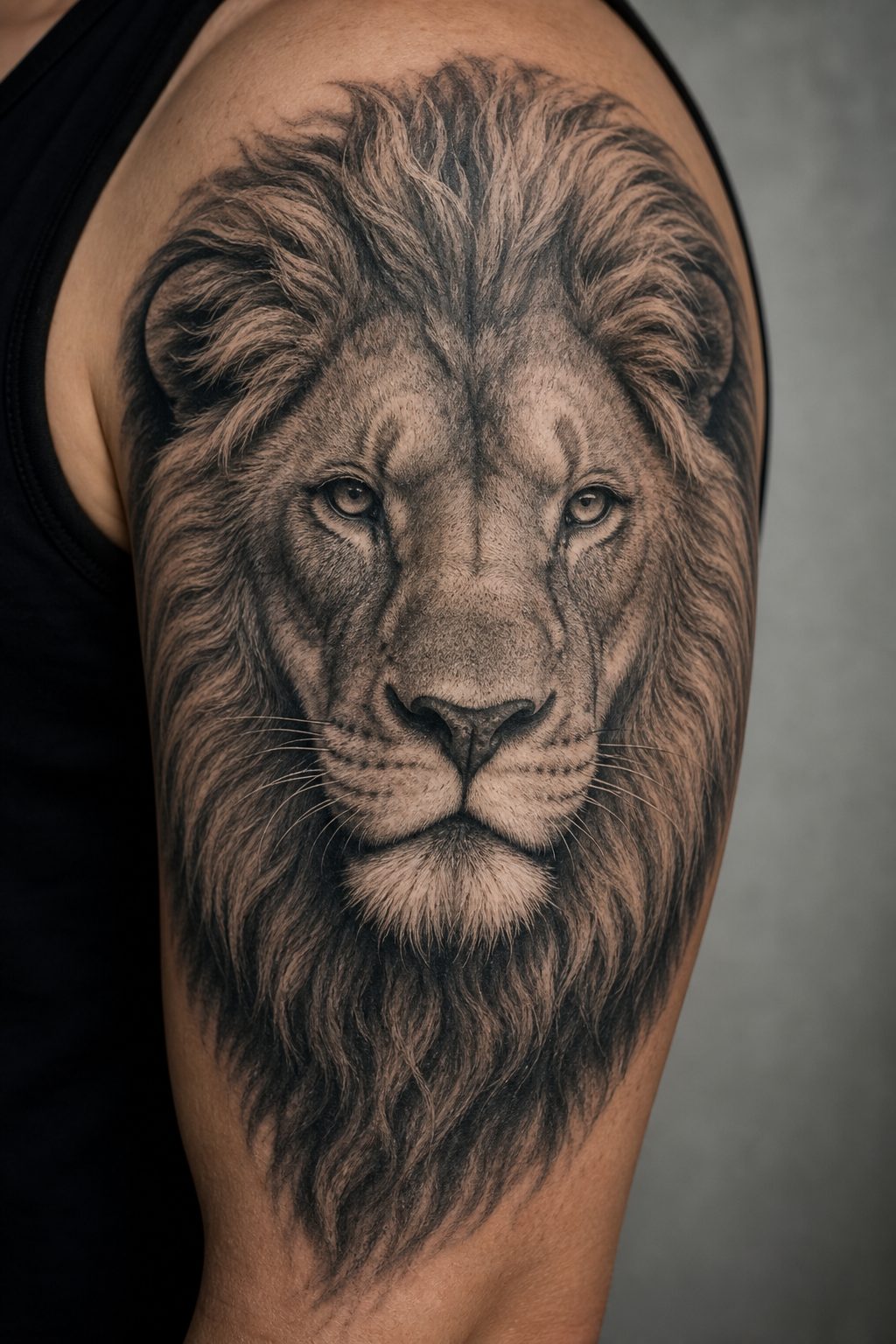
The lion head tattoo most commonly signals strength, leadership, and protective instinct. Across cultures, the lion’s face, not the full body, puts emphasis on identity and watchfulness rather than action. Someone wearing this image usually wants to broadcast resolve, familial loyalty, or a refusal to back down from hardship.
Mythology & Folklore
Human fascination with lion imagery stretches back to the first cities. Unlike some symbols that drifted into obscurity, the lion’s face remained consistently loaded with authority.
Ancient Guardians
In Egyptian tradition, the lioness-headed goddess Sekhmet embodied retribution and necessary violence; her male counterpart, Maahes, carried the title “Lord of the Massacre.” These weren’t gentle protectors, they were forces that demanded respect. Mesopotamian cultures often linked lion imagery to kingship, with rulers keeping live lions or commissioning colossal gate guardians. The message was unambiguous: this territory is defended by something that cannot be intimidated.
European Heraldry & Christianity
Medieval heraldry adopted the lion as the premier symbol of nobility. A lion’s head in crest form, facing forward in “guardant” pose, signified vigilance and command. Christian tradition sometimes associated the lion with resurrection (the “Lion of Judah”) and with Mark the Evangelist. These layers mean a lion head tattoo can carry spiritual weight without being explicitly religious, depending on surrounding imagery.
Best Placements
Where you put a lion head changes how it reads. The face demands space for detail; crammed into too small a spot, it becomes a fuzzy blob as ink settles.
- Chest/upper pectoral: Classic placement that frames the heart. The lion faces outward, guarding the vital organs. Scales well from palm-sized to full-chest pieces.
- Thigh: Offers substantial flat canvas for detailed mane work. Less visible than chest or arm, which suits people who want personal significance without constant display.
- Outer forearm: Highly visible, reads as a statement of identity. The cylindrical surface challenges artists, poorly planned forearm lion heads can distort when the arm rotates.
- Shoulder cap: Natural rounding complements the mane’s radial flow. Aging tends to be kinder here than on hands or feet.
- Upper back, centered: Creates a throne-like effect. Works exceptionally well for symmetrical mane designs with ornamental framing.
Hands, fingers, and neck are generally poor choices for detailed lion heads. The skin there moves constantly, sheds faster, and holds fine lines poorly. A simplified version can work, but you’ll sacrifice the facial detail that makes the image recognizable.
Symbolism & Core Meaning
The lion head compresses several potent ideas into a single recognizable form. Understanding which layer resonates helps you direct the design.
Courage Under Pressure
The face is passive, mouth closed, eyes steady. This isn’t a lion mid-roar or mid-attack. That stillness matters. It suggests someone who doesn’t need to perform aggression to possess it. The symbolism here is about maintained composure, not explosive action. People recovering from trauma or rebuilding their lives often gravitate toward this interpretation.
Family & Pride Structure
Real lion prides operate around female cooperation and male protection of territory. A lion head tattoo can signal one’s role within family structure, provider, guardian, anchor, without the gendered baggage of “alpha” posturing. Some wearers incorporate cubs or lionesses into larger pieces to literalize this connection.
Who Chooses This Tattoo
There’s no single demographic. The lion head crosses gender, profession, and cultural background more freely than many symbols. What unites most wearers is a specific life context rather than a personality type.
People often arrive at this image after a period of proving themselves, parenting alone, surviving illness, building a business from nothing, leaving a destructive situation. The tattoo marks a threshold. Others get it preemptively, before a known challenge: deployment, major surgery, a risky career move. In both cases, the lion head functions as a self-administered standard to live up to.
Less commonly, people choose it for heritage reasons, connections to specific nations (Ethiopia, Sri Lanka, England, the Netherlands) or sports clubs. These wearers usually combine the lion with flags, colors, or dates to avoid generic symbolism.
Common Variations & Styles
The lion head adapts to nearly every tattoo tradition, but each style carries different technical and symbolic consequences.
Realistic/Black and Grey
Photographic lion heads require exceptional technical skill. The best work shows individual whisker pores, subtle eye reflection, and mane texture that reads as layered fur rather than solid black. Healing is demanding, large areas of smooth grey wash can heal patchy if aftercare slips. This style ages reasonably well if the original contrast was strong, but soft grey-only pieces tend to muddy over five to ten years.
Neo-Traditional & American Traditional
Bolder outlines, limited color palettes, stylized manes. The traditional approach sacrifices anatomical accuracy for immediate readability. These hold up better over decades because the heavy black lines maintain definition as surrounding skin changes. The symbolic tone shifts too, less “this is my spirit animal,” more “I am marked with an ancient symbol of power.”
Geometric & Dotwork
Breaking the face into triangles or building it from thousands of individual dots creates a contemporary aesthetic. The mane especially lends itself to radiating geometric patterns. Technical risk: dotwork in large solid areas can heal unevenly, and touch-ups are harder than with line work. Symbolically, this style suggests the lion as constructed identity, power built rather than inherited.
With Crown
Adding a crown is the most common modification. It shifts meaning from general strength to sovereignty over one’s own life. The crown’s style matters, a simple gold band reads differently than an elaborate heraldic crown with crosses and jewels. Be specific with your artist about which royal tradition you’re referencing, or the result can look like clip art.
Personal & Modern Meanings
Contemporary wearers increasingly detach the lion head from its traditional masculine associations. The face itself is relatively androgynous, it’s the framing and surrounding elements that gender the piece.
Some modern interpretations include:
- Silent leadership: The watchful face as emblem of leading by example rather than declaration
- Boundaried compassion: The lion’s capacity for gentleness within the pride, fierceness toward threats
- Surviving visibility: For people who’ve been publicly diminished and refuse to shrink further
- Ancestral reconnection: Particularly for diaspora communities with lion imagery in their national heritage
Social media has flattened some of the symbol’s impact, scroll any platform and you’ll see hundreds of lion heads. What preserves meaning is specificity in your particular design. Generic Pinterest lions communicate generic determination. A lion with your grandmother’s birth flower woven into the mane, or scarred in a pattern matching your own, carries weight that survives repetition.
The Bottom Line
The lion head tattoo works because it’s instantly legible across cultures while remaining flexible enough for personal adaptation. It announces something without needing explanation. The key to doing it well is resisting the default option: the symmetrical face, the flowing mane, the empty stare. Collaborate with an artist who can find the particular angle, expression, or stylistic treatment that makes this ancient symbol yours. Technical execution matters enormously, poorly rendered lion heads age into unrecognizable grey masses, while precise work becomes more distinguished over time. Take the design process seriously, choose placement with aging in mind, and you’ll have something that functions as both personal marker and enduring visual statement.
Frequently Asked Questions
Does a lion head tattoo always mean the same thing as a full lion body?
Not exactly. The head emphasizes identity, watchfulness, and internal state rather than action or movement. Full-body lions often suggest readiness or pursuit, while the face alone tends to read as settled authority and self-definition.
How well do detailed lion heads age on the forearm?
Forearm placement is visible and popular, but the skin there moves constantly and sees sun exposure. Fine detail in eyes and whiskers can soften within five to seven years. Heavier black outlines and strong contrast age more gracefully than subtle grey-wash realism.
Is a lion head with a crown too cliché?
The combination is common, but cliché is a function of execution, not concept. A generic stock-image crown on a generic lion face feels empty. A crown referencing specific family heraldry, national regalia, or personal symbolism transforms the familiar into something particular.
What’s the difference between a lion and lioness head tattoo?
Lioness heads typically carry less mane, which changes the silhouette entirely. Symbolically, lionesses are often associated with cooperative hunting, maternal ferocity, and sustained effort rather than territorial display. The choice matters for people wanting to emphasize protection of family over individual dominance.