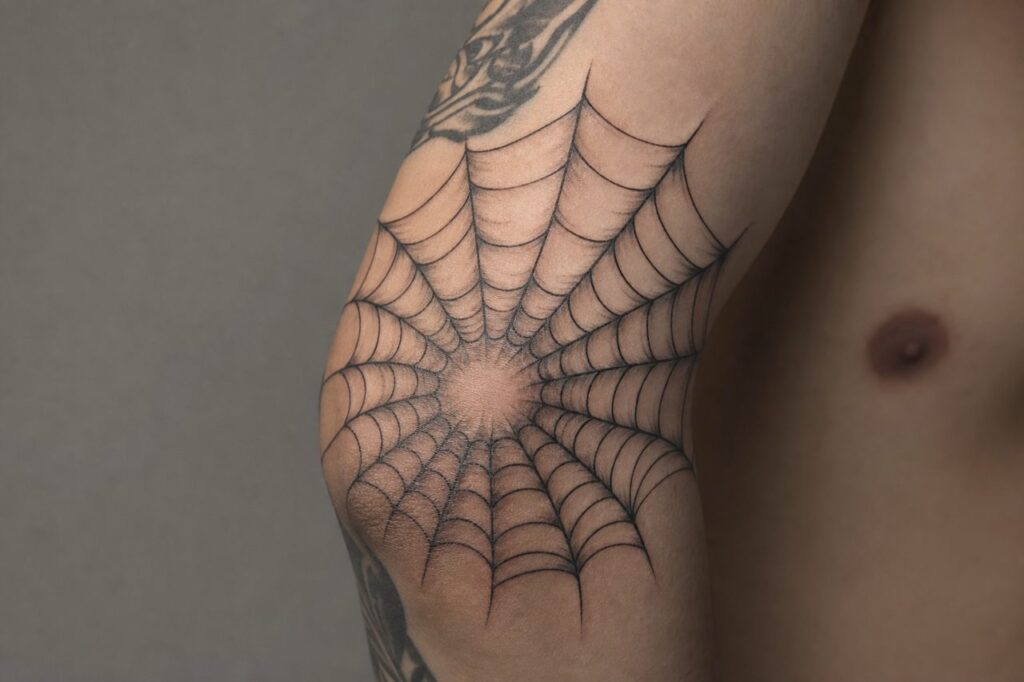
A spider web tattoo most commonly signals being trapped, stuck in a situation, or caught in time, though the meaning shifts dramatically depending on context, placement, and who’s wearing it. In American prison culture, particularly the elbow web, it marks time served. Elsewhere, it can represent struggle, addiction recovery, patience, or creative energy. The symbol’s power comes from its visual immediacy: everyone recognizes a web, and everyone understands what it means to be caught in one.
Religious & Spiritual Angles
Spiritual readings of the spider web tend to emphasize creation and fate rather than entrapment. Several traditions view the spider as a weaver of reality itself.
Christian and Indigenous Frameworks
Some trace the web to Christian ideas of human sin and divine rescue, being caught in the “web of sin” but pulled free by grace. This reading shows up in older flash sheets from the 1950s and 60s, often paired with a cross or praying hands. In Lakota and some other Indigenous traditions, the spider web carries different weight: Iktomi, the trickster spider, weaves the web of dreams and stories. The dreamcatcher, a related form, uses the web to filter bad dreams while allowing good ones through. A tattoo drawing on this lineage typically centers the web more openly, with a small gap or hole left deliberately unfinished.
Modern Spiritual Adaptations
Contemporary wearers sometimes choose the web to mark a period of waiting or transformation. The spider builds, destroys, and rebuilds. That cycle appeals to people processing grief, recovery, or major life transitions. Unlike the prison reading, this version tends toward larger placements, upper back, thigh, ribs, with more organic, asymmetrical web structures rather than the tight geometric elbow classic.
Who Chooses This Tattoo
The spider web’s audience has broadened significantly over the past two decades. Understanding who gets it now means looking past the old stereotypes.
Prison and Street Associations
The elbow spider web remains one of the most recognizable prison tattoos in American visual culture. Traditionally, each ring or section represented a year inside, or a specific conviction. This origin is well-documented enough that some shops still hesitate to place it on elbows unless the client clearly understands the signaling. That hesitation has softened in recent years, but the association persists, especially with thick black line work, minimal shading, and a perfectly circular form.
Beyond the Stereotype
Outside prison contexts, the web attracts people in recovery from addiction, artists who identify with the spider’s solitary creative process, and individuals marking a feeling of being “stuck” in a job, relationship, or mindset they want to escape. The symbol works because it’s ambivalent: the web catches prey, but it also protects spiderlings. It binds, but it also enables survival. Wearers often emphasize one pole or the other through placement and surrounding imagery.
How It Ages on Skin
Spider webs are line-work tattoos, and line work ages differently than heavy black fill or watercolor styles. Knowing what happens to those fine strands helps you choose wisely.
Line Spread and Detail Loss
The thinnest web lines, especially those done with a single needle or tight round liner, tend to blur and spread over five to ten years. On high-movement areas like elbows, knees, and necks, this happens faster. A web that looks crisp and delicate at six months can become a soft gray mesh by year eight. The solution isn’t necessarily thicker lines from the start; it’s strategic spacing. Lines that start slightly farther apart maintain their web structure longer as they naturally expand. Dense, hyper-detailed webs collapse into muddy texture more quickly.
Shading and White Ink
Traditional spider webs use minimal shading: black lines on skin tone, maybe a drop shadow to lift the web off the surface. Some modern versions add white highlights for “dew drops” or a 3D effect. White ink fades fastest, often yellowing or disappearing entirely within two to four years depending on sun exposure and skin type. If you want that wet, glistening look, plan for touch-ups. Grey wash shading behind the web can help it read clearly even as the lines soften, but too much wash competes with the line structure and makes the whole piece look dirty rather than dimensional.
Mythology & Folklore
The spider web’s symbolic reach extends far beyond American tattoo culture. Different traditions assign it meanings that sometimes overlap with, sometimes contradict, the prison reading.
European and African Traditions
In Scottish folklore, encountering a spider web indoors meant a letter or message coming, an association with communication and fate. Some West African stories, often linked to Anansi the spider, emphasize cleverness and survival through wit rather than force. A tattoo drawing on Anansi typically incorporates more narrative elements: the spider figure itself, storytelling motifs, or specific cultural patterns within the web structure. These aren’t interchangeable with the generic prison-style web; they require research and usually collaboration with an artist who understands the source material.
Asian Symbolism
Japanese tattooing occasionally uses the spider web in horror-inspired designs, often linked to the jorōgumo, a spider-woman spirit who traps and devours men. This connection leans into the web’s dangerous, seductive aspect rather than the time-served or spiritual-weaver readings. The visual language differs too: more irregular, broken strands, sometimes with a human eye or face emerging from the center. It’s distinct from the symmetrical American traditional web and carries different cultural weight.
Design Tips & Pairings
What you put with the web, and how you render it, determines whether the tattoo reads as generic flash or personal symbol.
Classic Combinations
The spider itself is the obvious partner, but its placement matters. A spider descending into the web from above suggests active construction or hunting. One at the edge, half-in and half-out, implies escape or hesitation. Skulls caught in webs reinforce mortality and entrapment; clocks or hourglasses push the time-served reading. For recovery narratives, some pair the web with broken chains, open birds, or growth imagery, though these combinations require care to avoid looking like clip-art juxtaposition.
Stylistic Variations
- American traditional: Bold black lines, limited color, symmetrical circular or half-circle web, often on elbow or knee. Most legible from distance; ages most predictably.
- Black and grey realistic: Irregular, torn web sections with dimensional shading, sometimes with background texture. Reads as more organic, less institutional.
- Geometric/dotwork: Precise mathematical web structures, often extending beyond circular boundaries. Appeals to technical precision but requires an artist with steady mandala or sacred geometry experience.
- Neo-traditional illustrative: Saturated color, decorative elements, stylized spider figures. Allows more personal narrative but risks dating faster.
Best Placements
Where the web sits on your body changes its meaning and its practical longevity.
High-Impact Classic Placements
The elbow remains the iconic spot, visible, slightly painful, and immediately associated with the prison time tradition. The knee offers a similar circular canvas and comparable pain level. Both locations move constantly, which accelerates aging but also keeps the tattoo visible in short sleeves or shorts. The neck, particularly the side or front, carries boldness and some residual outlaw association; it’s hard to hide and reads as committed.
Lower-Visibility Options
The upper back, between shoulder blades, gives a large flat surface for an expanded web with surrounding imagery. The thigh offers similar space with easier concealment. Ribs and sides work for webs that wrap or flow with body contours, though the pain here is significant and the skin’s stretching with breathing can affect long-term line quality. Hands and fingers have become more common as workplace visibility norms have shifted, but web tattoos here blur notoriously fast due to constant use, sun exposure, and thin skin.
The Bottom Line
A spider web tattoo means what its context determines: time served, time trapped, patience, creativity, danger, or protection. The symbol’s power is its ambiguity, but that same quality means you need to be deliberate about placement, style, and accompanying imagery. Work with an artist who understands line-work aging and can adapt the web’s density to your chosen location. If you’re drawn to the form, know which reading you’re emphasizing, and if you’re comfortable with the associations that come with it, especially on high-visibility placements like the elbow or neck. The web is a simple image with complicated baggage; wear it with that knowledge built in.
Frequently Asked Questions
Does a spider web tattoo on the elbow always mean prison time?
Not anymore. While the elbow web originated in American prison culture, many people now choose it purely for aesthetic or personal reasons. Context matters, style, surrounding imagery, and the wearer’s background all shape how it’s read.
How painful is a spider web tattoo on the knee or elbow?
Both spots rank high on the pain scale due to thin skin directly over bone. The elbow’s inner crease and the knee’s center are particularly intense. Most people find the outer elbow slightly more manageable than the knee cap itself.
Can a spider web tattoo be covered up or modified later?
Yes, but with limitations. Dense black line work is harder to cover than grey wash or lightly shaded webs. A skilled artist can sometimes incorporate the existing lines into a larger design, but complete blackout or laser removal may be needed for heavy traditional pieces.
What colors work best with spider web tattoos?
Traditional webs stay black and skin-tone. Red can suggest danger or blood; blue or purple push toward more decorative or gothic moods. Bright colors generally fight the web’s stark graphic impact unless you’re working in a fully illustrative neo-traditional style.
Leave a Reply