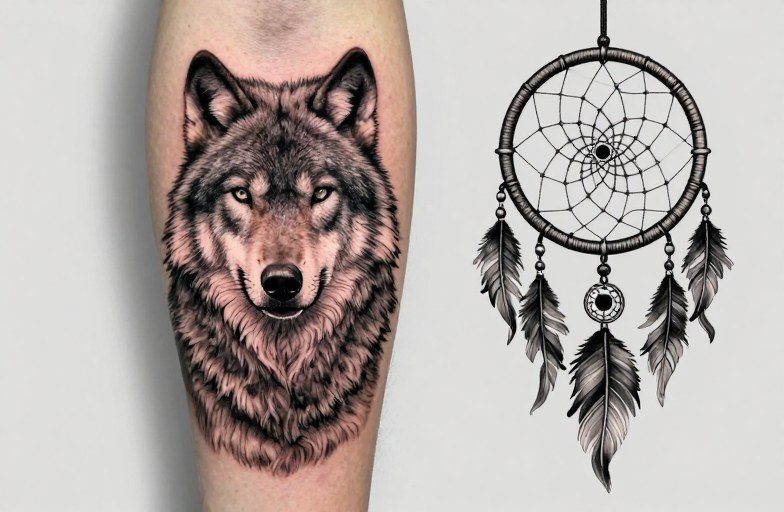
The wolf and dreamcatcher tattoo combines two powerful symbols into one cohesive design: the wolf as a creature of instinct, loyalty, and sharp perception, and the dreamcatcher as a filter for negative energy and a guardian of peaceful rest. Together, they typically represent protection guided by intuition, the balance between wild freedom and spiritual safety, or a personal guardian that watches over your inner life. The meaning shifts depending on how the elements interact, whether the wolf is woven into the web, howling beneath the hoop, or positioned as if guarding the sacred circle.
Best Placements
Where this design sits on your body changes how it reads and how much detail you can carry. The dreamcatcher’s hoop and dangling feathers need vertical or diagonal space to breathe; cramming both symbols into a spot too small usually means sacrificing the wolf’s facial detail or the web’s geometry.
Back and Thigh
These large, flat canvases let the dreamcatcher hang naturally with full feather drops while the wolf occupies foreground or background space. The upper back, between shoulder blades, gives the hoop a natural centering point and lets feather lines trail down the spine. Outer thighs work well for a side-view composition where the wolf appears to pace beside a suspended dreamcatcher.
Forearm and Rib
Forearm placements favor horizontal or slightly tilted hoops with the wolf’s head emerging from or integrated into the web. The bone sits close to the surface here, so line work stays crisp but shading can look patchy if overworked. Ribs accommodate vertical compositions, hoop at top, wolf below, feathers dropping toward the hip, but this area moves with breathing, which stresses fine lines during healing and over time.
- Upper arm/shoulder: good for medium-sized pieces with the wolf in profile
- Calf: excellent for vertical drops; muscle movement is minimal
- Chest (over heart): the wolf’s protective symbolism maps literally to placement, but hair growth and sun exposure complicate long-term clarity
- Behind the ear: only viable for micro versions; the dreamcatcher web rarely reads clearly at this scale
Mythology & Folklore
The dreamcatcher originates with Ojibwe (Chippewa) tradition, often linked to the Spider Woman legend who protected children by weaving webs in willow hoops. The web’s hole in the center allowed good dreams to pass through to the sleeper; bad dreams caught in the mesh dissolved with morning light. The wolf carries different weight across cultures, Norse traditions associate wolves with chaos and destruction (Fenrir), while many Plains Nations and some European folklore cast the wolf as teacher, pathfinder, or loyal pack guardian.
Some trace the pairing of these two symbols to late-20th-century tattoo culture rather than any specific tribal tradition. The combination gained traction in the 1990s alongside broader interest in Native American-inspired imagery, though contemporary artists increasingly encourage clients to understand the dreamcatcher’s specific cultural origins before requesting it. The wolf’s universality makes it easier to separate from any single tradition, but the dreamcatcher carries specific obligations of respect.
Symbolism & Core Meaning
Three main symbolic threads dominate this design, though personal interpretation always shapes the final meaning.
Guardianship of the Unconscious
The wolf’s nocturnal nature, its comfort moving through darkness, pairs logically with the dreamcatcher’s night-watch function. This combination suggests protection that stays active when you’re most vulnerable, asleep and unaware. The wolf doesn’t sleep when you do; it patrols. This reading appeals to people who’ve experienced disrupted sleep, nightmares, or who work night shifts and feel a kinship with darkness.
Intuition as Filter
Wolves rely on sensory information most humans ignore: scent trails, subsonic vocalizations, shifts in pack tension. The dreamcatcher’s web operates similarly, discriminating, catching what doesn’t serve you, letting through what does. Together they symbolize trusting your gut, your peripheral awareness, the information you process without conscious thought. This resonates with people who’ve learned to value their own perceptiveness through difficult experience.
Freedom Within Boundaries
Wild wolves roam vast territories but remain bound to pack structure; the dreamcatcher’s hoop is a contained circle with defined edges. The tension between these, unfettered movement within a protected space, speaks to anyone building a life that honors both independence and connection. The wolf outside the hoop suggests active guardianship; woven into the web, it becomes part of the protective structure itself.
Color vs Black and Grey
Color choices dramatically alter how this design ages and what emotional temperature it carries.
Black and Grey
The classic approach. Wolf fur renders beautifully in greywash, with soft transitions between light belly and dark saddle markings. Dreamcatcher webs in solid black line work stay readable for decades. The downside: without color contrast, feather drops can blur together, and bead details may disappear entirely. A skilled artist solves this through variation in line weight, heavy outline on the hoop, hair-fine web threads, medium-weight feather shafts, and strategic negative space.
Color
Teal and turquoise beads reference Southwestern aesthetics commonly associated with dreamcatcher craft. Warm amber or gold eyes on the wolf create immediate focal points. Red accents in feathers or background suggest danger, blood, or vitality depending on context. Color requires more frequent touch-ups; yellows and light greens fade fastest, while deep blues and blacks hold. Watercolor-style backgrounds behind a black-and-grey central image offer compromise, but the unstructured color bleed can fight the dreamcatcher’s geometric precision.
- Earth tones (umber, ochre, sage): read as naturalistic, grounded, age well
- Jewel tones (sapphire, garnet, amethyst): higher contrast, more dramatic, faster fading in lighter values
- Full realism with natural wolf colors: requires large scale to avoid muddying
How It Ages on Skin
Time and sun treat this design predictably based on its structural elements.
The dreamcatcher web is the weak point. Fine lines crossing at angles create optical confusion as they spread. A web drawn with 3-needle lines at year one becomes a grey smudge by year ten if exposed to regular sun without protection. The hoop, being a heavier line, holds its circle but may develop slight waviness as skin elasticity changes. Feather drops, long, parallel lines with minimal adjacent shading, are prone to blowout along their edges, especially on areas that move (wrist, ankle, ribs).
Wolf faces age better than you might expect because fur texture is inherently forgiving. Individual hairs blur, but the overall value structure, dark muzzle, light eye markings, medium body tone, maintains recognizable form. The eyes matter most. If the artist overworked the white highlights (common with heavy-handed white ink packing), they’ll yellow or fall out completely. Solid black pupils with minimal surrounding detail age more gracefully than complex iris rendering.
Placement on sun-exposed skin (forearm, calf in shorts, upper chest) accelerates all these processes. The upper back and thigh, typically covered, preserve detail longer. Moisturizing doesn’t prevent fading; sunblock does.
Common Variations & Styles
Artists have developed several compositional approaches that change the design’s impact without abandoning its core symbols.
Wolf Integrated Into the Web
The wolf’s face or full body forms the negative space at the web’s center, replacing the traditional hole. This creates immediate visual unity but requires careful planning, the web lines must follow the wolf’s anatomy logically, not just overlay it arbitrarily. Neo-traditional and illustrative styles handle this best; realism struggles because actual wolf fur doesn’t conform to radial geometry.
Wolf and Dreamcatcher as Separate Elements
The wolf sits below, beside, or above the hoop, often howling toward it or lying in apparent guardianship. This allows each symbol to be rendered in its optimal style, realistic wolf, geometric or stylized dreamcatcher. Japanese-influenced compositions sometimes show the wolf with wind bars or background waves, the dreamcatcher floating like a moon or sun element. The separation risks visual disconnection if the artist doesn’t unify through consistent line quality or shared color palette.
- Geometric/mandala hybrid: the dreamcatcher web becomes increasingly complex, almost mandala-like, with the wolf reduced to minimal silhouette
- Double exposure: wolf profile containing forest or night sky, dreamcatcher overlapping as separate layer
- Trash polka influence: black and grey wolf with red dreamcatcher elements, abstract splatter background
- Minimalist line work: single-needle continuous line forming both symbols, suitable only for small scale
What to Remember
This design works when the two symbols genuinely interact, not when they’re pasted together for accumulated “meaning.” The wolf needs a reason to be there beyond looking cool beside a dreamcatcher. Consider whether you want the guardian reading, the intuition reading, or something personal that doesn’t map neatly to either, then tell your artist specifically, because composition changes dramatically based on that choice.
The dreamcatcher’s cultural specificity deserves real thought. If you’re not Ojibwe or from a nation that uses this object traditionally, approach it as reference rather than claim. Some artists won’t tattoo dreamcatchers on non-Native clients; others will if the design is sufficiently transformed or if you’ve done genuine engagement with its origins. This isn’t political theater, it’s respect for something that still functions as sacred object in living communities.
Technically, prioritize the web’s line weight and the wolf’s eye clarity above all else. Everything else, feather detail, bead color, background elements, is secondary and will fade or blur first. A simpler design that reads cleanly at twenty years outperforms a busy masterpiece that becomes visual noise by year eight. Ask to see healed photos, not just fresh work, before committing to an artist.
Frequently Asked Questions
Does a wolf and dreamcatcher tattoo have to be large to look good?
Not necessarily, but the dreamcatcher web needs minimum size to remain readable, about palm-sized for the hoop. Smaller than that, and the web lines blur into a solid grey circle within a few years. The wolf can be simplified at smaller scales, but you’ll lose facial detail.
Can the wolf be replaced with another animal in this design?
Yes, though the symbolism shifts. Bear adds brute strength and grounding; owl emphasizes wisdom and night vision; raptor suggests vigilance from above. The dreamcatcher’s protective function pairs with any animal associated with watchfulness or nocturnal awareness.
Is it culturally appropriative to get a dreamcatcher tattoo?
This depends on your relationship to the symbol and your willingness to engage with its origins. Many Native artists find non-Native use disrespectful when treated as generic “spiritual” decoration. Researching Ojibwe history, supporting Native artists, and avoiding sacred-specific elements (like exact ceremonial web patterns) can mitigate but not eliminate this concern.
How much should I expect to pay for a quality wolf and dreamcatcher piece?
Custom work from an experienced artist typically runs $150-$250 per hour, with most medium-sized pieces (6-8 inches) taking 4-6 hours. Highly detailed realism or large back pieces can reach 15+ hours. Extremely low quotes usually mean rushed work, stencil reuse, or an artist who isn’t specializing in this complexity.