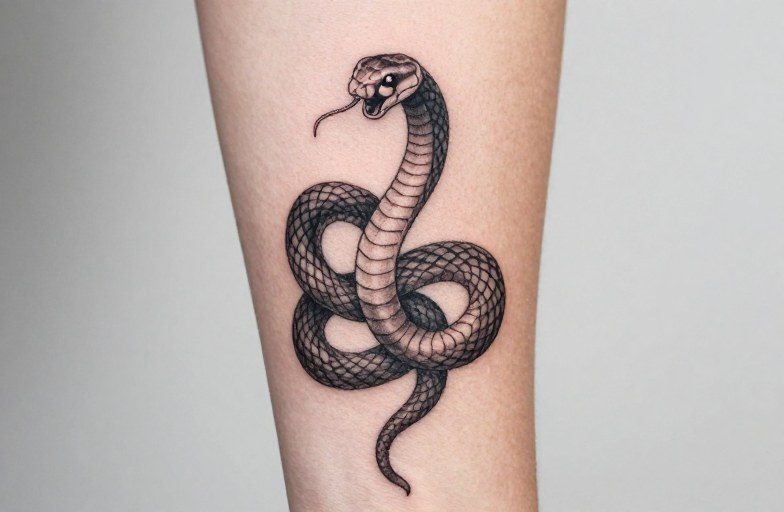
The ouroboros depicts a serpent consuming its own tail, forming an unbroken circle. At its simplest, this ancient image means eternal return, life feeding on death, death feeding on life, the snake endlessly remaking itself. The symbol carries weight across alchemy, Gnosticism, and modern personal philosophy, but its visual logic is immediate: completion through self-reference, wholeness built from paradox.
Symbolism & Core Meaning
Unlike many symbols that point outward, the ouroboros turns inward. The snake’s mouth at its own tail creates a closed system, suggesting that endings and beginnings are the same event viewed from different angles.
The Cycle of Consumption and Rebirth
Alchemical texts often linked the ouroboros to the magnum opus, the process of transmuting base material into something refined. The snake devours itself to survive, implying that transformation requires sacrifice of the old self. In this reading, the tattoo suits people who’ve undergone radical personal change: recovery, career reinvention, leaving behind a former identity. The image doesn’t celebrate the new self as much as it acknowledges the necessary destruction of the old one.
Infinity Without Escape
There’s a darker read too. The snake cannot stop eating; the cycle has no off-ramp. Some choose the ouroboros to mark patterns they can’t break, addiction cycles, repeated relationship dynamics, the grind of work and burnout. The symbol becomes honest rather than hopeful, a visual admission that some loops persist despite awareness. This ambiguity between liberation and trap gives the ouroboros its lasting power.
Personal & Modern Meanings
Contemporary wearers rarely reference alchemical texts directly, yet the symbol’s core ideas translate cleanly into modern concerns.
- Mental health and recovery: The loop of progress and relapse, the daily choice to begin again. The ouroboros acknowledges that recovery isn’t a straight line but a circling back with incremental change.
- Creative process: Artists destroying old work to generate new, the necessary cannibalism of influence and reinvention.
- Environmental awareness: Some wearers use the image to comment on human consumption, civilization eating its own resources, the feedback loop of climate and consequence.
- Existential acceptance: The stoic or absurdist embrace of life’s lack of external meaning, finding purpose in the loop itself rather than some imagined endpoint.
The symbol’s flexibility is genuine, not forced. Its visual paradox supports multiple interpretations without collapsing into vagueness.
Design Tips & Pairings
Placement and execution dramatically shift how the ouroboros reads on skin. The circular form creates specific constraints and opportunities.
Placement and Scale
Small ouroboros tattoos (under two inches) work best on the wrist inner/outer, behind the ear, or along the finger side. At this scale, clean line work matters enormously, shading tends to muddy and blur as the tattoo ages. Medium sizes (three to five inches) suit the forearm, calf, or upper arm, where the circle can breathe and detail holds. Large pieces (six-plus inches) on the chest, back, or thigh allow for textural scales, open mouths with visible fangs, or integrated background elements.
The wrist is particularly apt given the circular form echoes a watch or bracelet, but be aware: wrist skin moves constantly, flexes, and sees sun. Line work here spreads faster than on the upper arm or thigh. Touch-ups within five years are common.
What Pairs Well
- Geometric framing: A perfect circle behind or around the snake reinforces the mathematical precision of the symbol. Sacred geometry, flower of life patterns, Metatron’s cube, extends the mystical register without cluttering.
- Alchemical text: Small script in Latin or Greek, placed as if wrapping the snake or floating within the loop. “Solve et coagula” (dissolve and coagulate) is the classic pairing, but personal phrases work if the typography suits the image’s age.
- Floral or botanical elements: Vines, roots, or mushrooms emerging from the snake’s body suggest natural cycles rather than abstract philosophy. This softens the image, makes it more organic.
- Moon phases: Placed around the circle’s perimeter, emphasizing temporal cycling. Best on larger pieces where the phases remain legible.
Avoid overloading small pieces. The ouroboros is already conceptually dense; competing imagery dilutes rather than enriches.
Who Chooses This Tattoo
There’s no single demographic, but patterns emerge in placement and styling that reveal intent.
People in technical or scientific fields often gravitate toward precise, geometric renderings, almost diagrammatic snakes with measured scales and perfect circularity. The symbol appeals to systems thinkers, people comfortable with feedback loops and recursive logic. Conversely, those drawn to occult or esoteric aesthetics typically prefer more organic, illustrative versions: snakes with visible ribs, rougher linework, perhaps a single eye open in awareness.
Age-wise, the ouroboros skews slightly older than trend-driven imagery. It requires some philosophical investment to carry well; a twenty-year-old can absolutely wear it meaningfully, but the choice tends to follow genuine experience rather than aesthetic browsing. The tattoo rarely works as pure decoration, the symbol’s weight shows through regardless of styling.
Common Variations & Styles
The basic form allows significant modification without losing recognition.
Stylistic Approaches
- Traditional/Americana: Bold outlines, limited color palette, stylized scales. The snake’s head often oversized, mouth gaping, tongue forked. Reads as classic, timeless, slightly aggressive.
- Blackwork/dotwork: Dense stippling creates texture and depth without color. Excellent for medium to large pieces where the patterning becomes meditative to view. Healing requires more care, dotwork scabs differently than lines, and picking destroys the effect permanently.
- Neo-traditional: Expanded color range, more anatomical detail in the snake’s face, perhaps jewel-toned scales. Allows for personality and flair while maintaining symbolic clarity.
- Minimalist single-line: One continuous stroke forming snake and circle. Elegant, modern, but technically demanding. The artist must plan the entire path before touching skin; there’s no correcting mid-line without visible joins.
Structural Variations
The infinity ouroboros twists the snake into a figure-eight rather than simple circle, explicitly invoking the lemniscate. The double ouroboros shows two snakes intertwined, each eating the other’s tail, more complex, suggesting mutual dependence or dialectic process. The broken ouroboros leaves a gap between mouth and tail, the snake nearly but not quite completing the loop. This variation often signals interrupted cycles, trauma, or the desire to escape pattern.
Similar & Related Symbols
Understanding adjacent imagery helps clarify whether the ouroboros is truly the right choice.
The uroboros (variant spelling, same image) appears in some contexts with more explicitly alchemical associations. The phoenix shares rebirth symbolism but emphasizes dramatic, fiery renewal rather than continuous cyclical process. The triskelion and triple spiral suggest cycling without the self-consuming edge. The ouroboros with sun and moon (found in some Gnostic texts) adds cosmic scale, the snake encircling celestial bodies rather than itself.
The Jörmungandr (Norse world-serpent) sometimes gets confused with the ouroboros. While both are cosmic snakes, Jörmungandr encircles the world, biting his own tail only at Ragnarök, destruction of the cycle, not its eternal continuation. Conflating them isn’t wrong aesthetically, but the distinction matters for personal meaning.
Modern adjacent imagery includes the recycling symbol (three arrows in loop) and the feedback loop diagrams used in systems thinking. These lack the visceral, bodily quality of the snake consuming itself, but share conceptual DNA.
Before You Decide
Consider the direction your snake faces. Clockwise and counterclockwise carry different energetic associations in some traditions, though this is largely personal preference rather than fixed rule. More practically, direction affects how the image reads on your specific body, follow the natural curve of the chosen placement.
Think about the mouth’s expression. An ouroboros with visible pain or aggression in the snake’s face reads differently than one with serene, almost meditative consumption. The first suggests struggle; the second, acceptance. Both are valid, but the choice should be deliberate.
Finally, remember that circular tattoos age differently. The eye seeks completion; as lines spread slightly over decades, the circle may appear less perfect. This actually suits the symbol, nothing stays exact in eternal return, but if geometric precision matters to you, plan for potential touch-ups or choose a style where slight softening enhances rather than diminishes the effect.
The ouroboros rewards slow consideration. Its meaning deepens with wear, the snake on your skin becoming more personally resonant as you live through your own cycles of ending and beginning.
Frequently Asked Questions
Does an ouroboros tattoo always have to be a perfect circle?
No. Elliptical, twisted, or even broken variations work well and can add personal meaning. The key is maintaining clear visual connection between mouth and tail so the self-consuming logic remains readable.
How well does an ouroboros tattoo age compared to other designs?
Circular line work holds up reasonably well if initially crisp, but wrist and finger placements spread faster due to movement and sun exposure. Blackwork versions age more gracefully than fine-line, and dotwork can blur if not packed densely enough.
Can the ouroboros represent something negative or is it purely positive?
The symbol carries genuine ambiguity. It can mark destructive cycles, addiction, or feeling trapped as readily as it celebrates renewal. Many wearers specifically value this dual capacity for honest acknowledgment of difficult patterns.
What’s the difference between an ouroboros and a snake eating its own tail in a straight line?
The closed circle is essential to the symbol’s meaning. A linear snake consuming itself lacks the infinite return, the completion-through-destruction that defines the ouroboros. Without circularity, it’s just a striking image, not the specific philosophical statement.
Leave a Reply