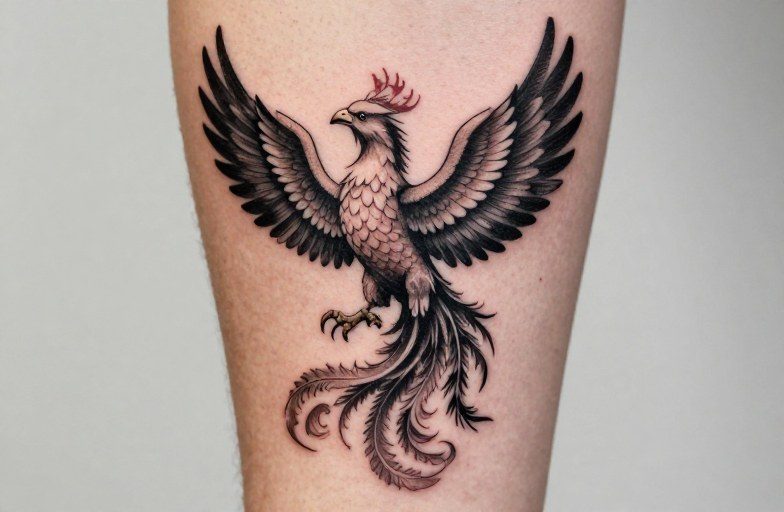
A phoenix vector tattoo strips the mythical firebird down to sharp, mathematically precise lines and geometric shapes. The meaning stays rooted in rebirth, resilience, and rising from destruction, but the vector style adds a contemporary layer: control, clarity, and the idea that transformation can be intentional rather than chaotic. Someone wearing this usually wants the symbolism without the ornamental fluff of traditional neo-Japanese or watercolor phoenixes.
Symbolism & Core Meaning
The phoenix carries one of the most straightforward symbolic loads in tattoo culture. Death and return. Total loss followed by emergence. The vector treatment doesn’t dilute this; if anything, the clean geometry reinforces a sense of deliberate reconstruction.
Rebirth vs. Continuity
Traditional phoenix imagery often shows flames, ash, dramatic motion. Vector versions tend to freeze the bird in a moment of poised ascent or abstract it into wings, feathers, or circular forms that suggest cyclical return. This shifts emphasis from the fire itself to the structure of the cycle. You’re not getting a scene; you’re getting a diagram of resilience.
Personal Application
People gravitate here after divorce, recovery, career collapse, or sobriety. The vector style suits those who want the mark to feel forward-looking rather than memorial. It’s less “I survived the fire” and more “this is the shape I took after.”
- Single-line vector: emphasizes continuity, the unbroken thread through disruption
- Geometric fragmenting: suggests breaking apart and reassembling stronger
- Negative space flames: the fire is implied, not depicted; the bird exists because of what burned
Common Variations & Styles
Vector work isn’t one uniform look. Within the style, you’ve got meaningful options that change how the tattoo reads on skin.
Linework Density
Thin, hairline vectors sit differently than bold 3mm+ lines. Fine lines read subtle, almost scientific; thick lines hold up better over time and read more like graphic design or logo work. On high-movement areas like wrists or ribs, fine lines blur faster. The chest and outer upper arm give bold vectors room to breathe and age cleanly.
Fragmented vs. Whole Form
Some designs keep the full bird silhouette intact, just rendered with angular edges and flat color blocks. Others break the phoenix into constituent geometry: triangles suggesting feathers, hexagons for the body, a perfect circle for the rising sun behind. The fragmented approach reads more abstract and pairs well with adjacent tattoos; the whole form works better as a standalone centerpiece.
- Minimalist outline: single weight line, no fill, often small (2-4 inches)
- Low-poly render: hundreds of tiny triangles creating dimension
- Circular mandala hybrid: phoenix wings spread into symmetrical geometric patterns
- Cyberpunk vector: neon color blocks, circuit-like line extensions
Color vs Black and Grey
The color question changes everything for vector phoenixes. Traditional phoenix tattoos lean hard into red, orange, gold. Vector work can go either way, and the choice isn’t just aesthetic.
Black and Grey Vector
Stark black lines on bare skin. No shading gradients, no color transition. This ages the most predictably; black ink holds, and without greywash to muddy, the design stays readable for decades. The tradeoff is emotional temperature: it reads cooler, more analytical, less visceral. Good for someone who wants the symbol without the drama.
Flat Color Blocking
Vector style doesn’t do soft blends. Color arrives in solid, unmodulated planes. A red wing, an orange chest, a yellow eye. This references the traditional phoenix palette but treats it like a screen print. The risk: color ink fades and shifts differently than black. Reds and oranges are particularly prone to sun damage and blurring over five to ten years. Placement matters more with color, protect it from UV, or budget for touchups.
- Black vector: lower maintenance, sharper aging, reads as graphic/iconic
- Two-tone (black + one accent): compromise, the accent draws focus to a specific element like the eye or heart
- Full color block: highest impact, highest upkeep, best on larger pieces with skin real estate to let colors separate clearly
Mythology & Folklore
The phoenix appears across cultures with overlapping but distinct stories. A vector tattoo doesn’t usually illustrate these narratives directly, but knowing them shapes what you’re carrying.
The Greek phoenix, often linked to the sun, burns at life’s end and regenerates from its own ashes. The cycle is solitary; there’s one phoenix at a time. Egyptian Bennu bird mythology shares the solar association, with some tracing it to the creation cycle and the flooding of the Nile. Chinese Fenghuang pairs the phoenix with the dragon as cosmic balance, and here the bird is often linked to virtue and prosperity rather than destruction and return.
Vector style tends to flatten these distinctions. A geometric bird doesn’t read Greek or Chinese specifically. But your intent matters. If you’re drawn to the solitary rebirth narrative, emphasize ash tones and single-form composition. If balance and harmony speak more, the circular mandala-hybrid vectors carry that resonance better.
Religious & Spiritual Angles
The phoenix isn’t a religious symbol per se, but it has been adopted and interpreted through spiritual frameworks.
Christian Resonance
Early Christian writers, including some in the first few centuries CE, used the phoenix as a metaphor for resurrection. The bird’s self-immolation and return paralleled Christ’s death and rising. A vector phoenix can carry this meaning quietly, without the explicit cross imagery some people want to avoid. The clean geometry almost suggests divine order or design.
Secular Spiritual Use
Outside organized religion, the phoenix functions as a symbol of personal transformation and spiritual awakening. The vector style’s precision suits this well; it suggests that inner work has structure, that enlightenment or growth isn’t just feeling but practice. Someone coming out of meditation or mindfulness practice might prefer this controlled aesthetic to more expressive, fluid styles.
- Combined with sacred geometry: explicit spiritual framing
- Placed over the heart: personal, emotional transformation
- Placed on the back between shoulders: carrying the symbol, rising upward
Who Chooses This Tattoo
There’s no single demographic, but patterns emerge in placement and design choices.
Tech and design professionals often gravitate to vector styles generally; the aesthetic matches their visual vocabulary. People with existing geometric or blackwork sleeves use phoenix vectors to introduce organic/mythological content without breaking stylistic continuity. Those who’ve outgrown earlier tattoos sometimes choose this as a replacement or cover-up, the phoenix meaning dovetailing with the literal act of burying old ink.
Age-wise, it skews slightly younger than traditional phoenix collectors, vector style correlates with tattoo trends of the last fifteen years. But that’s not a rule. The meaning transcends age; the style is what dates it to a visual era.
What to Remember
Vector phoenix tattoos demand technical precision from your artist. Not everyone who does geometric work handles complex bird anatomy well. Ask to see healed photos, not just fresh work; crisp lines in the shop blur in six months if the artist pushed too deep or used inconsistent pressure.
Consider scale carefully. Small vector pieces lose their impact as lines soften. Medium to large works better. Think about placement relative to your body’s movement, ribs expand and contract, distorting geometry; the flat planes of the thigh or outer calf hold shape more faithfully.
Finally, the meaning is durable but not automatic. The phoenix doesn’t grant resilience; it marks a claim you’ve already staked. The vector style makes that claim with unusual clarity. Make sure that’s the tone you want.
Frequently Asked Questions
How well do fine-line vector tattoos age compared to bold line versions?
Fine lines blur and spread faster, especially on high-movement areas like wrists and ribs. Bold vector lines hold their structure for years with minimal spreading. If you want longevity, ask for 3mm minimum line weight and avoid extremely detailed micro-elements.
Can a vector phoenix work as a cover-up tattoo?
Yes, but the geometric style limits your options. The clean lines and negative space need to incorporate or frame the old tattoo rather than fully mask it with dense black. A skilled artist can sometimes use the old tattoo’s shape as the “ash” or background element.
What’s the typical healing time for a vector phoenix with color blocking?
Surface healing runs about two to three weeks, same as most tattoos. Color-blocked areas may peel more visibly than blackwork. Avoid sun exposure for the first two months; fresh color ink is especially vulnerable to UV damage that causes premature fading.
Should I get the phoenix facing upward, downward, or in profile?
Upward-facing suggests ascent and forward motion, most common for rebirth symbolism. Downward or profile can work compositionally but reads more static. Circular or symmetrical designs avoid the question entirely by abstracting direction into pattern.
Leave a Reply