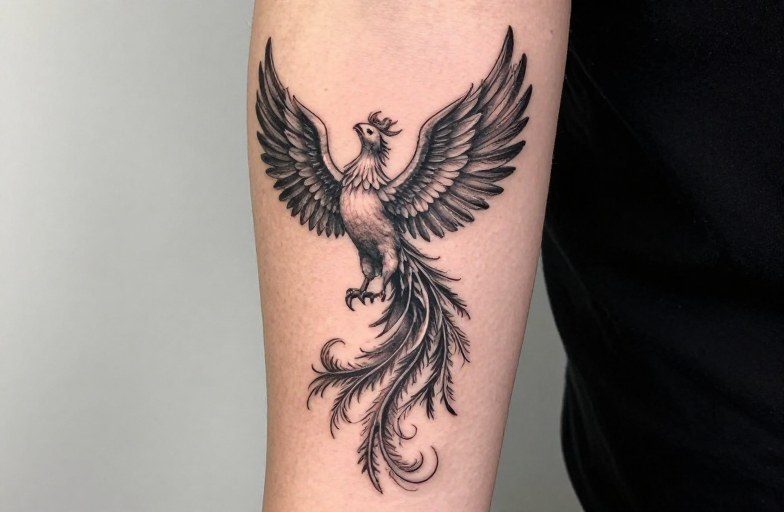
A feminine phoenix rising from the ashes tattoo represents survival, renewal, and the strength to rebuild after destruction. Unlike traditional depictions that lean toward fierce masculinity, the feminine version emphasizes grace, fluidity, and emotional depth without sacrificing power. The ashes beneath her are not defeat, they are the necessary ground for transformation.
Common Variations & Styles
The feminine phoenix adapts across tattoo traditions with remarkable flexibility. Line work and watercolor dominate current preferences, but the subject carries weight in nearly every genre.
Neo-Traditional and Illustrative Approaches
Neo-traditional builds the bird with bold outlines, jewel-toned plumage, and decorative flourishes, think elongated tail feathers curling like ribbon, eyes rendered with human-like expressiveness. Illustrative styles soften further, trading heavy black for graphite-like shading that gives the phoenix a drawn, storybook quality. Both approaches allow the artist to exaggerate curves in the wings and neck, pushing the form toward elegance rather than aggression.
Watercolor and Fine Line
- Watercolor backgrounds of orange, rose, and ash-gray suggest flames and smoke without literal fire illustration
- Fine line phoenixes rely on single-needle detail for feather texture, often paired with minimal ash elements below
- Black-and-grey realism creates dramatic contrast between scorched remnants and emerging light on the wings
Clients frequently request the bird mid-transformation, some feathers still charred, others bursting into renewed color. This in-between state reads more authentically than a fully-formed, pristine creature.
Religious & Spiritual Angles
Spiritual frameworks give the feminine phoenix additional resonance without requiring literal belief in the myth.
Christian and Grief Contexts
The resurrection narrative maps cleanly onto phoenix imagery. Some wearers choose this design after loss, miscarriage, divorce, death of a parent, where the “ashes” carry specific, painful memory. The feminine rendering can echo Marian imagery: protective, sorrow-bearing, yet ultimately triumphant. Crosses integrated into the tail structure or halo-like flame rings around the head make this connection explicit without becoming preachy.
Eastern and Contemporary Spiritual Practice
In Hindu and Buddhist-adjacent practice, the phoenix sometimes parallels the garuda or concepts of samsaric cycles. More commonly, modern spirituality treats the bird as a meditation on impermanence and non-attachment. The feminine form here tends toward flowing, almost liquid shapes, less bird, more energy pattern, suited to practitioners who view the body as a site of ongoing transformation rather than fixed identity.
Design Tips & Pairings
Specific choices separate memorable feminine phoenix tattoos from generic fire-bird clipart.
Integrating Feminine Cues
“Feminine” in this context does not mean adding eyelashes or a curvy silhouette. Effective approaches include elongated neck proportions suggesting swan or crane elegance, feather groupings that read as hair or fabric in motion, and color palettes drifting toward coral, wine, and gold rather than primary red-orange. Some designs incorporate botanical elements, ash twigs, blooming flowers from the pyre, vines threading through wing structure, that root the myth in organic growth.
Complementary Imagery
- Broken chains or open cages beneath the ash pile signify released confinement
- Moon phases arching above or below suggest cyclical time and feminine rhythm
- Single words in delicate script, “still,” “after,” “become”, anchor meaning without over-explaining
- Geometric framing (circles, mandala fragments) contains the chaos of rebirth within order
Negative space matters enormously. The ashes need breathing room; overcrowded fire and smoke turn muddy within five years as ink spreads.
Best Placements
The phoenix’s vertical or diagonal thrust determines placement more than most subjects.
Thigh pieces allow full wing extension with the body in natural standing position, crucial since wings drawn flat on a table distort dramatically when the leg stands. Ribs and side torso follow the body’s own rising curve, though the pain here is significant and healing requires conscious breathing management. Shoulder caps and upper back provide broad, relatively flat planes for detailed plumage, with the neck and head extending toward the collarbone for a forward-facing presence.
Smaller designs work on forearms and calves if the composition simplifies to a single wing or head-and-flame motif rather than full body. Ankle and wrist placements generally fail this subject, the required detail blurs at small scale, and the phoenix’s upward energy fights against horizontal, narrow formats.
Consider how the tattoo ages with skin changes. Breasts and upper arms shift substantially with weight fluctuation; feather edges that read crisp at 25 may feather themselves by 40. Stomach and lower abdomen present similar challenges post-pregnancy.
History & Cultural Roots
The phoenix myth spans cultures with enough variation that uncritical “ancient meaning” claims mislead.
Mediterranean and Near Eastern Origins
Greek sources, particularly Herodotus and later Pliny, describe the Egyptian benu or phoinix as a solitary bird dying in flame and regenerating. Some trace it to Phoenician purple dye associations, the bird’s name possibly linked to that culture’s color and wealth. The Roman adaptation emphasized imperial continuity; emperors minted phoenix coins to mark new eras. The feminine dimension enters here only through later interpretation, as classical sources describe the bird without fixed gender.
Chinese Fenghuang and Japanese Ho-Oh
The Chinese fenghuang pairs male and female aspects across two birds, with the feminine huang representing virtue and grace. Japanese ho-oh imagery, often linked to the sun and royal authority, influenced anime and contemporary tattoo aesthetics significantly. Modern feminine phoenix designs borrow heavily from these East Asian visual traditions, flowing tail plumage, layered wing structures, and the sense of auspicious arrival rather than mere survival.
Contemporary tattooing merges these lineages freely. The “feminine phoenix” as a recognized category largely emerges from 1990s-2000s Western tattoo culture, when women sought powerful imagery that didn’t default to masculine-coded aggression.
Personal & Modern Meanings
Current wearers attach specific, non-mythological significance to this design.
Recovery and Survival Narratives
Addiction recovery, escape from abusive relationships, and post-suicide-attempt survival appear frequently in client motivations. The ashes become literal: the detritus of a previous life. The feminine rendering matters here, many survivors reject imagery that feels like performative toughness, seeking instead a strength that acknowledges vulnerability as part of the journey. The bird’s expression, often rendered with visible effort in the wings, honors that struggle without romanticizing it.
Career and Identity Transitions
Midlife career pivots, coming out as queer or trans, and leaving religious communities all generate phoenix requests. The tattoo marks a boundary: before, after. Some schedule the appointment to coincide with anniversary dates, treating the process as ritual completion rather than mere decoration. The feminine form particularly serves those whose new identity centers femaleness or femininity reclaimed from suppression.
Social media has amplified this symbolism’s reach while sometimes flattening it. The genuine personal weight behind a phoenix tattoo distinguishes it from trend-following, something a skilled artist can usually sense in consultation.
Key Takeaways
The feminine phoenix rising from ashes operates as a sophisticated symbol precisely because it balances opposed qualities: destruction and emergence, grace and power, memory and forward motion. Successful designs honor this tension rather than resolving it into simple uplift.
- Style choices should emphasize the “feminine” through proportion, palette, and flow rather than literal gender markers
- Placement must accommodate the form’s vertical energy and the wearer’s aging body
- Historical roots are genuinely mixed, Mediterranean, Egyptian, Chinese, and Japanese sources all contribute
- Personal meaning sustains the tattoo through decades better than borrowed symbolism
- Ashes deserve visual weight equal to the bird; without them, rebirth becomes cheap triumph
A well-executed feminine phoenix tattoo should look like struggle made visible, and beautiful for that struggle, not despite it.
Frequently Asked Questions
Does a feminine phoenix tattoo have to include actual flames?
No. Smoke, ember glow, or abstract ash texture can suggest fire without literal flame illustration. Many effective designs use color temperature shifts, cool greys below, warm tones above, to imply heat without drawing every lick of fire.
How much detail can realistically fit in a small phoenix tattoo?
Below three inches, feather detail becomes indistinguishable mush within a few years. Small phoenixes work better as silhouettes, single-wing compositions, or stylized head-and-flame motifs rather than full-body attempts.
Will the red and orange inks fade faster than black in a phoenix design?
Yes. Warm pigments, especially cheaper orange and yellow formulations, fade and blur sooner than black or dark blue. Expect touch-ups every 5-8 years for bold color, or design with this aging in mind by making black structure carry the form.
Can a phoenix tattoo be covered up later if my feelings change?
Covering a phoenix is challenging due to its typically dense, dark ink load. The wings and flame elements often spread into surrounding skin, limiting cover-up options. Consider this a lifetime commitment, not a temporary statement.


Leave a Reply