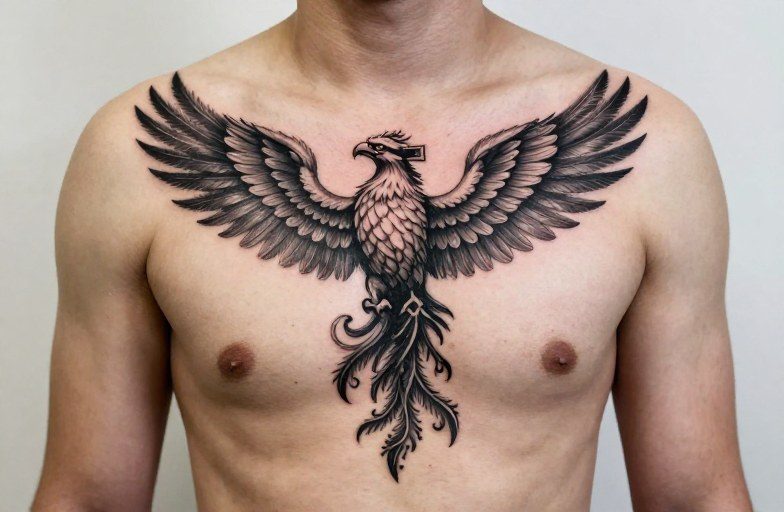
A phoenix with cross tattoo fuses two potent symbols of death and rebirth. The phoenix, consumed by flame and born again from ash, meets the cross, central to Christian resurrection. Together, they create a design about surviving destruction through faith, whether that faith is religious, spiritual, or simply the belief that you can rebuild after burning down.
Common Variations & Styles
The way these two elements interact changes the entire feel of the piece. Some designs subordinate one symbol to the other; others weave them into a single form.
The Phoenix Emerging From the Cross
Here, the cross serves as the framework or the pyre. Wings burst upward from the horizontal beam, or flames lick up the vertical post while the bird’s head rises from the intersection. This reads as faith generating rebirth, the cross as the source of renewal. Line weight matters: thick black outlines on the cross with softer, feathery shading on the phoenix create visual hierarchy. Reverse that, and the bird dominates.
The Phoenix Cruciform, Wings Spread as Crossbar
Less common but striking: the phoenix’s outstretched wings form the horizontal of the cross, while the body and tail create the vertical. The bird itself becomes the cruciform shape. This demands a larger canvas, upper back, chest, or thigh, to keep the wingspan from looking cramped. Small versions on forearms or calves often muddy the silhouette; the eye needs distance to read both symbols simultaneously.
- Traditional/Americana: bold lines, limited color palette, flames as decorative background filler
- Realism: individual feather detail, actual fire reference photos, subtle cross texture (wood grain, stone, oxidized metal)
- Blackwork/ornamental: cross as geometric frame, phoenix simplified to silhouette or negative space
- Japanese influence: phoenix rendered in irezumi style, cross integrated as background element or omitted in favor of a torii-like gate
Placement affects longevity. Chest pieces over the sternum see constant movement and sun exposure; ink there fades faster, especially fine feather detail. Upper arms and outer thighs hold lines better. Hands and feet are poor choices, the detail required won’t survive the abrasion and regeneration rates of those areas.
Who Chooses This Tattoo
People drawn to this combination usually carry a specific narrative: recovery from addiction, surviving abuse, returning to faith after abandonment, or rebuilding a life after loss. The phoenix alone has become somewhat generic; adding the cross narrows the field to those with a particular relationship to suffering and redemption.
There’s a noticeable pattern among people who got religious tattoos young, covered or removed them during a rejecting phase, and now want something that acknowledges both the original faith and the interval of destruction. The phoenix-with-cross accommodates that arc without requiring two separate pieces.
Military and first responder populations also gravitate here, though often with the cross rendered as a departmental memorial cross or thin-line variant. The phoenix represents surviving the job; the cross, the colleagues who didn’t.
Color vs Black and Grey
This choice fundamentally alters symbolism and maintenance.
Color: Fire and Blood
Traditional phoenix palettes, scarlet, gold, orange, against a black or wooden cross create immediate contrast. The fire reads as active, present, consuming. Color saturation determines how the piece ages; yellows and light oranges fade fastest, sometimes to a washed peach within five years without strict sun protection. Red holds better. Solid black cross lines provide anchor points that keep the composition readable even as surrounding color softens.
Black and Grey: Ash and Stone
Removing color shifts emphasis to texture and form. The phoenix can read as sculptural, carved from smoke, or as a photographic negative, ashes still holding shape. The cross gains weight; without competing hues, it becomes architectural. Healing tends to be cleaner with black and grey, fewer variables in ink behavior, less risk of muddied adjacent colors. For darker skin tones, black and grey often provides better contrast and longevity than attempting to make bright yellows and oranges pop against melanin-rich backgrounds.
One hybrid approach: black and grey phoenix with a single red accent, blood at the cross’s center, or one flame-colored eye. This borrows from Japanese tradition (the red spot in otherwise monochrome work) and focuses the viewer’s attention.
Personal & Modern Meanings
Contemporary wearers frequently detach the cross from specifically Christian reference. The shape functions as a universal symbol of intersection, where the horizontal (human, earthly) meets the vertical (aspirational, divine). The phoenix crossing through that intersection point becomes the moment of transformation.
Recovery communities have adopted this heavily. The cross represents the day count, the program, the surrender; the phoenix, the actual lived experience of coming back from a body and mind that seemed destroyed. It’s not uncommon to see dates or small text integrated at the cross’s base, sobriety dates, initials of people who didn’t survive, coordinates of a bottoming-out place.
Some choose the design after relationship collapse and reconstruction. The phoenix represents the self that survived; the cross, the commitment to something beyond romantic partnership, children, purpose, community. The symbolism stays private; the image reads publicly as generic religious imagery, which some wearers prefer.
History & Cultural Roots
The phoenix myth predates Christianity by millennia, with Egyptian (Bennu) and Greek sources often linked to the symbol. Early Christians adopted it readily, the bird’s cyclical death and rebirth paralleled resurrection without requiring direct biblical reference. Clement of Alexandria and other church fathers explicitly made the connection around the 2nd-3rd centuries CE.
The Cross as Later Addition
Phoenix imagery in early Christian art typically appeared alone or with laurel wreaths, not crosses. The cross as primary Christian symbol rose significantly after Constantine’s adoption in the 4th century. Combining phoenix and cross in visual art remained relatively rare until medieval illuminated manuscripts, where the bird sometimes perched on or near cruciform structures. Tattoo-specific fusion is largely a modern development, accelerating in the 1990s-2000s as religious tattooing became more acceptable in Western cultures.
Japanese phoenix (hou-ou) imagery, often linked to imperial and Buddhist contexts, occasionally merges with cross forms in contemporary work, though this is generally a Western tattoo convention rather than traditional Japanese practice. The hou-ou carries connotations of virtue and grace that differ from the Western phoenix’s emphasis on destruction and rebirth.
Religious & Spiritual Angles
For practicing Christians, the combination offers a way to wear resurrection theology without the empty tomb or risen Christ imagery that can feel either too explicit or too passive. The phoenix actively fights through flame; the cross, in this reading, is not merely suffering endured but suffering transformed. The theology of redemption through struggle, Paul’s “death in me, life in Christ”, finds visceral visual form.
Non-Christian Spiritual Use
Some wearers with eclectic or New Age leanings treat the cross as a pre-Christian symbol, the world axis, the four directions, the meeting of opposites. The phoenix then represents the soul’s journey through elemental destruction. This usage sometimes draws criticism from committed Christians who see it as appropriation, though the cross shape genuinely predates Christianity in multiple cultures. The tension between these readings is part of the symbol’s charged nature in contemporary tattooing.
Orthodox Christian tattooing traditions, particularly Coptic and some Eastern European practices, occasionally include phoenix imagery, though the cross itself, especially the Orthodox cross with three bars, remains the dominant element. A phoenix with three-bar cross is rare but unmistakably specific in its denominational claim.
Final Word
A phoenix with cross tattoo works when the two symbols genuinely interact, not when they’re simply adjacent. The worst versions look like clip art collision, bird pasted over cross, no visual logic. The best make the cross necessary to the phoenix’s rising, or the phoenix’s fire necessary to the cross’s meaning. That requires a designer who thinks in symbolism and composition, not just technical execution.
Before committing, consider which element you’d keep if you had to lose one. If it’s clearly the phoenix, you may want that alone. If it’s the cross, same. The combination demands that both matter equally. The flame and the wood, the destruction and the structure, the death and the resurrection, held in tension, not resolution. That’s where the power lives.
Frequently Asked Questions
Does a phoenix with cross tattoo have to be religious?
No. While the cross carries Christian weight for many, some wearers treat it as a general symbol of intersection or sacrifice. The phoenix’s rebirth narrative can stand alone. Your intent shapes the meaning more than any fixed symbolism.
How big should this design be to read clearly?
Minimum palm-sized for basic recognition; forearm or larger for detail that holds up over years. The cross’s proportions and the phoenix’s wingspan need room to breathe. Shrinking complex feather and flame work leads to muddy healing.
Will the color fade faster than black and grey on this design?
Yes, especially yellows and oranges. The cross’s black lines will outlast surrounding color by years. Plan for touch-ups if you choose bright fire tones, or design with the fade in mind, let the cross remain the constant anchor.
Can this work as a cover-up tattoo?
Often, yes. The phoenix’s flames and the cross’s solid black areas provide excellent coverage for older work. The vertical and horizontal structure helps restructure existing tattoo shapes. Consult specifically about what you’re covering, some colors and saturations resist coverage more than others.

Leave a Reply