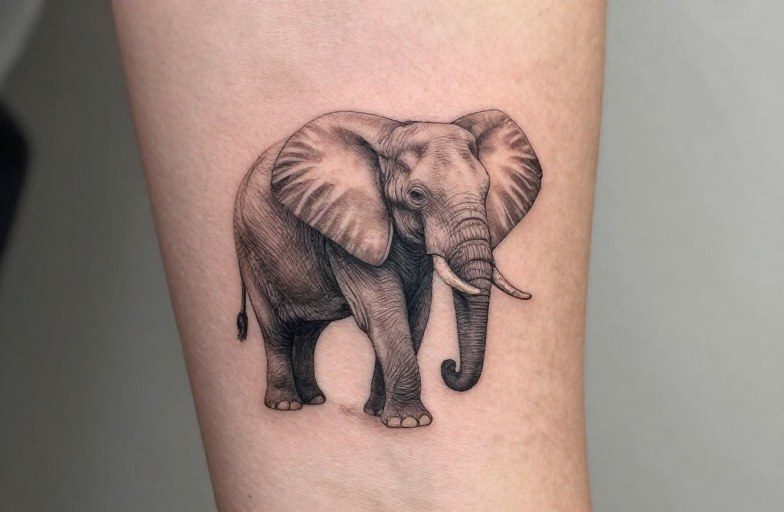
Elephants carry weight without needing much ink. A few well-placed lines can suggest the whole animal, its mass, its memory, its calm. The trick is knowing what to leave out. Minimalist elephant tattoos work because negative space does the heavy lifting; a curved trunk, a single tusk, the fan of an ear. This guide covers where to put them, how to make them yours, and which approaches hold up over time.
Best Placements
Small doesn’t mean invisible. The right placement makes a minimalist elephant feel intentional rather than tucked away.
High-Visibility Spots
Behind the ear, the side of the wrist, and the collarbone all frame the design like jewelry. These spots suit single-line elephants or tiny silhouettes under an inch. The wrist’s outer edge, especially facing you, lets you see it without a mirror. Behind the ear, follow the natural curve of the skull; a trunk flowing downward echoes that anatomy. Collarbone placements work best slightly off-center, avoiding the bone’s ridge where ink can blur.
Hidden or Intimate Areas
- Ribcage side: Enough flat skin for clean lines, easy to conceal, painful enough that you’ll want to keep it small
- Ankle inner bone: The elephant’s rounded shape sits naturally against the curve
- Finger side, not top: Less sun exposure, less contact with surfaces, better longevity
- Upper inner arm: Soft skin holds fine detail longer than sun-exposed forearms
Finger tops and palms are placement traps. The ink dumps out fast; you’ll be touching up yearly if it takes at all. Same for the foot’s arch, constant friction, poor healing.
How to Personalize It
Minimalism risks generic. A basic elephant outline from Pinterest becomes yours through specific choices.
Family and Bond References
A calf tucked against a larger elephant’s leg reads immediately as parent and child. Two trunks intertwined, one slightly smaller, suggests partnership without needing full figures. For multiple children, a line of three elephants decreasing in size, wrist to elbow, or hip to rib, creates procession without clutter. The spacing between them matters more than the detail within; too tight feels crowded, too loose loses connection.
Geographic and Cultural Nods
Indian elephants carry different head shapes than African: smaller ears, a domed forehead, often a howdah or decorative blanket suggested in a few lines. An African silhouette with its large ears and concave back reads as savanna, travel, wildlife conservation. If you have specific heritage, ask your artist to study reference photos of that subspecies. The difference between a generic elephant and a specific one is about six careful lines.
Consider integrating coordinates in tiny text beneath the design, or a semicolon-shaped trunk for mental health awareness, subtle enough that it doesn’t become a billboard.
Standout Design Ideas
These approaches separate memorable minimalist elephants from the flash-sheet crowd.
- Continuous single line: One unbroken stroke forming trunk, body, tusk, and ear. Requires an artist with steady hands and a plan; the line can’t cross itself messily. Best at 2-3 inches minimum.
- Negative space elephant: The animal formed by the gap between other elements, leaves, geometric shards, or waves. The surrounding ink does the work.
- Half-faded silhouette: Solid black rear dissolving into nothing toward the trunk, suggesting memory, loss, or the passage of time. Needs a skilled shader; “faded” easily becomes “muddy.”
- Origami fold lines: The elephant rendered as if paper, with crease marks and angular geometry. Sharp, modern, reads well at small sizes.
- Trunk-only curve: Just the spiral of a trunk and a hint of tusk, emerging from or disappearing into skin. Abstract enough to puzzle viewers briefly.
Watercolor splashes behind minimalist outlines are a dated look from 2015. The combination fights itself; minimalism wants restraint, watercolor wants exuberance. Pick one.
Matching & Pairing Ideas
Elephants pair naturally with certain symbols; the key is keeping both elements equally reduced.
Floral and Botanical
A single lotus stem curving beneath an elephant’s feet grounds the design. In Buddhist contexts, often linked to, the elephant-lotus connection carries specific resonance. For a lighter touch, a few lavender sprigs or olive branches, thin enough to match the elephant’s line weight. Mismatched line thickness is the most common pairing mistake; the delicate flower overwhelms the bold elephant, or vice versa.
Celestial and Abstract
A crescent moon cradling an elephant silhouette works because both shapes curve. A small constellation, three to five dots, trailing from the trunk as if dust or stars. Geometric frames: a thin circle or triangle containing the elephant, giving it a stamp-like quality. These pairings succeed when the secondary element is smaller than the elephant, never competing.
Matching tattoos for couples or siblings: one person carries the elephant, the other carries a specific associated element, the lotus, the moon, a single footprint. Connected but not identical.
Trending Variations
What’s actually being requested in shops now, not what’s trending on Instagram.
Micro realism: Tiny elephants with actual eye detail, skin texture suggested through dotwork. Requires a specialist; most minimalists can’t execute this. At under two inches, it’s a technical flex that ages poorly, those fine dots spread into gray mush over five years.
Stick-and-poke adjacent: Slightly wobbly, hand-poked look without being actually hand-poked. Machines can mimic this, but the charm is the imperfection. Best for single-line designs where a slight waver feels organic, not accidental.
Mixed media illusion: The elephant as if drawn in pen on skin, complete with a “sketch line” that overshoots, a tiny “eraser mark.” Clever once, gimmicky twice. If you go this route, commit fully; half-hearted sketch effects look like mistakes.
Color-restricted: Not black-only, but single-color, deep indigo, rust, forest green. The color itself carries meaning: indigo for night/depth, rust for earth/arid landscapes, green for growth. The elephant remains outline or silhouette, but the monochrome shift makes it distinctive.
Popular Styles
Style labels get thrown around loosely. Here’s what each actually means for your elephant.
Line Work
Single-weight lines, no shading, no color. The purest minimalism. The artist’s challenge is line quality, every wobble shows, every point of uneven depth catches light differently. Good line work elephants use the body’s natural curves; a trunk following a forearm’s muscle, an ear echoing a shoulder’s roundness. Bad line work looks like a logo slapped on skin.
Dot Work and Stipple
Density of dots creates tone. An elephant’s body in sparse dots, its shadow in concentration. Slower to execute, slower to age poorly than solid black, dots spreading read as softening, not blowout. The stipple style suits smaller sizes where smooth shading would granulate anyway.
Geometric and Abstract
The elephant deconstructed into triangles, or a low-poly count like early video games. The recognizability threshold is narrow; too abstract and it’s a Rorschach test. Successful versions keep the trunk curve identifiable, that single gesture reads as elephant even when everything else is angular. Abstract versions might show only the trunk and a single ear, the rest implied by the viewer’s pattern-completion.
Key Takeaways
Minimalist elephant tattoos reward restraint and punish carelessness. The less ink there is, the more each mark matters. Choose an artist whose line work you can examine healed, not just fresh, Instagram photos are usually day-of, when swelling flatters everything. Consider the elephant’s direction: trunk up is commonly associated with luck in Western tattoo culture, though this originates more from circus imagery than authentic tradition. Trunk down reads as drinking, groundedness, receiving. Neither is wrong; both communicate differently.
Plan for aging. A single clean line at age 25 will soften by 45; that’s not failure, it’s transformation. The elephant you get and the elephant you’ll have are related but distinct. Design for that future version, not the mirror tomorrow. Most importantly, make the specific choices, species, direction, associated elements, placement, that turn a generic symbol into something that actually belongs on your particular skin.
Frequently Asked Questions
How small can a minimalist elephant tattoo be before it blurs?
Below one inch, trunk detail and eye definition become risky. At that size, a solid silhouette or single continuous line holds better than anything with interior detail. Expect touch-ups regardless; fine work spreads over time.
Do minimalist elephant tattoos hurt more in certain placements?
Bone-adjacent spots like ankle, collarbone, and wrist bone sting more. The ribcage and inner arm have softer tissue but the skin pulls differently, which some find more uncomfortable. Small designs mean short sessions, so placement matters more than design complexity.
How do I find an artist who actually does good minimalist work?
Look for healed photos, not fresh ones. Check their portfolio for consistent line weight, clean curves, and work that’s aged at least a year. Ask specifically about their experience with single-needle or fine-line work; not every artist enjoys or excels at it.
Can a minimalist elephant tattoo be expanded into a larger piece later?
Yes, if planned. A small outline can become the center of a mandala, the focal point in a sleeve, or surrounded by later elements. Keep initial placement away from areas you’ll want fully covered, and leave breathing room around the design.


Leave a Reply