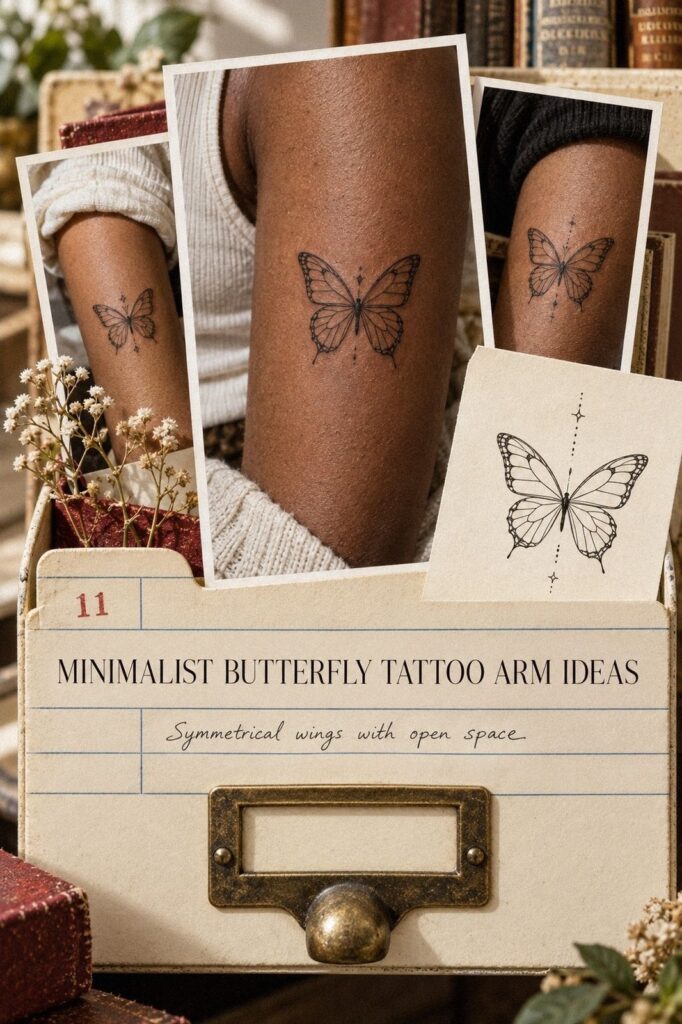
Minimalist butterfly tattoo arm designs can stay crisp for years when you choose the line weight, placement, and aftercare before you book. I learned that a delicate sketch isn’t automatically timeless; skin, sunlight, and spacing decide the result. This guide walks you through the choices in order. Start here!
- Start With Crisp Single-Needle Butterfly Linework
- Pick A Dainty Side-Profile Wing Shape
- Place The Butterfly Along Your Forearm
- Keep Symmetry Subtle With Organic Wings
- Plan A Meaningful Wrist-To-Arm Butterfly Trail
- Choose An Intricate Minimal Wing Detail
- Match Tiny Butterflies With Fine Linework
- Add A Bold Accent To One Wing
- Position A Flowing Butterfly Near Your Elbow
- Balance Negative Space Around Small Ink
- Protect Your Delicate Butterfly During Healing
1Start With Crisp Single-Needle Butterfly Linework

Begin with single-needle linework if you want a minimal butterfly that feels personal rather than copied. Ask your artist to draw open wings, a narrow body, and restrained vein details directly around your forearm shape. You don’t need every wing cell to be outlined.
I prefer a crisp black contour with only a few interior lines. Too many tiny marks can blur together as the skin settles, especially if the butterfly is smaller than 2 inches. A bold outer silhouette gives your design structure while keeping the center delicate.
The Crisp-Line Rule
Bring black tattoo ink references that show healed work, not only fresh photographs. Fresh lines often look sharp and dramatic, while healed lines can soften slightly. Your artist should explain how their chosen needle grouping behaves on your skin.
And don’t let the phrase single-needle push you toward the thinnest possible line. A slightly stronger outline may age better than a whisper-light contour, particularly if you’re outdoors often or your forearm gets regular sun exposure.
For a graceful result, leave breathing space between the wing veins. I’d skip dense ornamental filling here because it competes with the butterfly’s shape. Browse these minimalist fine line butterfly tattoo examples before you save references.
2Pick A Dainty Side-Profile Wing Shape
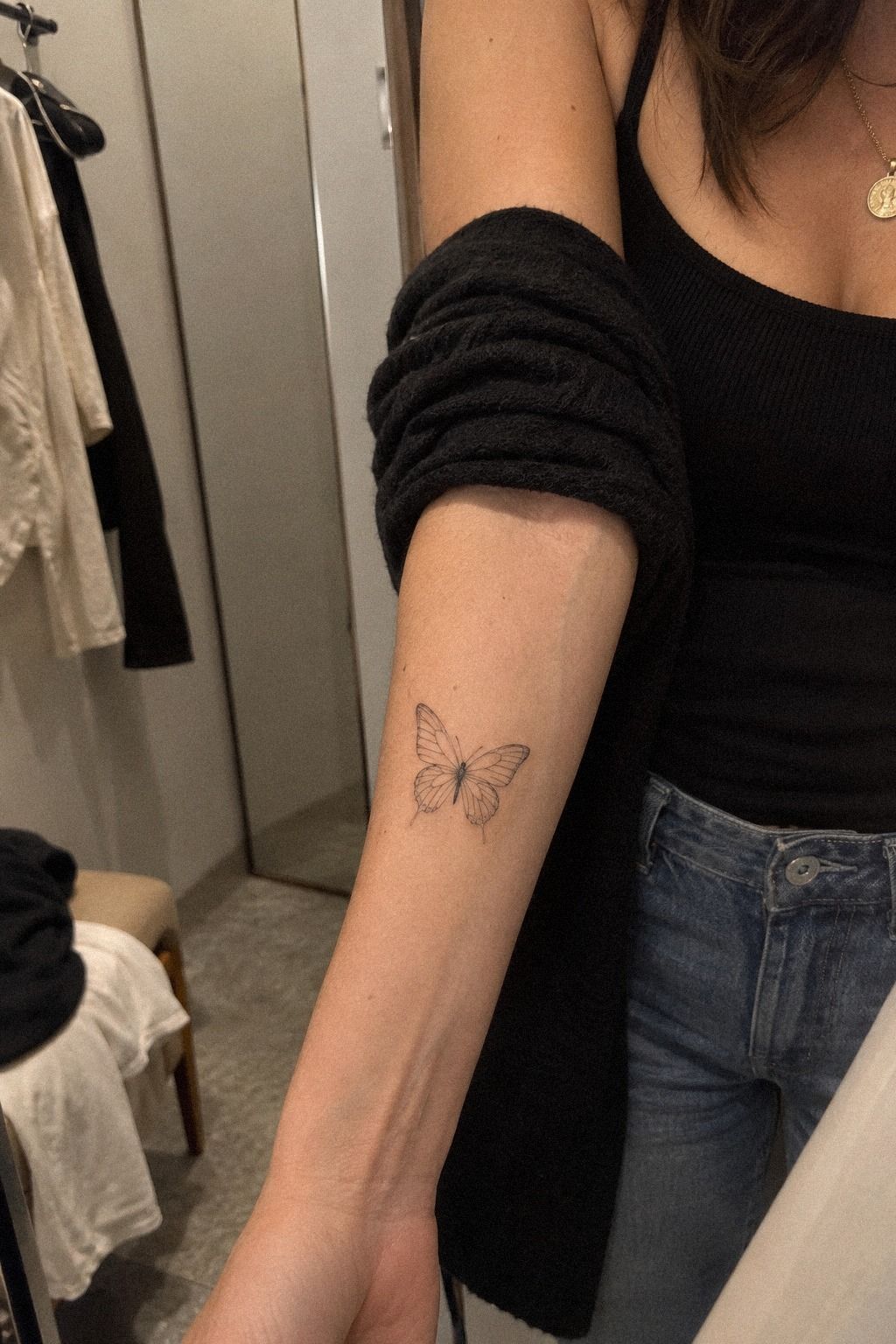
Choose side-profile wing structure when you want a butterfly that feels sleek and understated. Instead of showing both wings at equal width, let one wing lead while the second recedes behind it. That slight angle creates movement without requiring heavy shading.
Your reference should show the butterfly from the same viewing angle as your forearm. A design that looks balanced on paper might feel tilted once it wraps around the arm. Ask your artist to rotate the stencil before the final placement.
The Side-Profile Balance
A fine-point stencil helps you compare several versions without committing immediately. Try one with a rounded upper wing, one with a sharper tip, and one with a longer lower wing. You’ll notice that tiny changes can make the butterfly feel feminine, edgy, or more graphic.
I’d avoid an overly ornate profile if your goal is longevity. Fine decorative curls can look striking fresh, but they may become visual noise after years of natural spreading. Your strongest version will probably use fewer marks than you first expect.
And if you want a more personal symbol, adjust the wing angle instead of adding random charms. A rising wing can suggest release or change, while a lowered wing can feel quieter and more reflective. See these small butterfly tattoo arm ideas for scale comparisons.
3Place The Butterfly Along Your Forearm

Place the butterfly on the inner forearm skin if you want easier visibility and a relatively tolerable tattooing experience. The outer forearm can offer stronger contrast and more daily exposure, while the inner area often feels more private and personal.
Your artist should test the design at several points between the wrist and elbow. Leave enough room from the wrist crease so movement doesn’t make the wings look cramped. A placement about 2 to 3 inches above the crease often gives the design a cleaner visual pause.
The Forearm Anchor
Use transfer stencil paper to check how the butterfly reads when your arm hangs naturally. Look at it standing, seated, and with your wrist turned. You’ll catch awkward angles much sooner than you will while staring at a flat reference.
I’ve seen people choose the exact center of the forearm because it looks tidy in a photograph. That isn’t always the best choice for your body. A slightly offset placement can follow the arm’s natural taper and make the butterfly look more organic.
But don’t place the lowest wing directly on a bend just because the stencil looks centered. Creases and constant movement can make tiny details harder to preserve. Compare the placement with this minimalist butterfly tattoo stencil guide before your appointment.
4Keep Symmetry Subtle With Organic Wings

Keep the organic wing contour slightly imperfect so your butterfly feels alive instead of mechanically mirrored. Symmetry matters, but identical left and right wings can make a small tattoo look stiff. Let one edge curve a fraction differently.
Ask your artist to mirror the major wing shape while varying the tiny vein paths. That gives you a harmonious silhouette with enough irregularity to feel hand-drawn. The best result is polished without looking like a logo.
The Organic Mirror Method
A light hand-drawn draft lets you compare strict symmetry with a softer version. If your skin has visible texture, an organic contour can follow it more naturally than a geometric outline. Your artist should still keep the body centered and the main wing tips balanced.
I’d skip heavy black patches on both wings unless you want a more powerful blackwork look. Solid fill can be timeless, but it changes the weight of the design and leaves less negative space. Your choice should match the mood you want every day.
Why force perfect symmetry when butterflies themselves have delicate variation? A slightly uneven line can make the tattoo feel expressive and personal. Save this minimalist butterfly tattoo design collection and mark the wing shapes that feel most like you.
5Plan A Meaningful Wrist-To-Arm Butterfly Trail

Plan a wrist-to-arm butterfly trail if one butterfly feels too isolated or you want a sequence with personal meaning. Start with the largest butterfly near the forearm, then let smaller forms travel toward the wrist rather than scattering them randomly.
Your artist can vary the direction, scale, and wing opening while keeping the same line language. A trail of three butterflies may feel symbolic without becoming crowded. Leave visible skin between each design so the group stays crisp as it ages.
The Three-Scale Trail
Use aged off-white flash paper to compare the sequence before choosing a final arrangement. Sketch the largest butterfly first, then add smaller shapes at roughly two-thirds and half its visual width. The exact measurements can change with your arm, but the hierarchy should remain clear.
I’d avoid placing the tiniest butterfly directly on the wrist crease. That spot bends constantly and can be more sensitive. Instead, keep your smallest shape slightly above the crease, where you can still see the trail without forcing every detail into a narrow area.
And if your idea includes a date, initial, or tiny star, keep it separate from the wings. Your meaningful detail should be readable rather than trapped inside the linework. For more compact references, compare these tiny butterfly tattoo arm designs.

6Choose An Intricate Minimal Wing Detail

Choose one intricate wing detail as the focal point instead of decorating every section.
7Match Tiny Butterflies With Fine Linework
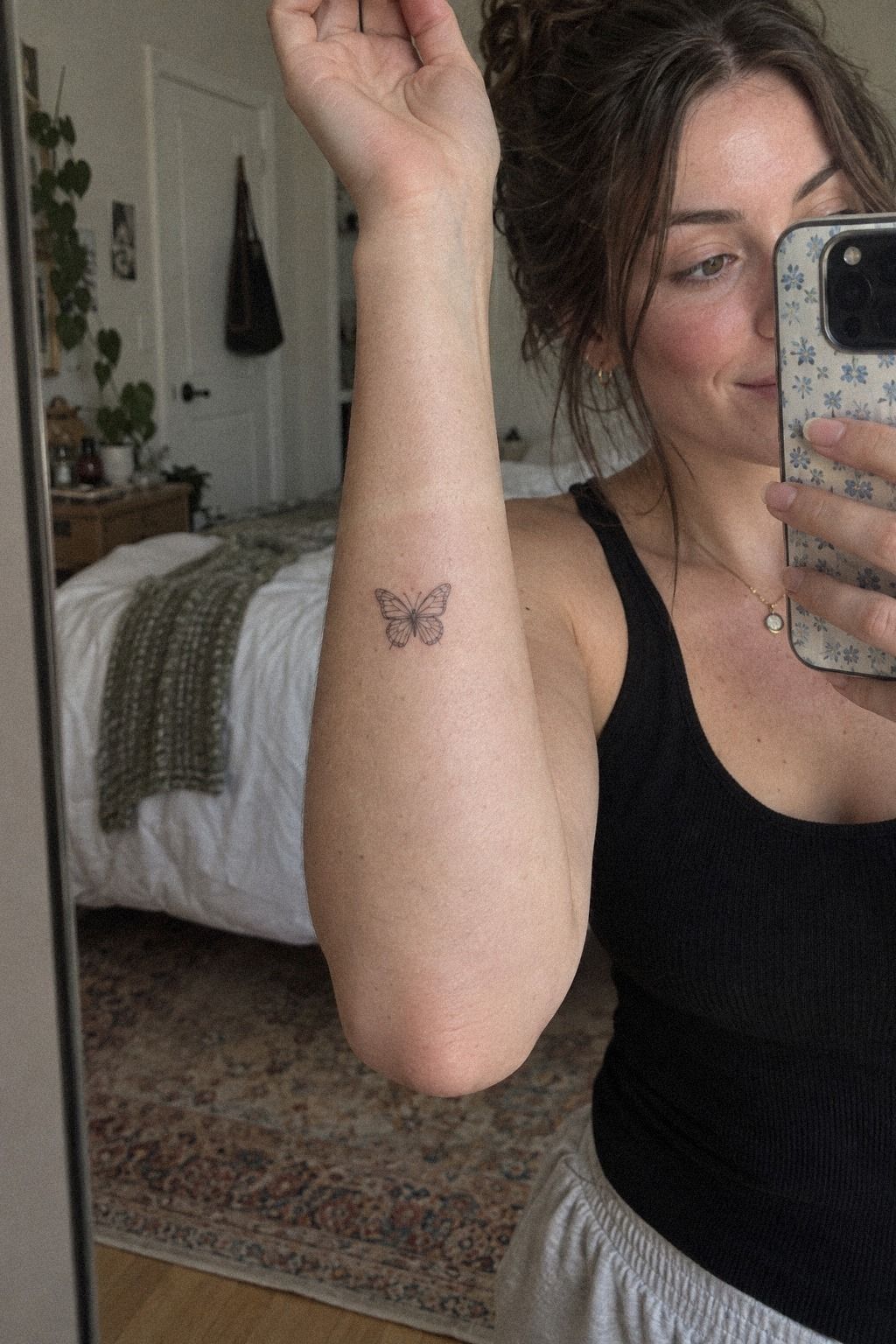
Match tiny butterfly proportions across your reference sheet if you want several small designs that feel connected. Keep the body length, wing style, and line character related, even when each butterfly faces a different direction.
Your artist can create variation through open and closed wings, slight rotations, or one lifted upper wing. That keeps the set playful without making it look like a repeated stamp. A consistent visual language is more important than identical shapes.
The Tiny-Line Test
Use healed portfolio photographs to judge how small details behave over time. Ask whether the photos were taken after at least a few weeks, when surface healing has settled. Fresh work can make every narrow vein look sharper than it will later.
I’d avoid squeezing four or five micro-butterflies into a short forearm section. They may look dainty at first but can merge visually as lines soften. Your spacing should be generous enough that each butterfly still reads from a few feet away.
But tiny doesn’t have to mean fragile. A clear silhouette, open wing centers, and restrained detail can remain elegant for years. Compare these minimalist small butterfly tattoo references before you commit to a multi-butterfly arrangement.
8Add A Bold Accent To One Wing

Add one solid black wing accent when your minimalist design needs a sharper focal point. Keep the accent confined to one upper or lower wing, then leave the opposite side mostly open. That contrast gives the butterfly a daring but controlled feel.
Your artist can use a compact filled shape, a dark body, or one short black stripe. The best choice depends on your skin and the scale of the tattoo. Ask how much fill is needed for the mark to stay readable after healing.
Black Over Gray
Choose black over graywash shading if longevity is your first concern. Gray can create a soft, ethereal result, but it may fade more noticeably with sun exposure. Solid black usually gives you stronger contrast, provided the placement and saturation are handled well.
I’d skip adding several dark accents just because one looks effective. More contrast isn’t always more expressive. Your butterfly will feel more polished if the eye lands on one intentional mark instead of bouncing between competing patches.
A bold accent can also carry meaning. One dark wing might represent resilience, a difficult chapter, or the part of yourself you no longer hide.
That’s a powerful idea, but keep the shape simple enough to remain crisp. See these minimalist butterfly tattoo ideas for restrained black accents.
9Position A Flowing Butterfly Near Your Elbow
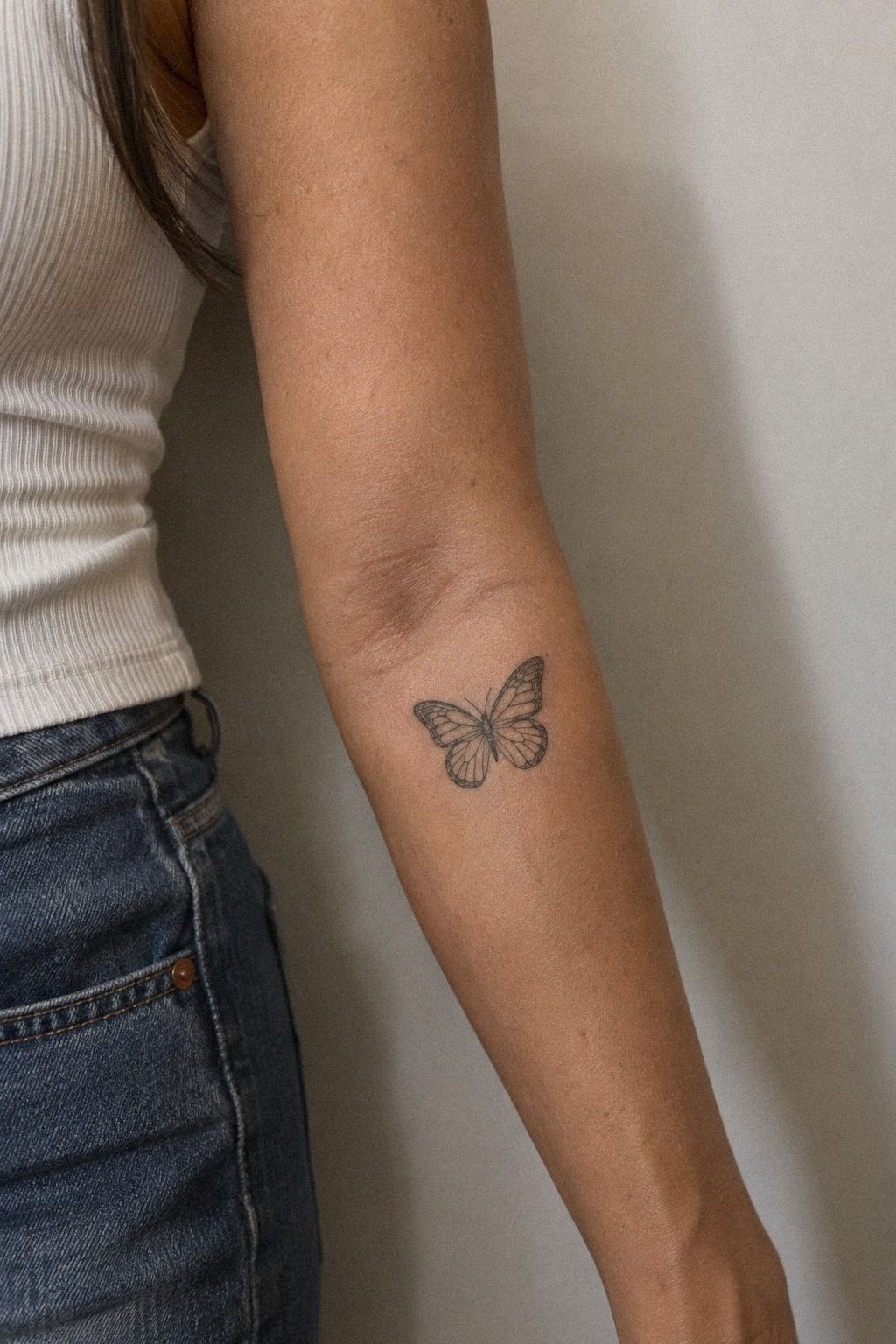
Position a flowing upper-forearm butterfly below the elbow if you want the design to follow the arm’s natural movement. Angle the body slightly toward the elbow, then let the wings open into the wider part of the forearm.
Your artist should check the design while your arm bends. A butterfly that looks centered when straight can shift visually when the elbow folds. Keep the upper wing away from the crease so the most delicate detail doesn’t sit on constant motion.
The Elbow Buffer
Leave a clear skin buffer between the tattoo and the elbow crease. That small gap helps the butterfly breathe visually and avoids forcing fine lines into a high-movement area. It can also make future additions easier if you decide to build a larger arm story.
I’d avoid placing a tiny body directly over the bony point. That area can be more uncomfortable, and its changing angle may distort the design when you move. Your forearm gives you plenty of space for a flowing composition without using the most demanding spot.
And don’t confuse visibility with placement quality. A tattoo can be easy to show and still age poorly if it’s exposed to constant rubbing or sunlight. Review this unique minimalist butterfly tattoo arm collection before finalizing your angle.
10Balance Negative Space Around Small Ink

Balance open skin spacing around the butterfly before you approve the stencil.
11Protect Your Delicate Butterfly During Healing

Protect your fresh butterfly tattoo during the first surface-healing stage. Wash gently according to your artist’s instructions, pat dry with a clean towel, and use a thin layer of the recommended moisturizer. Don’t scrub, soak, or pick at peeling skin.
Surface healing commonly takes about 2 to 3 weeks, while complete healing can take roughly 2 to 3 months. Your artist may adjust advice based on the placement, saturation, and covering method used during your appointment.
The Sun-and-Water Rule
Keep fragrance-free aftercare lotion light and comfortable rather than applying a thick coating. Avoid swimming while the surface is healing, and protect the healed tattoo from UV exposure with clothing or broad-spectrum sunscreen once your artist says the skin is ready.
I’d skip direct sun on fresh work completely. UV exposure can make delicate lines lose contrast sooner, especially on an exposed forearm. Your long-term result depends on ordinary habits as much as the appointment itself.
For a realistic budget, typical US pricing often looks like this:
And remember that a delicate tattoo isn’t disposable just because it is small. Follow the artist’s aftercare, return for a touch-up only if they recommend one, and use minimalist butterfly tattoo inspiration to plan any future piece. Protect the lines you chose so carefully!
The Line I’d Trust After Seeing These Heal
I used to think the smallest butterfly would be the most timeless choice. Then I saw several healed pieces side by side, and the winners weren’t always the tiniest or most delicate.
They had clear silhouettes, thoughtful spacing, and enough contrast to remain readable after the surface softness disappeared. That’s the part I now prioritize for my own designs.
A butterfly can be striking without being large. The strongest forearm pieces often use a crisp outer wing, a restrained body, and one meaningful detail rather than a crowded collection of symbols.
I’d rather see one elegant curve survive than six intricate veins turn muddy. Your tattoo has to work during an ordinary morning, not only under a studio lamp.
Placement matters just as much. The forearm is generally more tolerable than the ribs, feet, hands, or sternum, but it still receives sunlight and friction.
If you’re choosing an exposed position, plan for protection after healing. A soft, polished line can stay vibrant when you treat UV exposure as part of the design decision.
And don’t let social media pressure you into copying the exact butterfly everyone else saved. Your wing angle, scale, and accent should have a reason, even if that reason is simply that the shape feels right.
A personal tattoo doesn’t need a dramatic story to be meaningful. It needs to keep making sense when you look at it years later.
A Few Things Worth Answering
How much does a minimalist butterfly tattoo arm usually cost?
A small piece commonly costs about $100 to $300 in the US, though a studio minimum may run about $50 to $100 and hourly rates often fall near $100 to $250. Your artist, region, size, and detail level all affect the final quote.
– Studio minimum – Hourly rate – Size and placement – Linework complexity
Are minimalist butterfly tattoo arm designs a good idea for a first tattoo?
Yes, a forearm butterfly can be a manageable first tattoo because the placement is often more tolerable than ribs, feet, hands, or sternum. Your design should still use clear spacing and a healed reference so fine lines don’t carry more detail than they can support.
– Forearm placement – Crisp outline – Personal symbolism – Moderate session length
How do I choose a tattoo artist for minimalist butterfly tattoo arm work?
Choose an artist with a clean healed portfolio, not only fresh close-ups. Check their linework, symmetry, stencil placement, hygiene standards, and experience with your skin tone. Your consultation should feel specific, and the artist should explain what they would simplify.
– Healed photographs – Fine-line experience – Studio hygiene – Clear consultation
How much does a minimalist butterfly tattoo arm hurt?
Forearm tattoos are usually more tolerable than tattoos on the ribs, feet, hands, or sternum, although sensation varies from person to person. Your inner forearm may feel more sensitive than the outer forearm, especially near the wrist or elbow crease.
– Outer forearm – Inner forearm – Wrist proximity – Elbow proximity
How long does a minimalist butterfly tattoo arm take to heal?
The surface commonly heals in about 2 to 3 weeks, while complete healing can take roughly 2 to 3 months. Follow your artist’s instructions, wash gently, moisturize lightly, and avoid sun exposure and swimming while the surface is healing.
– Gentle washing – Thin moisturizer – No picking – No swimming
What’s the best placement for minimalist butterfly tattoo arm?
The mid-to-upper forearm is often a practical placement because it offers visibility, tolerable sensation, and enough space for clean negative space. Your artist can compare inner and outer forearm positions while your arm is relaxed and bent.
– Mid-forearm – Upper forearm – Inner placement – Outer placement
Where I’d Start First
If I had to pick one step, I’d start with the outer silhouette. A clear wing shape survives softened details better than a crowded interior ever will.
Save your favorite references, test the stencil at real scale, and show your artist the healed work you trust. That’s where the lasting design begins.

