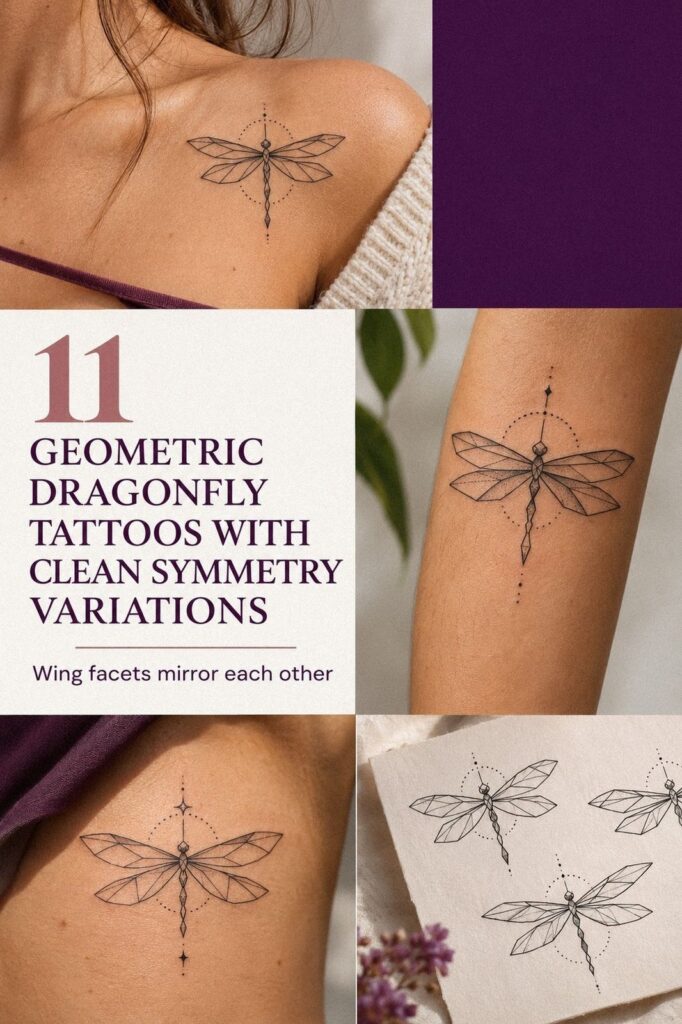
A geometric dragonfly tattoo usually feels more manageable when you control three choices first: size, placement, and line density. I learned that after seeing a small collarbone design swell faster than expected because the stencil was too crowded. You’ll get a calmer session when your artist can work slowly, your skin isn’t irritated, and the design leaves room to breathe.
Editor’s note: Minimal pain isn’t about finding a painless spot. It’s about choosing a tolerable placement, a readable design, and a pace your body can handle.
- Start with a Small Geometric Dragonfly Tattoo
- Why Intricate Wings Need More Room
- Place Crisp Linework Along Your Forearm
- Keep Negative Space Between Angular Wing Segments
- What Should the Silhouette Mean?
- Choose Flowing Geometry for Graceful Movement
- Balance Bold Shapes With Delicate Details
- A Sacred Center for Your Dragonfly
- Match Ink Scale to Your Body Placement
- Test Pain Levels Before Detailed Linework
- Protect Sharp Geometry During Tattoo Healing
1Start with a Small Geometric Dragonfly Tattoo

A small design gives you a gentler introduction to tattooing, especially if this is your first piece. A collarbone placement suits a few stars better than a crowded wing structure, and clean spacing keeps the session focused. You’ll want your artist to test the stencil while you’re standing, sitting, and relaxing your shoulders.
Your skin undertone affects how black shapes read, so your artist should check contrast before the needle starts. I’d skip squeezing a full dragonfly into a tiny area. It may look intricate on a screen, but cramped geometry can blur as your skin ages.
Ask for one central shape, a few small stars, and enough untouched skin around each mark. That gives the design rhythm a striking quality without forcing your artist to pack every gap. You’ll find more compact placement ideas in this guide to tiny dragonfly tattoo designs.
For a first appointment, discuss whether the design scale will hold the details you care about. Your artist might recommend going slightly larger if the wings need delicate interior lines.
That advice isn’t a failure. It’s a practical way to keep the result crisp.
I call this the Collarbone Scale Rule: if you can’t describe the design in one calm sentence, it’s probably too busy for a small placement. And if you’re nervous, tell your artist before the stencil goes on. You’re allowed to pause, look again, and change your mind!
2Why Intricate Wings Need More Room

The spine can carry a longer design, so it suits spine placement and a dragonfly that seems to curl down the body. A vertical layout can feel sleek when the body follows the natural line of your back.
Your artist should measure the full dragonfly silhouette before adding tiny wing divisions. Intricate work needs breathing room. If the outer shape is too narrow, the interior marks may compete with one another.
Ask how the chosen session length affects your comfort. A larger design may take longer, but rushing a detailed stencil can create more tension than the tattoo itself. You’ll make a better decision when you know where pauses fit.
I’d also ask to see examples of healed geometric work at a similar scale. Fresh ink can look sharp and dramatic, while healed lines may soften. That comparison tells you whether the planned spacing is genuinely durable.
3Place Crisp Linework Along Your Forearm

A forearm gives you a relatively tolerable placement with a long, visible path for geometric linework. The dragonfly should follow the length of your arm instead of sitting sideways like a sticker. That direction makes the design feel sleek and intentional.
The forearm skin can move and crease, so ask your artist to check the stencil with your wrist relaxed. A bold center line may look powerful when your hand is flat but feel awkward when your arm hangs naturally. I’ve found that a design should make sense in the position you’ll actually wear it.
If you want plum, gray, or rose-gold-inspired accents, your artist can adjust contrast and spacing rather than simply making every line heavier. Clean black ink usually gives the crispest result, while too many pale details may disappear after healing.
You’re not trying to win a drawing contest. You’re building a mark that needs to remain legible.
Look through minimalist dragonfly tattoo examples if your idea feels too dense. A restrained silhouette can still look edgy when the angles are intentional. I’d skip decorative filler around the elbow because that area bends, rubs, and can make precise geometry feel cluttered.
The Forearm Direction Check is worth doing before the needle starts. Stand, lower your arm, rotate your wrist, and ask whether the dragonfly still reads correctly. You’ll catch more problems in thirty seconds of movement than you will by staring at a flat stencil.
4Keep Negative Space Between Angular Wing Segments

Negative space keeps angular wings from becoming a dark block. Preserve the openings between the wing segments instead of filling every triangle. You’ll need to discuss which spaces are essential before the session begins.
Check contrast in the light you normally live with, then imagine the healed design without temporary shine. A vibrant pattern doesn’t need maximum saturation everywhere. Sometimes the most understated section gives the eye a place to rest.
Try the Negative Space Ladder: one large opening near the wing root, a medium opening through the middle, and smaller accents near the outer edge. This creates movement without making the design fragile. You’ll get a more graceful result if the gaps follow the wing structure.
Use geometric butterfly tattoo ideas to compare spacing, but don’t copy the proportions blindly. Butterfly wings spread broadly, while dragonfly wings often read better with longer, narrower divisions. Your artist should adapt the geometry to your body.
Don’t let the word “negative” make you think those areas are unfinished. They’re doing the visual work. If you’re tempted to add one more line, wait until the stencil is on your skin.
The open patch you nearly removed may be the reason the healed tattoo still looks sharp.
5What Should the Silhouette Mean?

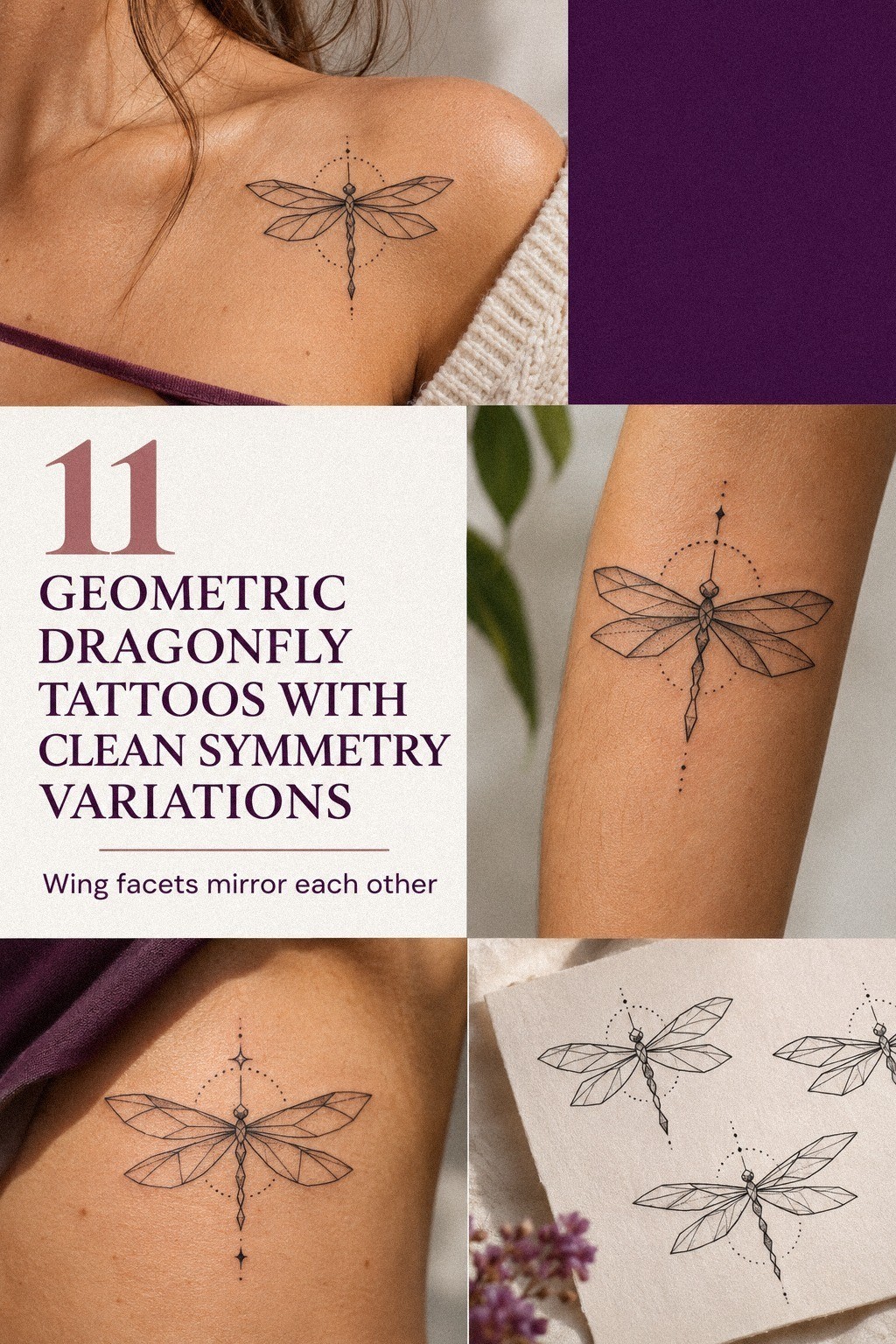
Start with three possible silhouettes rather than committing to the first sketch.
6Choose Flowing Geometry for Graceful Movement

A shoulder placement gives your artist a rounded surface, and a dragonfly can travel naturally along that curve. You’ll want the design to follow the shoulder rather than stop abruptly at the edge. Flowing geometry can make angular work feel less rigid without losing structure.
Your artist should inspect the design under even light and choose contrast that respects your skin tone. A raw black outline may read differently from gray wash, so discuss the healed goal instead of focusing only on the fresh tattoo.
Try the Shoulder Sweep Method: place the head near the upper shoulder, let the body follow the curve, and keep the wings aligned with the natural slope. This creates graceful movement that you’ll still recognize when your arm is down.
You can browse watercolor dragonfly tattoo references for movement, but color isn’t required to create flow. Black geometric lines can feel ethereal when the spacing changes gradually. You’ll have more control over aging when the silhouette doesn’t depend on delicate color transitions.
Your comfort affects line quality. If you’re bracing your shoulder for the entire session, the area may feel more tiring than expected.
Tell your artist when you need a pause. A calmer body gives you a more polished result, and that’s worth protecting.
7Balance Bold Shapes With Delicate Details

The upper arm is useful for balancing bold wing shapes with delicate internal marks. A clear upper-arm placement gives the dragonfly enough room to read as one design rather than several disconnected symbols. Establish the silhouette before adding smaller geometry.
On fair skin, a solid black section can create a bold anchor, while thin lines can suggest wing veins and scale. I’d avoid making every part equally dark. The eye needs contrast between weight and restraint.
Use the Bold-to-Delicate Ratio: one strong body shape, two medium wing structures, and a few fine accents. That proportion can make the tattoo feel polished without becoming overly ornate. You’re giving your artist a clear hierarchy, which makes the appointment easier to pace.
Compare your concept with geometric fine-line butterfly tattoos if you want to study thin wing divisions. Butterfly examples can show how much detail a small area can carry, but your artist still needs to account for your skin, placement, and preferred line weight.
A feminine or masculine reading shouldn’t control the design unless you want it to. The same angular dragonfly can feel fierce, dainty, or quietly personal depending on scale and spacing. Choose the marks you’ll still recognize years from now.
8A Sacred Center for Your Dragonfly

The upper back gives you room for a sacred motif, especially when the dragonfly sits between the shoulder blades. Align the central shape with your spine, but let the surrounding geometry remain slightly asymmetrical. That keeps the sacred center from feeling stiff.
A larger silhouette gives your artist more control over body length, wing spacing, and halo-like geometry. Ask for the complete upper-back stencil before discussing filler. A timeless design usually needs fewer additions than you expect.
If you’re drawn to circles, stars, or sharp angular marks, name the emotion you want them to carry. A sacred symbol should feel meaningful rather than decorative. You’ll have an easier time choosing if you separate personal symbolism from passing trends.
Use small dragonfly tattoo ideas as a scale comparison, not a strict template. A compact dragonfly can feel understated, while a larger upper-back silhouette can become more expressive and empowering.
The Sacred Center Rule gives you one test: cover the outer details with your hand and ask whether the middle still feels complete. If it does, the design has a strong foundation. If it doesn’t, you may be relying on filler to create meaning.
9Match Ink Scale to Your Body Placement

Scale should follow the body, not the other way around.
10Test Pain Levels Before Detailed Linework

Pain varies by placement, so use the stencil to test position before detailed stencil positioning begins. Walk around, bend the joint, and wear the clothing you expect to wear afterward. If the stencil makes you tense, solve that before the appointment.
Ask your artist to begin with a small outline section, then reassess. You’re not being difficult if you need a pause. A controlled pace can keep your breathing steady, and steady breathing makes a sharp, expressive design easier to finish.
Ribs, feet, hands, and sternum are usually more painful, while the forearm, thigh, and shoulder tend to feel more tolerable. Your session may still feel intense, but choosing an area with more padding can improve the value of your budget.
For a healed comparison, look through minimalist dragonfly tattoo designs. Restrained outlines can show how less dense work settles.
If your body says no that day, listen. Rescheduling is wiser than pushing through while dehydrated, exhausted, or anxious.
11Protect Sharp Geometry During Tattoo Healing

Healing begins with following your artist’s aftercare instructions, not improvising with every product you see online.
Pain, Placement, and the Real Tradeoff
The least painful choice isn’t always the best artistic choice. A forearm may be more tolerable and visible, while an upper back may give your artist more space for an iconic silhouette. I’d compare comfort, meaning, visibility, and long-term value together.
A cheaper appointment can become expensive if you later need major corrections. That doesn’t mean the highest quote is automatically worth it. It means you should compare healed work, artist hygiene, design control, and communication before comparing the final cost.
If a larger size protects the geometry, it may be worth it. If extra detail only makes the piece busier, it probably isn’t. Your best decision is the one that keeps the design readable and your body within its limits.
Why Healed Work Changes the Choice
Fresh tattoos can look darker, sharper, and more dramatic than they will after healing. Ask to see healed linework, especially from projects with similar scale and skin tone. That evidence tells you more than a flawless fresh result.
I’d ask how the artist handles softened lines, small gaps, and touch-ups. A confident answer can make the consultation feel more honest. You’re paying for judgment as much as the minutes under the needle.
The healed result should still feel personal when the novelty fades. A timeless dragonfly doesn’t need every trend at once. It needs a clear silhouette, deliberate spacing, and marks you won’t resent later.
The Three-Moment Budget Check
Your budget should account for the appointment, possible touch-up, and the quality of the artist’s healed work. Use this rough planning table before you decide whether a quote offers real value.
These are planning ranges, not promises. Location, artist demand, complexity, and placement can change the tattoo cost quickly. Ask whether the quote includes the consultation, stencil changes, and a standard touch-up.
If you’re working with a strict budget, simplify the geometry before choosing a cheaper artist. Reducing filler can preserve the central idea. Compromising on hygiene or healed-work quality usually offers poor value.
Skin Tone Is Part of the Geometry
Ink doesn’t read identically on every skin tone. Ask how the artist adjusts contrast planning for your complexion, especially if the design relies on thin lines or subtle gray shading.
A bold black body may remain clear where pale interior marks fade faster. That isn’t a reason to avoid delicate details entirely. It’s a reason to choose a hierarchy that still works when the lightest marks soften.
Your artist should show healed examples on a range of skin tones when possible. You’ll get a more realistic idea of how the dragonfly may age, and you can decide whether the expected result matches your personal taste.
What Should a Consultation Cover?
A useful consultation should cover placement, size, line weight, healing, and consultation planning. Bring your references, but explain what you like about them instead of asking for an exact copy.
Ask how long the appointment may take and whether breaks are built into the plan. If the session stretches far beyond your comfort level, the design may need to be simplified or divided into stages.
You can compare ideas through geometric butterfly tattoo references while keeping the dragonfly’s longer wings and narrow body distinct. The goal is inspiration, not duplication!
Aftercare Starts Before the Appointment
Eat a normal meal, drink water, and avoid arriving exhausted. Your appointment preparation won’t remove pain, but it can make it easier to stay still and communicate when you need a pause.
Wear clothing that leaves the placement accessible without pressing against it afterward. Plan for a quiet period if the area may rub against straps, waistbands, or tight sleeves. Loose clothing can make the first evening less irritating.
Ask your artist what products to have ready before you leave. A simple aftercare product plan is easier to follow than a complicated shelf of products you don’t understand.
Your Stencil Pause
The stencil pause is the moment when you stop treating the design as an idea and inspect it as a wearable mark. Stand naturally, move the joint, and look at the silhouette from several angles.
Check whether the head points in the direction you want and whether the wings feel balanced. Tiny adjustments can make the difference between a deliberate composition and one that feels accidentally tilted.
If something bothers you, speak up before the needle starts. You’re allowed to ask for a new stencil, a smaller symbol, or more open skin. That pause can protect both comfort and confidence!
The Three-Line Test I Trust More Than Trend Photos
I’ve looked at enough tattoo references to know that the most memorable geometric dragonflies aren’t always the most complicated ones. The design I’d choose for myself has three lines that matter: a clear body, a readable wing shape, and one deliberate symbol. Everything else has to earn its place.
Pain is part of the decision, but it shouldn’t be the only decision. A tolerable placement won’t rescue a design you don’t understand, and a meaningful design won’t feel easy if you ignore your body’s limits. I’d rather choose an understated forearm piece than a dramatic rib tattoo I rushed.
I made the mistake of treating a healed result like a promise. It isn’t.
Light, skin tone, line weight, sun exposure, and aftercare all change what you’ll see later. That’s why I trust an artist who shows healed evidence and answers awkward questions.
The best geometric dragonfly tattoo is personal before it’s stylish. It can be sacred, edgy, romantic, or quietly masculine, but the label should come from your intention rather than a caption. You’ll make a better choice when you can explain why the shape belongs on your body.
If you want another restrained comparison, tiny dragonfly tattoo designs can help you judge how much detail a small silhouette really needs. Planning can feel fussy. It’s still worth doing.
The Questions Worth Answering First
How much does a geometric dragonfly tattoo usually cost?
I’d expect a small geometric dragonfly tattoo to cost around $100 to $300 in the United States, depending on size, placement, artist, and region. Larger spine or upper-back work may cost $600 or more. I’d ask for a written estimate and confirm whether a touch-up is included.
Is a geometric dragonfly tattoo a good idea for a first tattoo?
I think it can be a strong first tattoo when you choose a readable scale, tolerable placement, and simple stencil. A small forearm, shoulder, or upper-arm design can feel less intimidating than a dense rib piece. I’d still schedule a consultation before deciding.
How do I choose a tattoo artist for a geometric dragonfly tattoo?
I’d choose an artist who shows healed geometric work, consistent hygiene, and designs with clean spacing. Ask how they adapt line weight to skin, how long your concept may take, and whether they’re comfortable with your placement. Their answers should feel clear rather than rushed.
How much does a geometric dragonfly tattoo hurt?
I’d expect discomfort to depend heavily on placement and personal tolerance. Ribs, feet, hands, and sternum are often more intense, while the forearm, thigh, and shoulder may feel more manageable. A calm session helps, so I’d eat beforehand, hydrate, and request breaks when needed.
How long does a geometric dragonfly tattoo take to heal?
I’d plan for the surface to heal in roughly two to three weeks, with deeper skin recovery taking longer. I’d wash gently, moisturize according to the artist’s instructions, avoid swimming, and protect the tattoo from direct sun during early healing.
What’s the best placement for a geometric dragonfly tattoo?
I’d start by comparing the forearm, shoulder, and upper arm because they usually offer useful space and manageable visibility. A forearm placement gives you an easy view of the design, while the upper back can support a larger, more expressive silhouette.
Where I’d Start First
If I had to pick one step, I’d start with the stencil test. You’ll catch scale, posture, spacing, and placement problems before the needle arrives, and that protects your skin from a rushed decision.
Bring the stencil idea to an artist who shows healed geometric work. If the design still feels striking, personal, and readable after you’ve checked comfort and cost, it may be worth choosing.