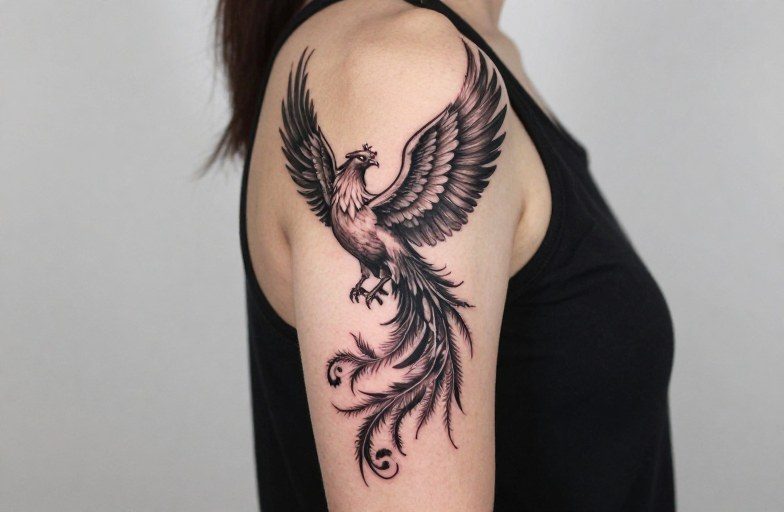
The phoenix tattoo carries a core meaning of rebirth through destruction, rising renewed from ashes. For women choosing this imagery, it often marks survival through divorce, illness, career collapse, addiction recovery, or any life phase that required starting over with nothing. The bird’s cyclical death and return makes it less about permanent victory than about the capacity to endure repeated burning.
Mythology & Folklore
Cross-cultural roots give this design weight beyond generic empowerment messaging. Understanding where the imagery comes from helps you choose authentic details rather than watered-down symbols.
Greek & Roman Sources
Herodotus and later Ovid described the phoenix as a single living bird, not a species, unique, self-generating, burning on a pyre of spices every 500 to 1,461 years depending on the source. The Greek phoinix connects to the Phoenician purple-red dye, tying the bird to crimson and gold color palettes. Roman imperial symbolism adopted the phoenix to represent the eternal nature of empire, a usage that can read strangely on modern skin if you do not know the lineage.
Related reading: phoenix tattoo meaning women | phoenix bird sleeve tattoo | phoenix tattoo easy | phoenix silhouette tattoo
Eastern Parallels
The Chinese fenghuang and Japanese hou-ou are often conflated with the Western phoenix but carry distinct attributes. The fenghuang pairs male and female aspects in one body, associated with virtue and prosperity rather than destruction-rebirth cycles. Some trace the visual blending to 19th-century European trade illustrations. Those drawn to Asian-inspired phoenix designs should know whether the artist is referencing the fenghuang’s elaborate tail plumage or the simpler Greco-Roman burning bird.
How It Ages on Skin
Phoenix designs age predictably poorly in some configurations and exceptionally well in others. The difference matters because this is typically a larger piece with significant investment.
Line Weight & Feather Detail
Thin, wispy flame tendrils and individual feather barbs blur within 5-8 years, especially on high-movement areas like ribs or shoulders. Lines that read as elegant at month three become indistinct gray smears by year ten. Better aging comes from:
- Heavier outline weights on primary wing shapes (0.35mm-0.5mm needle groupings)
- Feathers suggested through negative space or solid black contrast rather than hairline detail
- Flame elements rendered as bold color blocks or whip-shaded gradients, not spiky outlines
Color Choices Over Decades
Orange and yellow inks fade fastest, sometimes to a pale peach within seven years of sun exposure. Deep crimson, burgundy, and dark purple retain saturation longer. Black and gray phoenixes age most gracefully overall, with the added benefit of reading clearly across all skin tones. Those wanting that classic fire palette should plan for touch-ups every 5-7 years or accept the weathered look as part of the metaphor.
Placement affects aging significantly. Upper back pieces between the shoulder blades experience less sun and skin stretching than ribcage or hip placements. Forearm phoenixes work at smaller scales but compete with watch tan lines and frequent washing.
Personal & Modern Meanings
Contemporary wearers layer personal significance onto the traditional rebirth narrative. The tattoo functions as timestamp and talisman simultaneously.
Post-breakup phoenixes dominate consultation requests, but the specific imagery matters. A bird rising alone signals self-sufficiency; one emerging from visible wreckage (broken chains, crumbling structures) acknowledges the damage more explicitly. Women marking medical recovery sometimes request the bird with missing feathers or asymmetrical wings, imperfection as honesty rather than triumphalism.
Career reinvention tattoos trend toward phoenixes clutching tools of the new trade: a pen, stethoscope, coding bracket, or camera body integrated into talons or nest debris. The hybrid imagery prevents the design from floating in purely abstract symbolism.
Design Tips & Pairings
Compositional Approaches
Vertical ascending compositions suit spine placements and create natural flow with body lines. Horizontal spreading wingspan designs work across upper back or chest. Circular phoenixes, bird curled into self-immolation or hatching, fit rounded body areas like shoulders or thighs.
Common pairings that actually complement rather than clutter:
- Lotus: both emerge from murky origins, but the lotus grounds the phoenix’s fire in water/earth element
- Geometric framing: art deco angles or mandala sections containing the organic bird shape
- Script: keep text minimal, placed in smoke or ash negative space rather than banner scrolls
- Moon phases: the cyclical timeline reinforces the death-rebirth cycle without redundancy
Scale & Budget Reality
Recognizable phoenix detail requires minimum 6-8 inches in one dimension. Attempting smaller scales forces the artist to simplify to generic bird-of-prey shapes. Full back pieces allow narrative sequencing, burning, ash, emergence, but demand 15+ hours and significant healing coordination. Single-session upper back or thigh pieces (4-6 hours) hit the sweet spot of detail viability and manageable aftercare.
Religious & Spiritual Angles
Christian tradition often linked the phoenix to resurrection theology, with early church fathers like Clement and Tertullian citing the bird as natural proof of divine resurrection possibility. Medieval bestiaries placed the phoenix in Eden or as a symbol of Christ himself. This lineage makes the design compatible with Christian wearers who want bodily resurrection imagery outside standard cross formats.
In contemporary spirituality, the phoenix circulates through New Age and witchcraft communities as transformation archetype, sometimes stripped of specific religious anchoring. The difference between wearing a phoenix as Christian resurrection symbol versus general goddess energy symbol is substantial. Know which lineage you are drawing from when selecting accompanying imagery.
Common Variations & Styles
Neo-Traditional & Japanese
Neo-traditional phoenixes favor bold black outlines, limited color palettes (red, gold, black, cream), and stylized feather shapes derived from Sailor Jerry eagle traditions. Japanese-influenced pieces often incorporate the hou-ou with paulownia flowers, rendered with tebori-influenced shading or modern machine equivalents. The Japanese approach typically requires larger scale and more sessions but ages with exceptional clarity due to dense black saturation.
Realistic & Watercolor
Realistic phoenixes face the fundamental problem: no living reference exists. Artists work from golden eagle and pheasant anatomy, then add flame effects. Successful pieces hinge on the artist’s bird anatomy knowledge; failed ones look like burning chickens. Watercolor styles abandon linework for pigment splashes suggesting flame and motion. These read brilliantly at fresh completion but fade unpredictably, with color bleeding and soft edges becoming truly indistinct within 3-5 years.
Minimalist & Linework
Single-needle continuous line phoenixes trend on social media but require extreme precision. The abstracted form must still read as bird-in-flame; too minimal and it becomes a Rorschach blot. Best executed small on wrist, ankle, or behind ear where the intimate scale invites close inspection.
What to Remember
The phoenix endures as tattoo subject because its meaning structure accommodates genuine hardship without demanding permanent optimism. The bird burns, returns, will burn again. For women marking transitions that do not resolve neatly, ongoing recovery, chronic illness management, repeated reinvention, that cyclical honesty resonates more than one-time triumph imagery.
Choose heavy enough line weight to outlast the first decade. Place it where your life will not stretch it beyond recognition. Know which lineage you are referencing, Greek, Chinese, or blended, so your details align. Accept that the best phoenix tattoos, like the myth itself, look slightly different each time you return to examine them, fading, settling, becoming part of the skin’s ongoing history rather than frozen monument.
Frequently Asked Questions
Does a phoenix tattoo hurt more than other designs because of the detail?
Pain depends on placement and your personal sensitivity, not the design itself. Ribs, spine, and sternum hurt regardless of imagery. The phoenix’s feather detail does require longer sessions, which means extended time under the needle.
Can a small phoenix tattoo still look good?
Below 5-6 inches, phoenixes lose recognizable detail and resemble generic birds of prey. The minimum viable scale for readable flame and feather elements is roughly 6-8 inches in one dimension. Wrist or ankle placements can work with highly stylized or minimalist approaches, but these sacrifice the narrative detail that makes a phoenix specifically meaningful.
How do I choose between color and black and gray?
Black and gray ages better on all skin tones and requires fewer touch-ups. Color, especially the classic fire palette of orange, yellow, and red, demands more maintenance but carries immediate visual impact. Consider your willingness to return for refresh sessions every 5-7 years, and whether your artist has a strong portfolio in either approach.
Is a phoenix tattoo culturally appropriative if I am not Greek or Chinese?
The phoenix exists across too many cultures to claim exclusive ownership. The concern is accuracy, not permission. Avoid mixing sacred elements from closed traditions with your phoenix design. A Greek-derived phoenix with Christian symbolism raises no issues; a fenghuang paired with unrelated Buddhist mandalas without understanding the relationship between those symbols shows poor research, not malicious intent, but still worth correcting.
Leave a Reply