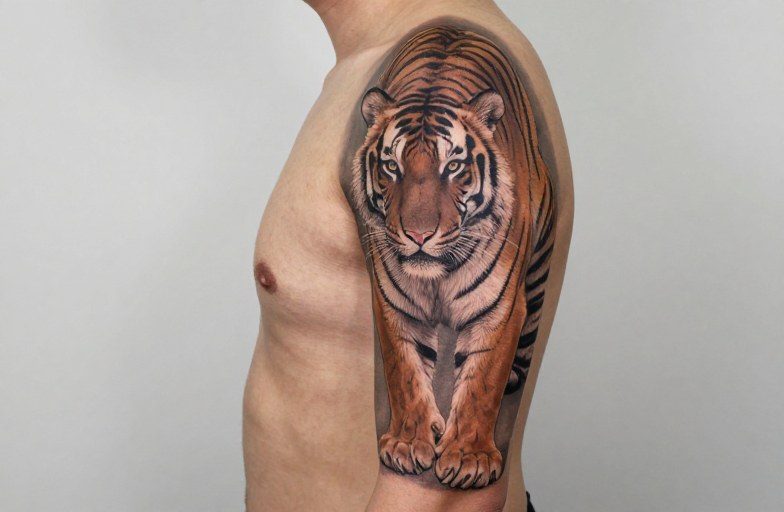
The Japanese tiger tattoo carries layered meaning rooted in centuries of Asian artistic tradition. the tiger represents strength, courage, and protection against malevolent spirits. Beyond brute force, the imagery also embodies the Buddhist ideal of disciplined power, ferocity held in check by spiritual control. Understanding these dual threads helps you choose imagery that actually resonates rather than defaulting to a generic “tough animal” design.
Mythology & Folklore
Tigers prowled through Japanese visual culture long before tattooing codified their image. In Chinese-derived folklore that filtered into Japan, the white tiger (Byakko) guarded the western direction as one of four sacred beasts. This celestial association lent the animal cosmic significance beyond mere earthly predator status.
The Tiger as Demon Queller
Folklore often linked tiger imagery to disease and misfortune prevention. The animal’s fierce countenance was believed to frighten off oni (demons) and plague spirits. This protective function made tiger motifs popular among travelers, soldiers, and those in dangerous professions. In visual art, tigers frequently appeared alongside bamboo, the rustling leaves said to draw the animal’s attention to lurking evil.
The 108 Heroes Connection
The classic Chinese novel Water Margin (known in Japan as Suikoden) influenced Edo-period tattooing profoundly. Several bandit-heroes in the tale bore tiger-related nicknames or emblems, connecting the animal to righteous outlaw courage. Ukiyo-e prints of these scenes became direct reference material for early Japanese tattoo artists, cementing specific poses and compositional approaches still used today.
Religious & Spiritual Angles
Buddhism reshaped how Japanese culture interpreted animal ferocity. Rather than celebrating violence, Zen and esoteric Buddhist traditions viewed the tiger as a model of controlled, mindful power, deadly capability held in disciplined reserve.
The Tiger and the Dragon Duality
Perhaps no pairing carries more weight than tiger and dragon. These two creatures traditionally symbolize complementary cosmic forces: tiger as earth, yin, wind; dragon as heaven, yang, water. Together they represent balanced power, the harmonious tension between opposing energies. Solo tiger designs sometimes reference this duality through background elements, storm clouds, wind bars, or rocky outcroppings that imply the dragon’s unseen presence.
Shugendo and Mountain Asceticism
Some trace tiger protective imagery to Shugendo, the syncretic mountain ascetic tradition. Yamabushi (mountain practitioners) adopted fierce animal iconography as spiritual armor during dangerous wilderness rituals. The tiger’s mountain domain and solitary nature aligned with ascetic ideals of isolation and self-testing against nature’s harshness.
Design Tips & Pairings
Effective Japanese tiger tattooing demands attention to specific visual conventions that separate authentic irezumi from generic big-cat imagery.
Striping and Directional Flow
Japanese tigers feature distinctive stripe patterns: broader, more calligraphic than realistic tiger rendering. Stripes should follow the body’s musculature and movement, never applied as flat decoration. The direction of the tiger’s gaze and body twist matters enormously, looking upward suggests aspiration and vigilance; downward prowling implies active hunting or guarding. Horizontal compositions work for back pieces and chest panels; vertical flowing designs suit arms and legs.
Traditional Background Elements
- Bamboo: Represents resilience and moral integrity; the tiger’s traditional habitat
- Storm clouds and wind bars: Convey movement, spiritual turbulence, the unseen dragon’s presence
- Maple leaves or peonies: Seasonal counterpoints that soften the composition and reference transience
- Rock formations: Ground the animal, provide structural anchors for the design
- Cherry blossoms: Classic Japanese motif that contrasts the tiger’s ferocity with beauty’s fragility
Color versus black-and-grey changes the emotional register significantly. Traditional Japanese color work (red, orange, black, with green accents) reads bolder and more folkloric. Black-and-grey with subtle warm tones feels more contemporary and graphically stark. Both approaches are valid; the choice should align with your broader tattoo collection’s palette.
Best Placements
Japanese tiger tattoos reward large scale. The animal’s coiled dynamism needs room to breathe, small tigers often look compressed and lose their characteristic muscular flow.
Classic Large-Scale Options
Full back pieces remain the canonical placement, allowing the tiger to stretch across shoulder blades with head turned toward one side. This mirrors traditional horimono (full-body tattoo) conventions where the back served as the composition’s central panel. Chest panels work similarly, with the tiger’s head centered over the sternum and body wrapping toward the shoulders.
Thighs and outer arms offer excellent secondary canvases. The arm’s cylindrical shape accommodates tigers in climbing or descending poses. Thighs provide flat planes that suit crouching or prowling compositions. Both locations allow future extension into larger bodysuit work if desired.
Scaling Down Successfully
Smaller tigers demand simplification. Focus on the head alone, snarling muzzle, heavy brow, distinctive striping pattern. Avoid full-body attempts below approximately 8-10 inches; the stripes merge into muddy confusion, and the musculature flattens to generic cat-shape. Tiger heads work well on upper arms, calves, or as part of multi-element sleeves where they share space with other motifs.
Common Variations & Styles
Japanese tiger imagery has spawned recognizable substyles that carry different tonal implications.
Traditional Irezumi Approach
Characterized by bold outlines, flat color fields with minimal blending, and extensive background integration. The tiger’s fur renders as patterned texture rather than realistic hair. This approach prioritizes graphic readability over naturalism. Heavier ink saturation means slower aging and better long-term legibility, traditional Japanese work was designed to last decades.
Neo-Japanese and Contemporary Fusion
Modern practitioners often incorporate realistic rendering techniques, subtle shading, individual hair texture, anatomical precision, while maintaining Japanese compositional conventions. This hybrid style can look striking but requires exceptional technical execution. The risk: realistic elements blur faster than graphic flatness as skin ages and ink spreads slightly. Discuss with your artist how they plan to maintain crispness at five, ten, fifteen years.
Single-Element vs. Narrative Compositions
Solo tiger portraits emphasize the animal’s iconic power. Narrative scenes, tiger descending from rocks, battling serpents, stalking through bamboo, create story tension but require more space and complex background support. Your preference should reflect how you generally respond to tattoo imagery: symbolic concentration or atmospheric immersion.
Personal & Modern Meanings
Contemporary wearers layer personal significance onto traditional foundations without displacing them. The tiger’s established protective association makes it popular among people in high-risk professions, military, emergency services, competitive athletics, who value symbolic armor without explicit institutional imagery.
Recovery narratives also attach naturally. The tiger’s emergence from hardship (storm, darkness, combat) mirrors personal struggle and renewed strength. Unlike phoenix imagery, which emphasizes rebirth’s spectacular nature, the tiger suggests grounded, ongoing vigilance, strength maintained rather than dramatically recovered.
Some choose the tiger specifically for its solitary nature. In an era of constant connectivity, the animal’s self-sufficient hunting and territorial independence resonate as deliberate counterpoints. This isn’t necessarily antisocial; it can signal self-reliance and comfort with one’s own company.
The Bottom Line
Japanese tiger tattoos reward research and purposeful design choices. The imagery carries genuine cultural weight, protective tradition, spiritual discipline, cosmic duality, that generic tiger tattoos simply don’t access. Work with artists who understand irezumi conventions, not just realistic wildlife rendering. Prioritize scale adequate to the composition’s complexity. Choose background elements that create meaning through relationship rather than mere decoration. Done with intention, this design endures beyond trend cycles because it connects to something structurally deeper than personal preference alone.
Frequently Asked Questions
Does a Japanese tiger tattoo need to include bamboo or other background elements?
Not strictly, but traditional compositions gain depth and cultural specificity from integrated backgrounds. Solo tiger portraits work at smaller scales, but the imagery reads as more authentically Japanese when paired with classic elements like bamboo, wind bars, or storm clouds.
How does a Japanese tiger differ visually from a realistic Western tiger tattoo?
Japanese tigers feature broader, more calligraphic stripes that follow body contours expressively rather than replicating natural patterns. The facial structure tends toward heavier brows and more stylized snouts, with muscular definition rendered through graphic line work rather than smooth shading.
Can a Japanese tiger tattoo work on dark skin tones?
Absolutely, though color choices and contrast strategies need adjustment. Deep oranges and reds remain visible; heavy black outlines provide structural clarity. Experienced artists adapt value ranges to ensure the tiger’s distinctive striping and musculature read clearly across all skin tones.
Is there any negative cultural association with Japanese tiger tattoos?
The tiger itself carries broadly positive associations, though full traditional bodysuit work historically connected to organized crime in Japan. Most contemporary wearers outside Japan face no stigma, but understanding this historical context helps avoid naive appropriation of imagery that carries complex social weight in its culture of origin.

Leave a Reply