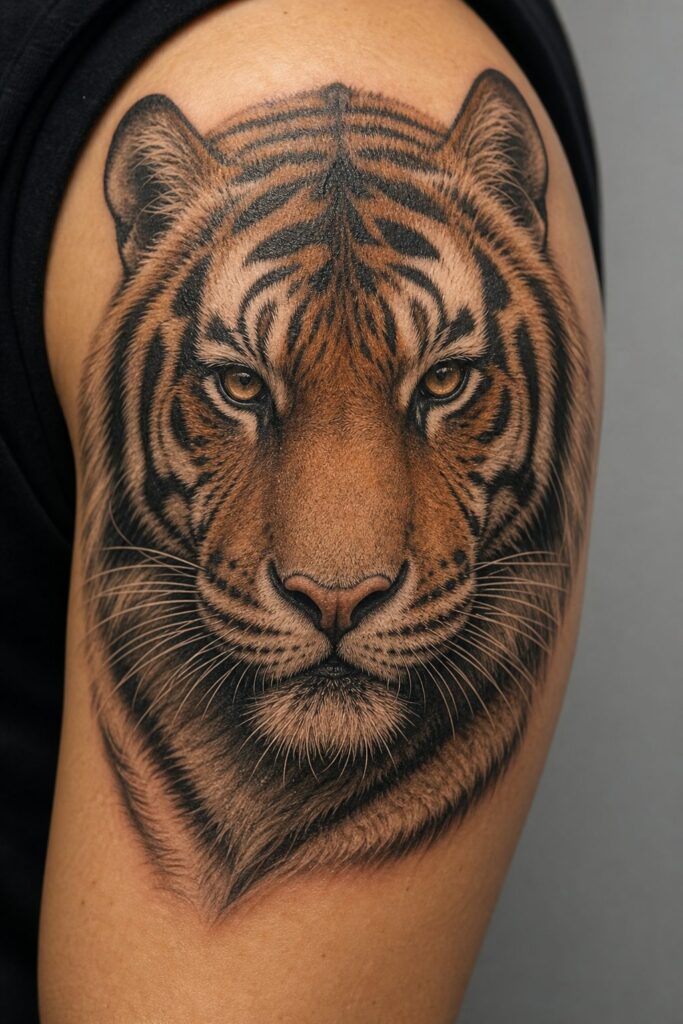
A tiger tattoo carries weight. Across cultures, the animal represents power that doesn’t need to prove itself, protection of what’s yours, and the discipline to wait before striking. Someone wearing this design usually connects to one of three threads: the tiger as guardian, as symbol of personal triumph over hardship, or as an expression of untamed energy held in check.
Color vs Black and Grey
Your choice here changes everything about how the tattoo reads on skin and how it holds up over time.
Color: Orange, Stripes, and Eye Contact
Traditional orange-and-black tiger tattoos pop immediately. The warm tones suit warmer skin undertones, and the high contrast between orange fur and black stripes creates instant readability even from across a room. Color realism demands technical skill, poorly saturated orange can heal into a muddy peach, and cheap pigments sometimes shift toward pink. The eyes, often done in amber or green, become the focal point. In color work, those eyes need to be perfect; they’re where the viewer’s attention lands first.
Color also opens up background possibilities: bamboo forests, red sun discs, water splashes. These elements add narrative but require more skin real estate to avoid looking crowded.
Black and Grey: Texture and Shadow
Black and grey tiger tattoos lean into texture. Stripes become negative space or whip-shaded lines against smooth grey fur. This approach ages more gracefully, no orange to fade or shift, and works across all skin tones. The trade-off: without color, the artist must nail the form. A flat black and grey tiger looks like a generic cat unless the muscle structure, whisker pads, and fur direction are meticulously rendered.
Black and grey suits Japanese-inspired designs particularly well, where bold outlines and background wind bars or cherry blossoms create a graphic, readable image that stays clean for decades.
Design Tips & Pairings
Placement determines what design approach actually works.
- Thigh or calf: Long vertical space suits a stalking or climbing tiger. The muscle movement under the skin can animate the pose.
- Back or chest: Enough room for a full portrait with environment. The shoulder blade area lets the head turn with the body’s natural structure.
- Forearm or outer bicep: Best for a single tiger head or a compact half-body composition. Too much detail in too small a space blurs within five years.
- Ribcage: Painful, but the long canvas suits a leaping or pouncing tiger following the body’s natural lines.
Common Pairings and What They Add
Pairing a tiger with specific elements shifts the meaning without needing to explain:
- With a dragon: Often linked to East Asian symbolism, this pairing represents the balance of opposing forces, tiger as earth/yin, dragon as heaven/yang.
- With lotus flowers: Softens the aggression, suggesting strength that coexists with peace or spiritual growth.
- With clock or hourglass: Personal, sometimes memorial, indicating time’s passage and the enduring nature of the qualities the tiger represents.
- Alone: No distraction from the animal itself. Demands the strongest technical execution.
Line weight matters. Thick outlines on the main form hold the tattoo together as skin ages and blurs; fine lines inside for fur texture provide detail that doesn’t need to stay razor-sharp to read correctly.
Common Variations & Styles
Not every tiger tattoo tries for realism. The style choice should match your actual aesthetic, not just what you think looks toughest.
Traditional and Neo-Traditional
American traditional tiger heads, bold black outlines, limited color palette, simplified features, have been shop staples for decades. They read instantly, heal predictably, and the graphic simplicity means they’ll still look like tigers in thirty years. Neo-traditional pushes further with ornamental elements, jeweled colors, and more anatomical detail while keeping the bold structure.
Japanese (Irezumi)
The Japanese tiger, often rendered with flowing fur, wind bars, and maple leaves or peonies, carries specific cultural weight. In irezumi, the tiger commonly symbolizes protection against evil spirits and bad fortune. The pose matters: a tiger descending a rock faces challenges head-on; one emerging from bamboo suggests hidden strength. These pieces are typically large, often full sleeves or back pieces, because the style depends on background elements to complete the composition.
Realism and Photographic Styles
Photorealistic tiger portraits require reference photos of actual animals, not other tattoos. The best work captures specific individuals, the slight asymmetry of real whiskers, the particular gold of one tiger’s eyes. This style demands large scale and skilled shading; small realistic tigers almost always age into unrecognizable blurs within a decade.
Who Chooses This Tattoo
There’s no single profile, but patterns emerge in placement and design choices.
People drawn to tiger imagery often identify with resilience after difficulty, not the loud, performative kind, but the capacity to endure and respond when necessary. The tiger doesn’t hunt constantly; it conserves energy, strikes with purpose. That resonates with people who’ve learned to choose their battles.
Protective symbolism shows up frequently in parent-focused pieces, tiger with cubs, or a single fierce portrait representing guardianship. Conversely, some choose the solitary tiger to mark independence or a period of self-reliance.
Placement sometimes signals intent. Visible placements (forearm, hand, neck) tend toward the statement of identity; hidden work (ribs, upper thigh, back) often marks private significance or memorial.
How It Ages on Skin
Tiger tattoos face specific aging challenges depending on approach.
Stripes and Fine Detail
The black stripes that define a tiger can spread over time. Lines placed too close together merge into solid black patches. Good artists leave breathing room between stripe elements, especially in smaller designs. In realism, individual fur stripes should vary in width and darkness, uniform stripes look artificial and age worse.
Color Fading
Orange pigment is notorious. Some brands fade toward yellow; others shift pinkish. Quality pigments and proper saturation help, but sun exposure is the real enemy. A color tiger on someone who tans heavily will need touch-ups to maintain the orange intensity. Black and grey avoids this entirely but requires strong contrast between the dark stripes and lighter fur to prevent the whole piece from becoming a single grey mass.
White ink highlights, often used for whiskers or eye reflections, almost always disappear within a few years on most skin tones. Plan for this; good design doesn’t depend on white to read correctly.
History & Cultural Roots
The tiger’s symbolic reach spans continents, though specific meanings vary significantly.
East Asian Traditions
In Korean folklore, the tiger is often linked to courage and is sometimes depicted as a mountain spirit or guardian. Korean tiger tattoos sometimes draw from Minhwa folk painting style, with exaggerated features and bright, flat colors. Chinese tradition commonly associates the tiger with protection against evil and is one of the twelve zodiac animals, representing those born in tiger years as bold and authoritative. The Japanese oni-gashira (demon-faced) tiger in irezumi specifically wards off misfortune and disease spirits.
South Asian and Southeast Asian Context
In India, the tiger carries complex symbolism, associated with Durga’s power and sovereignty, but also with the wilderness that exists beyond human control. Thai sak yant tattoos sometimes incorporate tiger motifs for protection and authority, particularly among those in dangerous professions. Some trace certain tiger tattoo traditions to specific regional temple practices, though individual meanings vary by practitioner and lineage.
Western adoption of tiger imagery largely began through sailors encountering Asian art, then expanded through circus and military iconography in the early twentieth century. The traditional American tiger head descends from this visual mixing, stripped of specific religious meaning and recontextualized as general symbols of ferocity and luck.
Final Thoughts
A tiger tattoo works when the technical execution matches the symbolic weight. The image carries enough cultural resonance that a poorly done tiger looks particularly unfortunate, there’s no hiding behind obscurity. Whether you connect to the guardian aspect, the personal strength, or simply the visual power of the animal, invest in an artist who understands how stripes age, how fur texture reads at scale, and how your specific skin tone will carry the color or grey values.
The meaning you bring matters, but the craft determines whether that meaning remains visible and potent for the life of the piece. Choose accordingly.
Frequently Asked Questions
Do tiger tattoos have negative meanings in any cultures?
In some contexts, the tiger represents uncontrollable danger or chaos rather than controlled strength. Japanese folklore includes man-eating tiger spirits, and certain Southeast Asian traditions associate the animal with specific taboos. Research matters if you’re drawing from a specific cultural tradition rather than generic imagery.
What’s the minimum size for a readable tiger tattoo?
For a head or half-body design, plan on at least palm-sized area, roughly 4 by 5 inches. Smaller than that, stripes merge and facial detail disappears within a few years. Full body compositions need significantly more space to avoid looking like a generic striped cat.
Can a tiger tattoo be covered up easily if I change my mind?
Tiger tattoos are challenging cover-ups due to dense black stripes and large scale. Light, scattered elements might be reworked into a larger design, but heavy black areas limit options. Think of it as permanent; plan accordingly.
How do I choose between a calm tiger and an aggressive snarling pose?
Calm, watchful tigers suggest contained power and patience, better for protective or personal growth meanings. Snarling poses read as active confrontation, suited to marking a specific struggle or warning. The eyes matter more than the mouth; even a closed-mouth tiger can project intense presence through gaze direction.


Leave a Reply