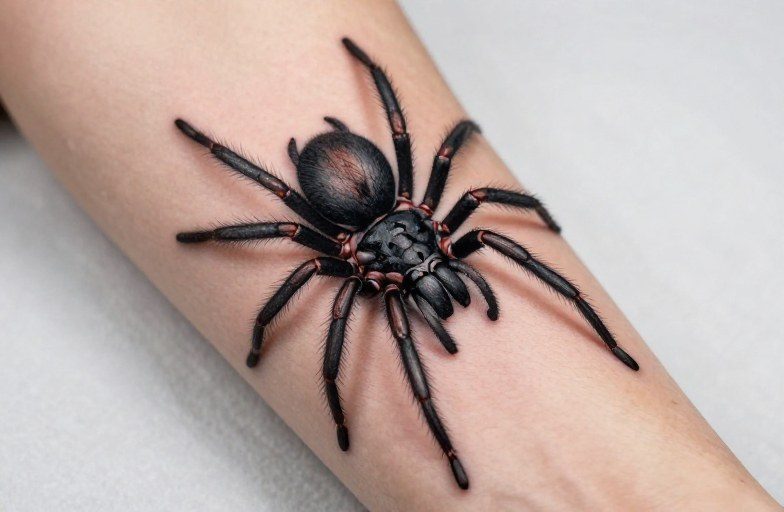
The black widow spider tattoo carries a concentrated punch of meaning: danger, feminine power, seduction, and survival. Most people who choose this image aren’t celebrating literal venom, they’re drawn to the spider’s reputation as a solitary predator, the sexual cannibalism lore, and the stark visual drama of that red hourglass against black. It’s a tattoo that announces someone who shouldn’t be underestimated.
Similar & Related Symbols
Spider imagery runs through tattoo culture with different emphases. Understanding where the black widow sits among them helps clarify what you’re actually saying with this design.
Other Spider Types
The generic spider web, usually elbow or knee, traditionally signals time served, struggle, or entrapment depending on context. Tarantulas read more masculine, heavy, grounded. Orb-weavers with their circular webs emphasize creativity and patience, the “weaver” archetype. The black widow specifically isolates the dangerous feminine; no other spider carries that loaded sexual mythology. If you want general spider energy without the femme fatale sting, you’d pick something else.
Adjacent Danger Symbols
- Snakes: transformation, rebirth, but less gendered in their threat
- Scorpions: similar arachnid danger, more desert-warrior coded
- Daggers through roses: romantic danger, but more theatrical
- Skulls: mortality, less active menace
The black widow compresses danger into a small, elegant package. That economy matters for placement and visual impact.
Design Tips & Pairings
How you render this spider determines whether it reads as elegant warning or edgy cliché. The red hourglass is non-negotiable for recognition, without it, you’ve got a generic black spider.
Line Work vs. Shading
Bold black lines with minimal shading keep the graphic punch; this ages cleaner on smaller scales. Heavy black-fill with red accent (the hourglass, maybe eyes) creates that classic tattoo flash look. Photorealistic rendering works but demands serious skin real estate, think thigh, ribs, upper back. Fine-line black widows exist now, but the spider’s natural hard edges and high contrast actually suit traditional boldness better. Over time, fine lines blur and the spider’s leg segmentation, that crucial spindly silhouette, can muddy into a black blob.
Smart Pairings
- Web background: obvious but effective; negative-space webs behind the spider add depth without clutter
- Dripping venom or blood: pushes into horror territory; know your audience
- Floral elements (dead roses, black lilies): softens the aggression, creates tension between beauty and danger
- Text banners: risky; “fatal” or “beauty” spelled out rarely improves the image
Placement shapes meaning too. Throat or hand: unapologetic confrontation. Ribs or hip: more intimate, revealed selectively. Behind the ear: small, almost secret, the hourglass a private warning.
History & Cultural Roots
The black widow’s tattoo presence grew alongside American traditional tattooing, but the symbol’s weight predates the needle.
Scientific Naming & Popular Fear
The common name “black widow” emerged in the early 20th century, referencing the female’s habit of consuming males after mating. That biological fact got amplified by pulp magazines, film noir, and eventually true crime into a cultural archetype: the beautiful woman who destroys men. The tattoo inherits this entire sedimented history. When someone marks themselves with this image, they’re tapping into decades of that specific narrative, not just nature documentary material.
Military & Subcultural Adoption
Naval and military tattoo culture often linked spiders to time spent waiting, killing time, “spider” as idle web-spinner. The black widow variant sometimes appeared as a darker joke, a warning about women back home or the dangerous allure of foreign ports. Biker and outlaw cultures adopted it too, the hourglass becoming a kind of anti-marriage symbol, or a mark of someone who’d survived a destructive relationship. These aren’t universal meanings, but they’re part of the symbol’s background noise.
Common Variations & Styles
The black widow adapts across tattoo genres, though some translations work better than others.
American traditional: thick black outlines, limited red, stylized hourglass, often with a web or heart motif. This is the baseline, how most people picture the tattoo. Neo-traditional: more dimensional shading, jewel-toned reds, perhaps decorative borders. Japanese-inspired: not common, the spider doesn’t carry traditional irezumi meaning, though some artists weave it into larger nature compositions. Blackwork: the spider becomes pure silhouette, the hourglass cut out as negative space or minimal red. This reads modern, stark, almost abstract.
Some people go literal-anatomical: correct leg count, proper eye arrangement, abdominal segmentation accurate. Others stylize into almost cartoon danger, the hourglass oversized, legs exaggeratedly long. Both work; they just say different things. The accurate version signals knowledge, perhaps a background in biology or genuine arachnid interest. The stylized version embraces the myth, the archetype over the creature.
Mythology & Folklore
Spiders globally carry creation and trickster energy, think Anansi, the Navajo Spider Woman, the Greek Arachne. The black widow specifically, though, lacks deep mythological roots; it’s a modern American symbol built from observation and anxiety.
The Femme Fatale Archetype
What the black widow lacks in ancient myth it makes up in 20th-century folklore. Film noir named actual characters “Black Widow.” True crime adopted the term for female killers. The tattoo thus connects less to sacred stories and more to pulp mythology, urban legend, the dangerous woman as cultural obsession. That doesn’t diminish its power; it just means the meaning is more contemporary, more consciously chosen.
Gendered Reversals
Men wearing black widow tattoos often intend irony or identification with the consumed male, survived her, or willing victim. Women wearing it reclaim the dangerous label, sometimes with explicit feminist intent, sometimes simply because the image resonates. The symbol’s flexibility here is genuine; the same spider can mark predator or survivor, warning or badge.
Personal & Modern Meanings
Beyond the cultural sediment, people bring individual reasons that reshape the symbol.
Surviving toxic relationships: the black widow as emblem of what was endured, or what was escaped. Some frame it as “I lived through the venom.” Sexual autonomy: embracing the dangerous feminine without apology, particularly for women who’ve been shamed for assertive sexuality. Medical battles: the hourglass as time running, urgency, the body as site of hidden threat. This overlaps with broader memento mori tradition but specifies the hidden, internal danger.
Isolation and self-sufficiency: black widows are solitary, territorial. The tattoo marks someone who operates alone by choice or necessity. There’s no collective spider; the symbol suits individualists.
Modern iterations sometimes subvert the red hourglass, green for toxic-exposure survivors, purple for domestic violence awareness, though these aren’t standardized codes and shouldn’t be assumed without context.
What to Remember
The black widow spider tattoo works because it’s instantly readable: danger, beauty, feminine power, the hidden threat. That clarity is its strength and its risk. Done poorly, it’s generic edgy imagery; done with intention, it carries specific weight.
Key practical notes: the red hourglass must read clearly or the symbol fails; small-scale work demands bold lines over fine detail; consider how the spider’s orientation reads, hanging downward (active, aggressive) versus centered (emblem, badge). Think about whether you want the mythic archetype or the actual creature; that choice shapes style, placement, and what you communicate.
Most importantly, this tattoo asks for confidence. The black widow doesn’t apologize or explain. Neither should the person wearing it.
Frequently Asked Questions
Does a black widow tattoo always mean someone is dangerous?
Not literally. Most people choose it for symbolic resonance, survival, feminine power, or having endured something toxic. The danger is metaphorical, a warning against underestimating the wearer.
How well does a black widow tattoo age over time?
Bold black lines and solid red age best. Fine detail in leg segmentation blurs within years, especially on high-movement areas like wrists or ankles. Plan for touch-ups or start with a slightly larger, graphic version.
Is the black widow tattoo only for women?
No, though the symbol carries feminine-coded energy. Men often wear it with ironic or survivor intent, having ‘survived’ a black widow, or identifying with the consumed male as willing participant.
What’s the most common placement for this tattoo?
Thigh, ribs, upper arm, and shoulder blade lead. These offer enough flat surface for the spider’s shape to read clearly, and allow scaling from small and hidden to large and dramatic.

Leave a Reply