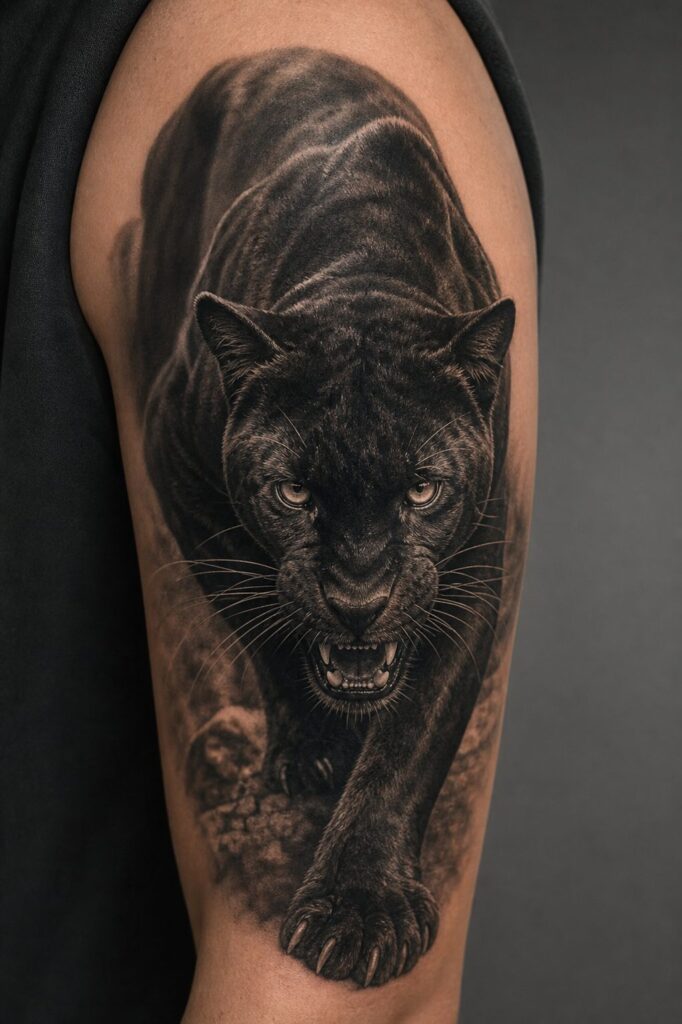
A black panther tattoo primarily signals power that moves quietly, strength without performance, dominance without announcement. The image draws from the melanistic leopard or jaguar, the same animal rendered invisible in shadow until it decides otherwise. That quality of controlled, patient force forms the core of what people seek when they choose this design.
Mythology & Folklore
Bagheera and the Panther’s Shadow
Rudyard Kipling’s The Jungle Book fixed the black panther in Western imagination as the mentor who operates outside pack hierarchy. Bagheera moves alone, negotiates with predators and prey alike, and protects the vulnerable without seeking dominance. This archetype, competence without ego, translates directly to tattoo choice. People who identify with the panther often reject the wolf-pack model of loyalty or the lion’s performative leadership. The panther leads by being undeniably capable, not by demanding recognition.
African and Diaspora Traditions
Among the Bambara people of Mali, the panther often linked to powerful female spirits and warriors who fought in ways that didn’t match male combat norms. In some Afro-Brazilian and Afro-Caribbean traditions, the black panther connects to entities that cross boundaries between visible and hidden worlds. These aren’t universal associations, specific lineages vary, but the through-line remains: the panther operates where others cannot see clearly, and that liminal power commands respect.
Symbolism & Core Meaning
Stealth as Strategy
Unlike the tiger’s striped warning or the lion’s visible mane, the black panther’s advantage is absence. Its coat absorbs light. This makes the tattoo a statement about strategic invisibility, choosing when to reveal strength, when to withhold it. The design appeals particularly to people in competitive fields, protective roles, or situations where obvious power would invite challenge rather than deter it.
Feminine Power and the ‘Dark Mother’
The panther carries unusually strong feminine associations for a large predator tattoo. In contrast to the lion’s male pride structure, female panthers hunt alone, raise young independently, and defend territory personally. This has made the symbol resonant for women rejecting domesticated or decorative tattoo imagery, and for anyone claiming self-sufficient protective capacity. The “dark mother” archetype, fierce, nurturing, uncompromising, finds visual form here more naturally than in softer animal alternatives.
Color vs Black and Grey
Placement and technique shift meaning more than people expect. Solid black panther designs, heavy saturation, minimal grey wash, read as aggressive, almost confrontational. The old-school crawling panther, thick with black ink, was prison and military shorthand for “don’t test me.” That lineage still carries weight.
Black and grey realism softens the image without weakening it. Photographic panther portraits, eyes catching light against dark fur, emphasize intelligence and watchfulness over threat. These age better on most skin tones than solid black, which can blue out and lose edge definition within five to seven years. The grey-wash panther also adapts better to cover-ups, since its tonal range can incorporate existing ink underneath.
Color panther tattoos are rare and usually incorporate the actual leopard rosette pattern, gold, cream, black spots, rather than true melanistic black. These read differently: more naturalistic, less symbolic, closer to wildlife appreciation than personal archetype. The choice between approaches matters more than most clients initially consider.
Similar & Related Symbols
Panther vs Leopard vs Jaguar
Tattoo artists hear these terms conflated constantly. The black panther is a melanistic leopard (Africa/Asia) or jaguar (Americas), same species, different pigment. In tattoo imagery, the distinction rarely matters visually, but jaguar-associated panther designs sometimes include Mesoamerican elements: stepped patterns, obsidian references, or open-jawed poses from Olmec and Maya iconography. Leopard-derived panther tattoos more often carry African or Asian compositional influences.
The Tiger Alternative
Tiger tattoos announce themselves. The stripe pattern demands attention, carries explicit Eastern martial-arts associations, and reads as competitive energy. Panther tattoos occupy adjacent territory but feel more contained, more self-directed. People who considered both and chose panther usually wanted power without the cultural baggage of tiger imagery, or preferred the panther’s nocturnal, solitary associations to the tiger’s daylight dominance.
History & Cultural Roots
The black panther as political symbol emerged in 1966 with the Black Panther Party, and that resonance persists. Party co-founder Bobby Seale chose the animal specifically for its reputation of not attacking unless pushed, but defending fiercely when provoked. This history means the tattoo carries explicit political weight for some wearers, unintended political association for others who simply wanted the animal. Neither reading is wrong, but awareness matters, particularly for white wearers who may be perceived as claiming or coopting imagery with specific liberation context.
Earlier, the “jungle cat” tattoo style developed through 1940s-50s American tattooing as part of the broader animal-catalog approach: eagles, panthers, snakes, each rendered in bold outline with limited color. These were flash designs, chosen from wall sheets, carrying generalized masculine energy rather than personal symbolism. The panther’s persistence while other flash animals faded speaks to its visual impact and adaptable meaning.
Personal & Modern Meanings
Placement and Scale
Small panther tattoos, wrist, ankle, behind ear, rarely work well. The animal’s power depends on mass and presence; shrinking it to decorative size loses the point. Effective placements include the upper arm/shoulder (the classic crawling pose, claws extended), thigh (frontal or crouching compositions with room for environmental detail), and back (full spinal or shoulder-blade spread). Rib placements suit the panther’s coiled, protective posture but hurt significantly and stretch with torso changes.
Who Gets This Tattoo Now
Contemporary panther wearers include protective parents, people leaving high-control environments who reclaimed their own judgment, combat veterans who prefer the panther’s contained readiness to more explicit military imagery, and women claiming physical competence in contexts that punish visible strength. The common thread isn’t aggression, it’s self-possession. The panther doesn’t perform for observers; it simply is dangerous, and knows it.
Key Takeaways
- The black panther tattoo centers on controlled, non-performative power, strength that doesn’t announce itself.
- Feminine and protective associations are historically grounded, not modern additions.
- Solid black traditional designs carry harder, more confrontational energy than black-and-grey realism.
- Political history (Black Panther Party) creates layered meaning that wearers should understand, not ignore.
- Placement matters: the panther needs scale to maintain symbolic weight; small decorative versions lose impact.
- Related animal tattoos (tiger, lion, wolf) make different statements about how power operates socially.
Frequently Asked Questions
Does a black panther tattoo always have political meaning?
Not necessarily. Many wearers choose it for personal symbolism, stealth, protection, feminine power, without political intent. But the Black Panther Party history means the image carries that resonance regardless, so understanding the dual context matters.
Will a solid black panther tattoo age well over time?
Heavy black saturation tends to blur and blue out within five to seven years, especially on areas with movement or sun exposure. Black and grey realism generally ages more gracefully and allows future touch-ups or modifications.
What’s the difference between a panther and jaguar tattoo?
Visually, not much in tattoo form. Technically, a black panther is a melanistic leopard or jaguar depending on geographic origin. Jaguar-derived designs sometimes incorporate Mesoamerican stylistic elements, while leopard-derived ones may carry African or Asian compositional influences.
Is the black panther tattoo mainly for women?
No, though it carries unusually strong feminine associations for a predator tattoo. The panther appeals across genders to anyone identifying with self-sufficient protective power, strategic patience, or strength that doesn’t require external validation.
Leave a Reply