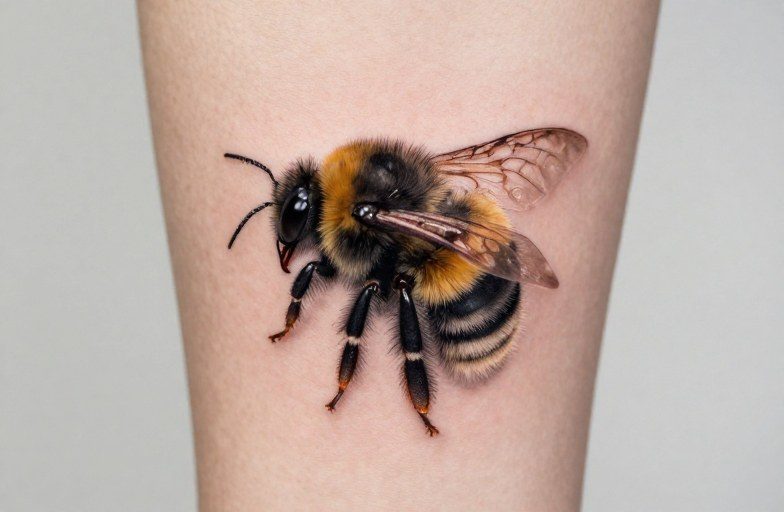
A bumble bee tattoo most commonly represents diligence, cooperation, and the courage to act despite one’s size. The insect’s fuzzy, almost clumsy appearance carries an underdog appeal, something small that contributes enormously to its ecosystem. You might choose one to mark a personal work ethic, a connection to nature, or a reminder that consistent effort matters more than brute strength.
What the Bumble Bee Actually Represents
The bumble bee’s symbolic weight comes from observable behavior, not abstract mythology. These insects fly despite aerodynamic theories that once claimed they shouldn’t be able to. They pollinate plants that would otherwise fail. They live in highly organized colonies where individual survival depends on collective function. Those biological realities translate naturally into human values.
Work and Productivity
“Busy as a bee” isn’t empty phrasing. Worker bees literally work themselves to death in about six weeks during summer. A bumble bee tattoo can mark a period of intense labor: starting a business, raising children, completing a degree, without romanticizing burnout. The image acknowledges grind as part of life, not something to transcend.
Community and Belonging
Unlike solitary wasps, bumble bees exist in colonies of 50 to 500 individuals. Queens don’t survive alone; workers can’t reproduce alone. The tattoo sometimes marks chosen family, team membership, or the recognition that individual identity depends on mutual support. This resonates particularly for people who’ve found their people after isolation.
Resilience and the Underdog
The bumble bee’s flight was once misunderstood by physicists who applied fixed-wing aircraft equations to its flexible, flapping motion. The story of the bee that “shouldn’t fly but does” is scientifically outdated, but the metaphor persists because it captures something real. Small creatures accomplish what larger analysis predicts is impossible. You might wear this as a private argument against doubt, yours or other people’s.
Religious and Spiritual Angles
Bees carry scattered but significant spiritual associations across traditions, though none dominate the symbolism. In some Christian iconography, bees represent the soul’s industry and the sweetness of spiritual discipline. Monastic communities in medieval Europe often kept bees, and the honey produced symbolized the fruits of contemplative labor. Celtic traditions often linked bees to wisdom and the threshold between worlds; they were thought to possess secret knowledge.
Contemporary spiritual adopters sometimes use the bee as a totem of manifestation: the idea that focused, repetitive action produces tangible results. This overlaps with secular productivity culture but roots the concept in natural process rather than capitalist optimization. The bee doesn’t manifest abstractly; it physically transfers pollen and makes honey.
Mythology and Folklore
Bees appear in folklore from multiple continents, though their role varies significantly. Ancient Egyptian associations with royalty and rebirth are often linked to the tears of the sun god Ra. Greek mythology commonly associated bees with nymphs called Meliae, and some trace the infant Zeus’s feeding to honey in a Cretan cave. These stories rarely appear directly in tattoo choices, but they layer possible resonance for people drawn to Mediterranean or Near Eastern heritage.
European Folk Beliefs
In British and Irish folklore, bees were treated almost as household members. Families “told the bees” about deaths, marriages, and births. Swarming bees might signal coming fortune or disaster depending on timing. A tattoo drawing on this tradition might emphasize the bee’s role as messenger between human and natural worlds, or between living and dead.
African and Diasporic Connections
Some West African traditions associate bees with ancestral communication. In parts of the African diaspora, honey and bees appear in certain ritual contexts. These associations are less commonly referenced in mainstream tattoo culture but offer meaningful depth for people with relevant heritage.
Where to Place Your Bumble Bee Tattoo
Bumble bee tattoos work across scales from thumbnail-sized to palm-covering. The insect’s natural shape, round thorax, elongated abdomen, angled wings, adapts to curved body surfaces better than rigid geometric designs.
- Behind the ear: Small, single bees here read as secretive or personal. The placement suits minimalist linework. Healing requires care; hair products and pillow friction complicate aftercare.
- Shoulder or collarbone: The bee’s flight path angles naturally along the clavicle or deltoid curve. Slightly larger designs, two to three inches, allow for the fuzzy thorax texture that distinguishes bumble bees from wasps or honeybees.
- Forearm or wrist: Visible but coverable. A bee here often faces forward in flight, creating directional movement along the arm. Inner wrist placement risks faster fading from sun exposure and friction.
- Ribcage: Accommodates compositions with flowers, honeycomb, or multiple bees. The canvas size allows for color gradients in the yellow-black banding. Pain level runs high; the ribs move constantly during breathing, which challenges steady needle work.
- Ankle or foot: Popular for first tattoos. The bee’s compact form fits the limited space. Be aware that foot tattoos fade faster than almost anywhere else; shoes, socks, and walking create relentless abrasion.
Color versus black-and-grey affects placement logic. Yellow and orange pigments fade fastest in sun-exposed areas. A brightly colored bee on the hand or forearm will need touch-ups sooner than one on the torso.
Design Tips and Pairings
The difference between a bumble bee and a generic bee tattoo often comes down to specific visual choices. Bumble bees have visibly fuzzy bodies, achieved through stipple shading, fine line texture, or deliberate negative space. Their abdomens are more rounded than honeybees. Their wings are shorter relative to body size.
Common Pairings
- Flowers: Not decorative filler but ecological accuracy. Bumble bees perform buzz pollination, vibrating specific frequencies to release pollen from certain flowers. Tomatoes, blueberries, and snapdragons depend on this. Pairing a bee with its actual food source adds botanical specificity.
- Honeycomb: Geometrically striking but technically inaccurate; bumble bees don’t produce significant honey stores. Honeybees build the hexagonal wax structures people picture. If you want honeycomb, consider whether you mean a honeybee specifically, or whether the geometric appeal outweighs biological precision.
- Script or lettering: Short phrases work integrated into flight paths or banner shapes. The bee’s natural movement creates dynamic negative space for text. Avoid cramming long quotes into small spaces; lettering below one-quarter inch tall blurs within years.
Line Weight and Style Considerations
Traditional American styling suits the bee’s bold silhouette: thick black outlines, limited color palette, strong readability at distance. Fine-line single needle work captures hairy texture but requires a skilled artist; wobbly lines in delicate work age poorly. Neo-traditional approaches allow for more saturated color and dimensional shading while maintaining clarity.
Watercolor backgrounds behind a structurally solid bee create contrast without sacrificing longevity. The bee itself needs defined edges to hold up; surrounding splashes can soften and blur without destroying the image.
Common Variations and Styles
Beyond the standard flying profile, several variations carry distinct tones.
- Anatomically precise: Scientific illustration style, often with labeled parts or Latin names. Appeals to biologists, gardeners, naturalists. Requires an artist comfortable with technical accuracy.
- Cute or kawaii: Rounded features, exaggerated eyes, sometimes smile lines. Popular in smaller sizes, often with hearts or flowers. Reads as approachable rather than intense.
- Skull-faced or gothic: The bee’s natural black-yellow patterning adapts to memento mori themes. Some designs replace the head with a tiny skull or integrate the bee into larger death-positive compositions.
- Mechanical or steampunk: Gear-work wings, clockwork bodies. The bee’s industriousness translated into industrial imagery. Works best at medium to large scale where mechanical detail remains readable.
- Minimalist: Single continuous line, or basic silhouette. Maximum longevity, minimum detail. The round thorax and striped abdomen remain recognizable even highly abstracted.
Before You Decide
A bumble bee tattoo succeeds when its specific biology matches your specific reason. The general symbolism, hard work, community, persistence, applies broadly, but the image gains weight when you know why you chose a bumble bee rather than a honeybee, a wasp, or an ant. Consider the actual insect: its fuzz, its flight, its preference for cool mornings when honeybees stay home. Consider whether you want accuracy or approximation, color that pops or black-and-grey that endures.
You will live with this longer than the impulse that suggested it. The best bumble bee tattoos belong to people who looked closely at the real creature first, who can explain why this particular small, loud, improbable flyer belongs on their particular skin.
Frequently Asked Questions
What is the difference between a bumble bee tattoo and a honeybee tattoo?
Bumble bees have rounder, fuzzier bodies and shorter wings relative to their size. They don’t produce significant honey stores, so honeycomb pairings are biologically inaccurate. Honeybees have sleeker abdomens and are more commonly associated with organized agriculture and traditional beekeeping imagery.
Do bumble bee tattoos have to be yellow and black?
No, though those colors are most recognizable. Some people choose blue or purple bees for personal aesthetic reasons, or black-and-grey for longevity. If you want color, be aware that yellow and orange fade fastest in sun-exposed placements like hands and forearms.
Are bumble bee tattoos only for women?
Not at all. The symbolism of work, community, and resilience applies universally. Style choices vary, but the core meaning is gender-neutral. Traditional bold styling tends to read more masculine in Western tattoo culture; fine-line or watercolor approaches are often perceived as feminine, though these associations are increasingly outdated.
How much does a bumble bee tattoo typically cost?
Prices vary enormously by artist, city, and complexity. A small simple bee might take an hour; a detailed composition with flowers could require multiple sessions. Most reputable artists charge by the hour or by piece. Focus on finding an artist whose healed work you trust rather than hunting for the lowest price.
Leave a Reply