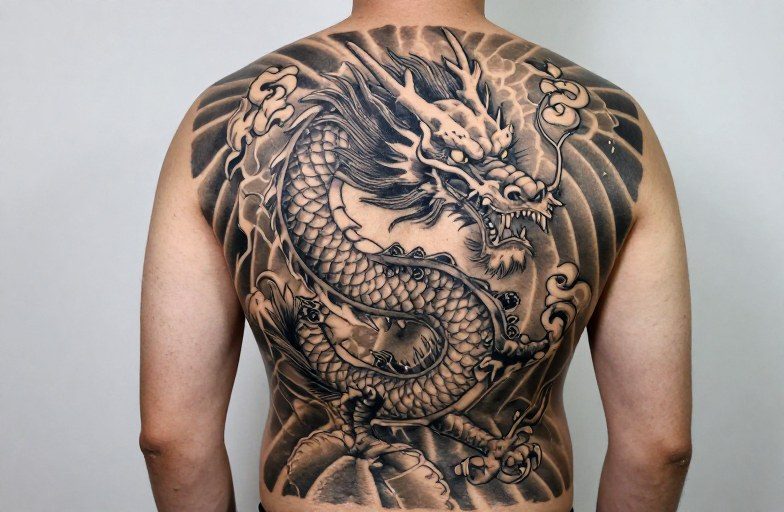
A Japanese dragon back tattoo represents wisdom, strength, and protection, with the full-back placement allowing the dragon’s coiling, serpentine body to move naturally across the spine and shoulder blades. Unlike Western dragons, the Japanese ryu is typically wingless and water-associated, symbolizing mastery over oceans, rainfall, and rivers. On the back, this imagery connects to the idea of carrying power behind you, literally at your back, while the scale of the canvas lets the artist render the full creature with claws, whiskers, and flowing mane intact.
Symbolism & Core Meaning
The Japanese dragon absorbs and blends multiple symbolic threads. It’s neither purely benevolent nor simply destructive; instead, it occupies a liminal space of controlled, earned power.
Water, Weather, and Agricultural Blessing
Japanese dragons are fundamentally water creatures. Temple and shrine art frequently depicts them ascending from or descending into waves, summoning rain, or guarding bodies of water. This association makes the dragon a symbol of life-giving force rather than fire-breathing destruction. For a back piece, artists often place the dragon’s head near the upper back or neck, with the body winding down toward the waist, mimicking the flow of water down a slope.
- Claws typically number three for Japanese dragons (five for imperial Chinese dragons, four for common Chinese)
- Whiskers and a flowing mane distinguish the ryu from Korean and Chinese variants
- Jewel or pearl held in the claw represents spiritual wisdom or the moon
Protection and Guardian Function
Dragons in Japanese Buddhist tradition guard temples and sacred spaces. A back tattoo draws on this protective quality, you’re wearing a guardian that faces outward, covering your rear. This differs from chest placement, which faces the world directly; the back dragon has your back, literally, in a way that feels more private and internal.
Mythology & Folklore
Japanese dragon mythology weaves together indigenous Shinto water deities, Chinese dragon lore imported during the Asuka period, and later Buddhist adaptations. The creature appears in countless tales, but a few recurring patterns shape how tattoo artists compose back pieces.
The Ascending and Descending Dragon
One core motif shows dragons ascending toward heaven or descending toward earth. An ascending dragon (nobori-ryu) symbolizes ambition, spiritual growth, and rising fortune, common for upper-back compositions where the dragon climbs toward the neck. A descending dragon (kudari-ryu) brings blessings down to earth, often rendered with the head lower and tail higher, sometimes coiled around a Buddhist sword or jewel.
The famous legend of Ryujin, the dragon god of the sea, shapes many compositions. His underwater palace, the Ryugu-jo, appears in the Tale of the Bamboo Cutter and other classics. Artists sometimes incorporate sea imagery, waves, fish, coral, around the dragon’s body to anchor this narrative.
The Dragon and the Tiger
While not required, many back pieces pair dragon with tiger. This combination represents balanced opposing forces: dragon as wind/heaven/spirit, tiger as earth/physical strength. On a full back, the dragon might occupy the left side with tiger on right, or dragon above and tiger below, creating a dynamic tension across the shoulder blades.
History & Cultural Roots
Japanese tattooing (irezumi) developed its dragon imagery through centuries of cross-cultural exchange and class association. Understanding this history helps avoid flattening a complex symbol into mere exotic decoration.
From Punishment to Art Form
Decorative tattooing in Japan emerged partly from punitive tattooing practices, where criminals received marks. By the Edo period (1603, 1868), decorative irezumi had developed into a sophisticated art form, with woodblock prints (ukiyo-e) providing the visual vocabulary that tattoo artists still reference. Dragons in these prints, often copied from Chinese originals or imagined through Japanese interpretation, became standard tattoo subjects.
The full-body suit (including back-focused pieces) became associated with working-class identity, firemen, and later yakuza. This class association means Japanese dragon tattoos carry social weight that differs from their meaning in, say, American traditional tattooing. A back dragon references this lineage whether the wearer intends it or not.
Post-War Globalization
After Japan’s 1948 legalization of tattooing, artists began engaging with international clients. The dragon back piece became a signature request from non-Japanese collectors seeking large-scale Japanese work. This export has sometimes stripped context, but serious artists still study classical compositions from Hokusai, Kuniyoshi, and other print masters.
Religious & Spiritual Angles
Japanese dragons occupy multiple religious registers simultaneously. A back tattoo touches on these layers depending on accompanying imagery and the wearer’s intent.
Buddhist Protectors and Cosmology
In Japanese Buddhism, dragons often appear as protectors of the dharma. The Eight Great Dragon Kings (hachidai ryu-o) appear in the Lotus Sutra, guarding sacred teachings. Temple roofs frequently feature dragon-shaped ornaments called onigawara, believed to protect against fire, ironically, given Western fire-dragon associations.
For tattoo purposes, this means a dragon paired with lotus flowers, Buddhist scriptures, or temple architecture carries explicitly religious weight. Without these elements, the dragon reads more broadly as spiritual power rather than doctrinal commitment.
Shinto Water Deities
Shinto recognizes numerous water kami (spirits) that predate or parallel dragon imagery. The dragon form sometimes serves as a visual representation of these forces. This indigenous layer adds depth that purely Chinese-imported dragon imagery lacks. A back piece incorporating Shinto shrine gates (torii), shimenawa ropes, or specific natural features can activate this reading.
Similar & Related Symbols
Japanese tattooing offers several alternatives or complements to the dragon that share thematic territory. Understanding these helps clarify what the dragon specifically does and doesn’t represent.
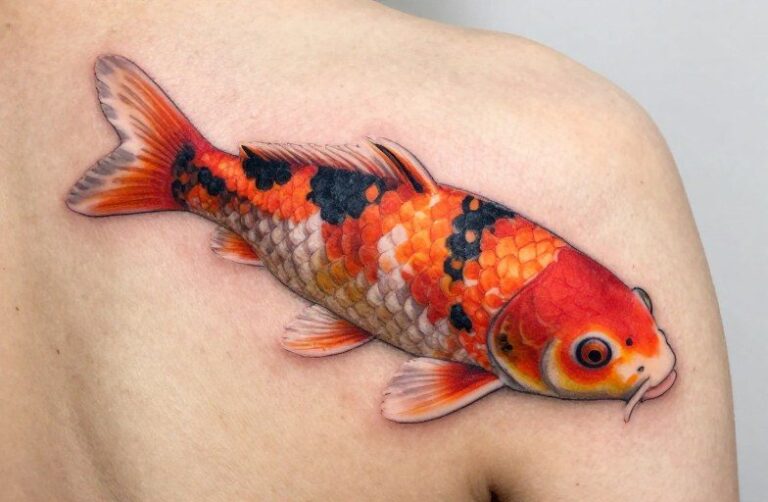
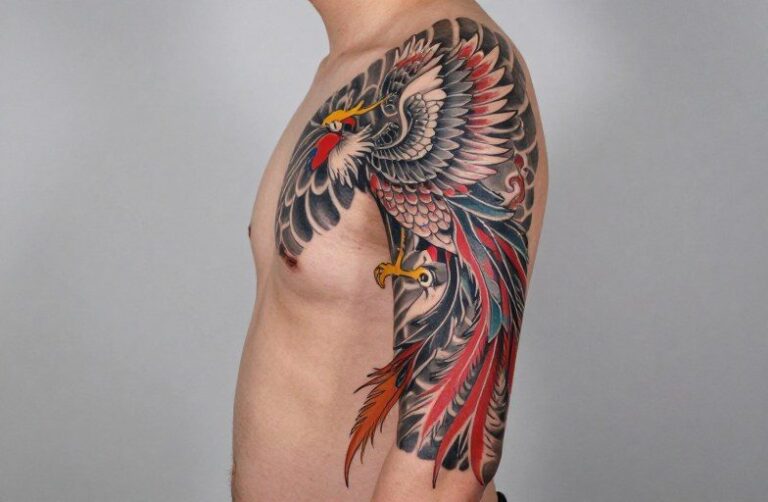
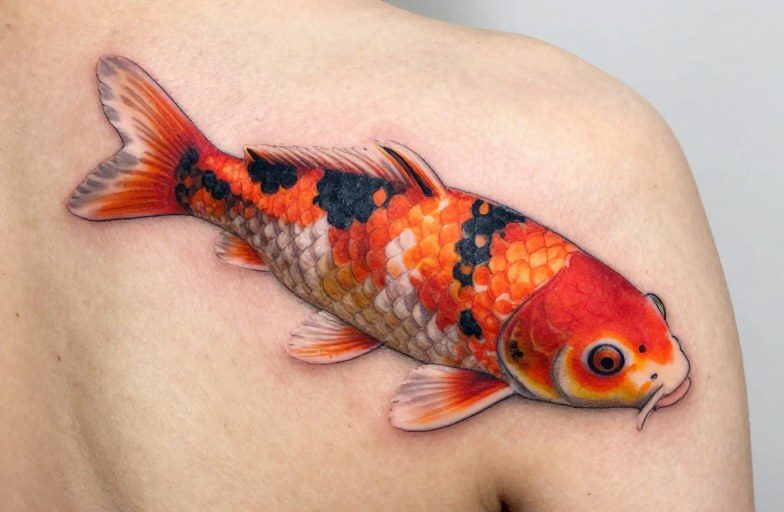
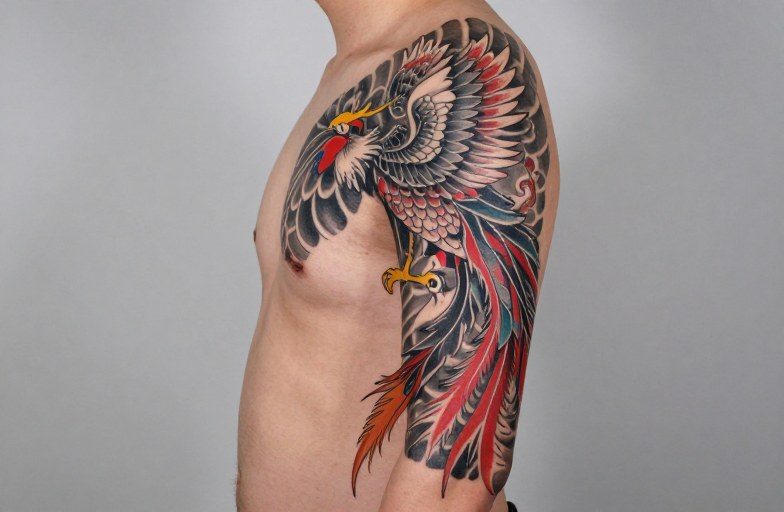
The phoenix (hou-ou) shares the dragon’s celestial, powerful nature but emphasizes rebirth and feminine/yin energy where dragon reads as masculine/yang. Pairing them creates a marriage or cosmic balance motif. The koi fish, especially in ascending waterfall compositions, represents perseverance and transformation, similar to the ascending dragon but grounded in concrete struggle rather than inherent supernatural power.
- Snake (hebi): earth-bound, sometimes antagonistic to dragon; more dangerous and cunning
- Kirin: gentle, auspicious beast; less raw power, more good omen
- Oni (demons): chaotic force requiring control; dragon masters what oni disrupts
Foo dogs (komainu) and actual tigers serve protective functions comparable to dragon, but without the water association and with more static, guardian-like poses. A back piece mixing dragon with any of these creates narrative relationships, conflict, alliance, seasonal progression, that skilled artists compose deliberately.
How It Ages on Skin
The back ages relatively well for large tattoos: less sun exposure than arms or hands, stable skin without the constant flexing of elbows or knees. But dragon back pieces present specific technical challenges that affect long-term appearance.
Scale Detail and Line Work
Dragon scales require fine line work that spreads over time. On the upper back near the neck, where skin stretches with head movement, tightly packed scales can blur together after 5-10 years. Experienced artists vary scale size by body zone, larger, bolder scales on mobile areas, finer detail on the relatively stable mid-back. The dragon’s belly (often rendered in lighter color or negative space) must be wide enough that it doesn’t disappear as surrounding ink settles.
Color vs. Black and Grey
Traditional Japanese back pieces use bold color: green scales, red accents, yellow or gold details. These pigments hold reasonably well on protected back skin but require periodic refresh. Black and grey Japanese dragons, while less traditional, age more gracefully with less obvious fading. The whiskers and hair-like mane, rendered in fine lines, are typically the first elements to soften, sometimes requiring touch-up within a few years.
Back skin also tends toward dryness, especially along the spine. This affects how ink sits in the skin and how colors read. Moisturizing matters for longevity, as does avoiding the heavy sun exposure that turns bold greens to muddy grey-brown.
The Bottom Line
A Japanese dragon back tattoo carries genuine cultural weight: water mastery, wisdom, protection, and the specific history of irezumi as an art form. The full-back placement lets the dragon’s serpentine body flow naturally, but demands technical decisions about scale detail, color longevity, and composition that simpler placements avoid. It’s not a design to choose casually or wear without understanding its lineage. Done well, with respect for the tradition and attention to how the image will live on skin for decades, it remains one of the most powerful compositions in tattooing.
Frequently Asked Questions
How long does a full Japanese dragon back tattoo take to complete?
A full-back piece typically requires 40-80 hours across multiple sessions, spaced weeks apart for healing. The dragon’s complexity, scales, claws, background elements like waves or wind bars, determines the higher or lower end of that range.
Can a Japanese dragon back tattoo include other elements like cherry blossoms or waves?
Yes, and traditionally they often do. Waves reinforce the dragon’s water association, while cherry blossoms or maple leaves can indicate spring or autumn, adding seasonal and temporal layers to the composition.
Is it culturally appropriative for non-Japanese people to get this tattoo?
This depends on approach and context. Working with a Japanese-trained artist, understanding the symbolism, and avoiding yakuza-specific stylistic markers (like specific finger configurations or exclusive family crests) matters more than ethnicity alone. Many Japanese artists actively share this art form internationally.
What’s the difference between a Japanese dragon and Chinese dragon tattoo?
Japanese dragons typically have three claws, no wings, and more serpentine, fluid bodies with prominent whiskers. Chinese dragons often show four or five claws, may include wings in some regional styles, and carry stronger imperial associations. The visual vocabulary differs in horn shape, scale pattern, and surrounding motifs.