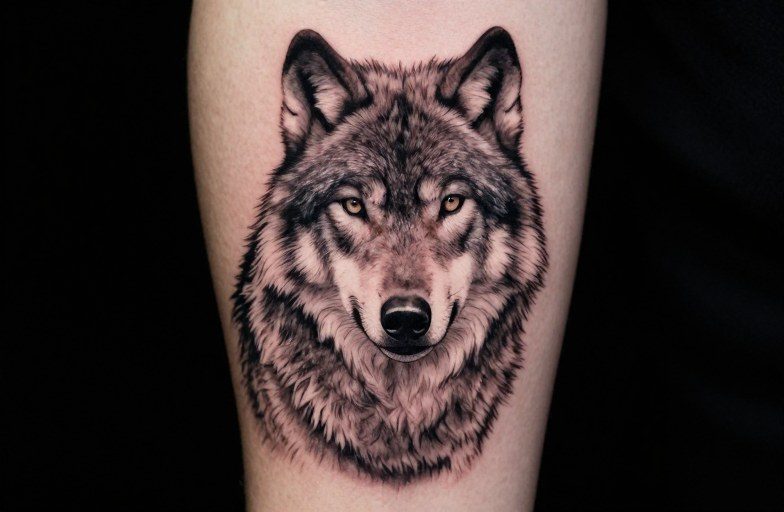
A gray wolf tattoo most commonly signals loyalty to family or pack alongside a stubborn, almost feral independence. The animal lives in tight social units but also wanders alone, hunts alone, survives alone. That duality, connection and self-reliance, is what draws people to the image. Some choose it to honor a protective role they play in their own family; others, to mark a period of surviving on their own terms.
Design Tips & Pairings
Placement and Composition
The wolf’s long muzzle and rangy body shape certain placements better than others. A howling profile stretches naturally across a forearm outer edge or along the ribs following the body’s curve. A frontal face, eyes forward, demands a broader canvas: chest center, upper back between shoulder blades, or a thigh panel. For smaller work, a single eye or a simplified head silhouette fits the wrist side or behind the ear, though detail gets compressed fast.
Pairings that actually complement rather than clutter: full moon behind a howling figure (classic for a reason, but avoid the floating-head-on-a-plate look by grounding it with neck fur or landscape line); forest silhouette below; geometric framing using the wolf’s natural angles. Paw prints trailing up an ankle or forearm read as afterthought in 2024. Skip them.
Line Weight and Detail Density
Fur texture determines how busy the piece reads. Heavy black-fill with minimal line work photographs well fresh but muddies as skin ages. Fine individual hair lines look stunning at six months, bleed together at six years. The compromise most solid artists land on: medium-weight outline defining major fur clumps, with selective detail lines in ears and around eyes, letting negative space do the work on the muzzle and neck ruff.
Color vs Black and Grey
When Color Works
Actual gray wolves aren’t gray. They’re buff, tawny, black, white, salt-and-pepper. A color piece can capture that variegated coat: warm browns at the shoulder, ice blue or amber eyes, pink tongue. Watercolor-style splashes behind the figure, blues, purples, muted greens, can suggest northern lights or forest shadow without literal landscape. The catch: color saturation in wolf tattoos often reads as “fantasy art” or “spirit animal” aesthetic whether you intended that or not. Be deliberate.
Black and Grey Realism
This is the dominant approach for good reason. The gray wolf’s natural tonal range maps perfectly to black ink washes. A skilled artist builds the coat through whip-shading and soft gray transitions, using solid black only for nostrils, eye rims, and deep mouth shadow. The result ages gracefully; even as lines soften slightly, the value structure holds. Photorealistic eye reflection (catchlights, iris striation) is where black and grey pieces live or die, flat eyes kill the whole thing.
Who Chooses This Tattoo
The demographic is broader than you’d guess. Military and first responders often gravitate toward the pack-protector angle, sometimes incorporating unit numbers or thin-line color bars subtly into collar fur. People who’ve rebuilt life after divorce or estrangement frequently choose the lone wolf iteration, not as self-pity, but as earned self-sufficiency. Parents, especially fathers with multiple children, sometimes get a wolf with several smaller figures trailing, though this verges on clip-art if not handled with restraint.
Less commonly discussed: women choosing the gray wolf for its hunting prowess and maternal ferocity, not despite being female but because of it. The she-wolf is the primary hunter, the den defender, the one who travels while the male guards. That biological reality rarely makes it into tattoo shop flash sheets, but informed clients request it specifically.
History & Cultural Roots
Indigenous and Northern European Associations
The gray wolf carries weight across cultures, though specifics vary sharply. Among several Plains nations, the wolf is often linked to scouting, tracking, and faithful service to the community. In Norse material, the wolf appears as destroyer (Fenrir) and as companion (the wolves Sköll and Háti chasing sun and moon). Roman myth traces the city’s founding to the she-wolf raising Romulus and Remus. These associations are deep but not interchangeable, appropriation concerns arise when someone slaps a war bonnet on a wolf or mixes Norse knotwork with unrelated tribal patterns without understanding the source.
Modern Pop Culture Layer
Game of Thrones, Twilight, and various fantasy franchises have saturated the wolf image. This isn’t inherently bad, but it means certain poses (direwolf heraldry, over-muscled “alpha” posturing) read as fandom rather than personal symbol. If you want distance from that, avoid symmetrical standing poses and generic snarling. Reference real wolf photography: the alert stillness before movement, the ears rotated to catch sound, the slight head tilt that reads as intelligence, not aggression.
Personal & Modern Meanings
Contemporary wearers layer private significance onto the traditional symbolism. Someone five years sober might see the wolf’s territorial persistence, returning to the same ranges, same mate, same patterns, as stability hard-won. Another person might focus on the animal’s communication: howling not for dominance but to locate scattered pack members, to regroup. The meaning that sticks is usually specific, not generic.
The “alpha wolf” concept has been scientifically debunked; wild packs are family units, not dominance hierarchies. Some clients know this and choose the wolf specifically to reject toxic hierarchy, embracing cooperative strength instead. Others still want the old alpha imagery and should know what they’re actually referencing.
How It Ages on Skin
High-Detail Areas to Watch
Fur texture is the first thing to go. Those fine individual hair strokes? They spread. The eye’s crisp highlight dot, if too small, disappears entirely. Solid black areas (deep mouth interior, nostrils) hold but can develop a slightly raised, waxy look over decades. The solution isn’t to avoid detail but to build redundancy: define the eye’s shape through surrounding shadow, not just the iris line; suggest fur through clump shadows rather than hair-by-hair rendering.
Placement and Sun Exposure
Outer forearm wolf tattoos fade fastest due to sun exposure and friction. The upper arm’s inner surface, the chest’s central panel, and the thigh’s outer face all preserve ink longer. If you’re set on a hand or finger wolf (a howling silhouette, say), accept that it will need reinforcement sessions every few years. The wolf’s facial features, especially the elongated muzzle, distort significantly on curved surfaces like the outer calf or shoulder cap. A good artist will adjust proportions to compensate, shortening the snout slightly or angling the head to minimize warp.
The Bottom Line
A gray wolf tattoo works when the wearer knows which wolf they’re claiming: the loyal pack member, the solitary survivor, the vigilant parent, the quiet tracker. The image has enough cultural weight to communicate without explanation, but enough flexibility to carry private meaning. Execution matters enormously, this is one of the most commonly attempted and most frequently botched subjects in tattooing. Choose an artist with proven animal work, demand to see healed photos (not just fresh), and resist the urge to pack every possible symbol into one piece. The wolf alone, rendered well, says more than a wolf plus dreamcatcher plus moon phases plus compass ever could.
Frequently Asked Questions
Does a howling wolf mean something different from a silent, watching wolf?
Howling usually reads as communication, connection, or calling out to someone absent. A watchful, still wolf suggests patience, assessment, and self-contained readiness. Posture matters as much as the animal itself.
Will a gray wolf tattoo look too masculine on a woman?
Not inherently. The subject’s gender neutrality depends on execution. Softer shading, slightly rounded features, and avoiding overbuilt “fantasy wolf” musculature all steer the image away from aggressive masculinity. Many women choose wolves specifically for the she-wolf’s hunting and maternal roles.
How much should I expect to pay for a quality gray wolf tattoo?
A palm-sized black and grey piece from a competent artist typically runs several hundred dollars; a detailed realistic forearm or back piece from a specialist can reach into the thousands. The range reflects time, skill level, and geographic market. Beware bargain pricing on complex animal realism.
Is it cultural appropriation to get a wolf tattoo if I’m not Indigenous?
The wolf appears across too many cultures to claim exclusive ownership. The issue arises with specific sacred imagery, certain tribal designs, war bonnets, or clan symbols, paired with the wolf without understanding or permission. A realistic wolf without borrowed cultural elements generally raises no appropriation concerns.
Leave a Reply