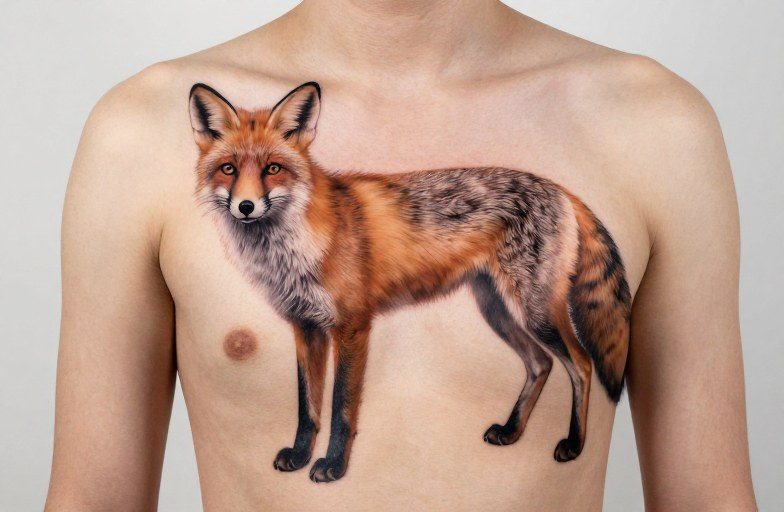
The Cervena Fox nude tattoo merges the cervená liška, the red fox of Czech and broader Central European folklore, with the unclothed human form. Together, they symbolize cunning intelligence stripped of pretense, survival instinct paired with authentic vulnerability. It’s a design about being fully seen and still dangerous.
History & Cultural Roots
The Czech Fox in Folk Tradition
In Czech, Slovak, and Moravian folk tales, the red fox occupies a specific niche: trickster, survivor, and sometimes supernatural messenger. Unlike the English Reynard or the East Asian kitsune, the cervená liška isn’t primarily magical, it’s pragmatic, slipping through fences, outwitting hunters, enduring harsh winters. Tattoo collectors drawn to this heritage often want that grit without the Disney gloss.
The nude human element entered tattoo culture more recently, through the mid-20th century European surrealist tradition and later the neo-traditional revival. Combining the two isn’t ancient; it’s a contemporary fusion that asks what happens when animal cunning meets human nakedness, no armor, no costume, pure strategy.
From Folk Motif to Tattoo Shop Staple
By the 1990s, Central European tattooers began incorporating regional folklore into their flash, partly as counter-programming against the American and Japanese styles dominating the continent. The fox nude emerged from this impulse: local symbol, universal theme. Today, you’ll find it in Prague, Berlin, and increasingly in American shops where clients request it by reference photos without always knowing the Czech connection.
Best Placements
Where the Lines Matter Most
This design lives or dies on line quality and negative space. The fox’s tail and the body’s curves need room to breathe. Ribs work well for the full composition, fox draped across or merging with the torso, because the natural body lines echo the forms. Thigh outer or front allows scale without distortion. Upper back, centered or offset to one shoulder blade, gives horizontal spread for the tail’s sweep.
- Forearm: Better for cropped compositions, fox head and partial figure, not full body. Lines blur faster here with age and sun exposure.
- Calf: Excellent for vertical arrangements, fox descending alongside the leg. Muscle movement adds subtle animation.
- Sternum/underboob: Popular but technically demanding. The sternum’s thin skin and bone proximity make consistent saturation difficult; the fox’s red tones can heal patchy.
- Side of hip: Offers concealment and a natural curve for reclining poses. Be aware that weight fluctuation distorts this area significantly.
Line Weight and Shading Strategy
Most successful versions use bold outer contours, 0.35mm to 0.5mm needles for the main structure, with finer interior lines for fur texture and facial detail. The nude figure typically carries less line weight than the fox, creating visual hierarchy: animal first, human second. Shading approaches vary dramatically. Traditional European work favors limited black-and-gray with a single red accent (the fox’s namesake color). Neo-traditional and new-school versions push full color, but the orange-red palette ages unpredictably, more on that below.
Mythology & Folklore
Beyond the Czech Borders
The red fox crosses cultures with remarkable consistency, though specifics shift. In Finnish tradition, the fox outsmarts both bear and wolf through pure cleverness, not strength. Korean folklore features the kumiho, a nine-tailed fox spirit, but that’s a different creature entirely, more demonic, less earthy. The cervená liška specifically lacks that supernatural inflation; its power is grounded, almost working-class.
The nude pairing introduces a classical layer. Greek and Roman art frequently depicted huntresses and wild women with animal companions or attributes, Artemis, the maenads. The fox nude operates in that lineage: human body, animal essence, no separation between civilized and wild. Some trace the tattoo’s specific composition to Art Nouveau prints where female forms and foxes intertwine in decorative patterns, though direct attribution is difficult.
What the Combination Actually Communicates
Stripped to its core, the design says: I am exposed and I am not prey. The fox isn’t protecting the figure; it is the figure, or the figure has become fox. That’s a different statement than, say, a wolf with a woman, wolf imagery tends toward pack loyalty and brute force. Fox energy is solitary, adaptive, sly. The nudity removes any social role: not mother, not warrior in armor, not professional in uniform. Just the calculating self.
Religious & Spiritual Angles
Christian Interpretations
Medieval European Christianity generally cast the fox negatively, false preacher, heretic, devil’s servant. But folk Christianity often preserved older, more ambiguous views. In some Czech regions, seeing a red fox was considered lucky if it crossed your path left-to-right, unlucky right-to-left. Tattoo collectors with Catholic or Orthodox backgrounds sometimes choose this design as reclamation: taking the animal the church feared and wearing it as personal emblem.
The nude element creates tension here. Christian art has its own long tradition of unclothed figures, Adam and Eve, martyred saints, the resurrected Christ, but always with theological framing. A fox nude tattoo carries no such frame. For some, that’s the point: spiritual identity without institutional packaging.
Pagan and Animist Readings
Contemporary pagan practitioners, particularly those drawing on Slavic or Germanic reconstruction, may interpret the design through an animist lens: the fox as spirit guide, the nude form as offering or invocation. This isn’t historically attested for the specific Czech fox; it’s modern interpretation layered onto old material. The tattoo functions as personal altar, portable and permanent.
How It Ages on Skin
Red ink is the technical story here. The iron oxide and naphthol reds used for that distinctive fox coloring are among the least stable pigments in tattooing. Within five to seven years, bright fire-engine red shifts toward salmon, then toward a muted rust-orange. Black lines hold better but spread slightly, what was crisp 0.35mm becomes 0.5mm or wider. The nude figure’s subtle gray shading, if done with diluted black, often fades faster than saturated areas, creating unintended contrast: the fox remains visible while the human form ghosts.
Sun exposure accelerates everything. A fox nude on the forearm, uncovered daily, will look a decade older than the same design on a ribcage under clothing. White highlights, sometimes added for eye gleam or fur texture, frequently disappear entirely within three years, they’re essentially scar tissue with minimal pigment.
Touch-ups are standard and expected. Plan for one at year five, sooner if the placement sees sun or friction. The best long-term strategy is conservative initial color saturation: slightly darker red than desired, knowing it will lighten, not slightly lighter hoping it stays.
Who Chooses This Tattoo
Demographics and Motivation
Collectors tend toward literary or artistic backgrounds, people who encountered the image in illustration, graphic novels, or fine art reproduction before seeking it as tattoo. There’s a notable cluster among second-generation Central European immigrants, particularly in the American Midwest, reclaiming heritage through body art. Age range skews 25-40; younger collectors often lack the patience for the required sitting time and the later maintenance.
Gender distribution is more balanced than many assume. The nude figure reads differently across bodies: on women, often as self-ownership and refusal of objectification; on men, sometimes as embrace of traditionally “feminine” attributes, cunning over force, adaptability over dominance. Non-binary collectors frequently emphasize the merging of forms, the dissolution of clear categories.
What It Replaces
Commonly, this design supersedes earlier tattoos: a generic tribal band, a former partner’s name, a zodiac sign that no longer resonates. The fox nude’s complexity and specific cultural weight offer cover and upgrade simultaneously. It’s rarely a first tattoo; the scale and commitment demand some prior experience with the process.
What to Remember
The Cervena Fox nude tattoo rewards research and punishes impulse. Its Czech folk roots give it substance that flash-sheet foxes lack, but that same specificity means it reads differently across audiences, some will recognize the reference, most will see only a striking image. Either outcome is valid if it’s the one you want.
Technically, prioritize line work over color flash. Find an artist with demonstrated skill in both animal realism and human figure work; the combination is rarer than either alone. Budget for the initial piece and a future touch-up. Place it where your body changes least and your clothing covers most, unless you’re committed to sunscreen as religion.
Most importantly, the design’s power comes from its tension: exposed yet dangerous, folk yet contemporary, animal yet human. Don’t smooth out that contradiction. That’s the whole point.
Frequently Asked Questions
Does the Cervena Fox nude tattoo have to include full nudity?
No. Many versions use strategic drapery, partial figures, or silhouettes to suggest nudity without explicit detail. The “nude” in the name refers more to vulnerability and lack of pretense than to literal undress.
How long does a detailed Cervena Fox nude piece typically take?
A palm-sized design with clean lines runs 3-4 hours. Full rib pieces or complex color work can require 8-12 hours across multiple sessions. The figure’s subtle shading demands patience that rushing destroys.
Can this design work in black and gray only, skipping the red?
Absolutely. Black and gray versions emphasize form over folklore reference, and they age significantly better. The red is traditional but not mandatory, some collectors prefer the ambiguity of a monochrome fox.
Will the nude figure look awkward if I gain or lose significant weight?
Any figurative tattoo shifts with body changes, but the fox’s organic curves adapt more gracefully than rigid geometric designs. Rib and thigh placements show the most distortion; upper back and outer arm remain relatively stable.
Leave a Reply