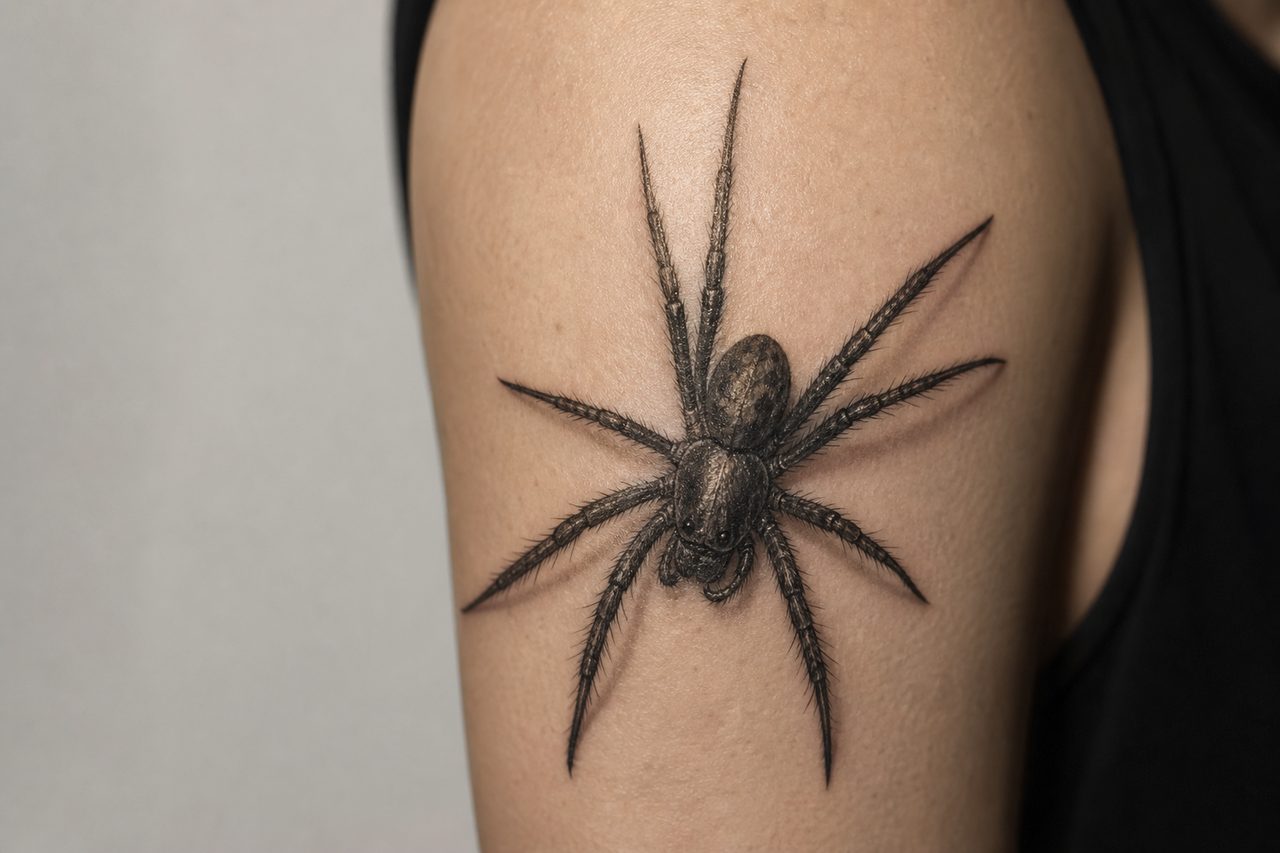
A realistic spider tattoo reproduces the creature’s actual anatomy with photographic precision, individual hairs, eye clusters, leg segmentation, and the subtle sheen of an exoskeleton. The style demands technical mastery of fine lines, smooth gradients, and an understanding of how arachnid bodies catch light. Done well, it can look ready to crawl off the skin. Done poorly, it collapses into a muddy silhouette that ages badly and reads as generic horror imagery.
Origins & History
Photorealistic tattooing emerged from the portrait work of artists in the 1970s and 1980s who pushed coil machines to render human faces with unprecedented accuracy. The spider as subject entered this tradition later, often linked to the rise of bio-mechanical and nature-realism styles in the 1990s. Some trace it to the broader cultural fascination with macro photography that made insect and arachnid anatomy visible in ways previously impossible.
Earlier spider tattoos were largely symbolic or stylized, tribal webs, traditional black-widow silhouettes, cartoonish tarantulas. The shift toward anatomical accuracy came as tattoo equipment improved and reference photography became accessible. Today’s realistic spider work owes more to scientific illustration and wildlife photography than to old-school tattoo flash.
From Symbol to Specimen
The transition changed what clients requested. A spider tattoo once meant danger, patience, or entrapment. Now many collectors want the creature itself rendered with the same reverence given to wolves or eagles. The symbolism hasn’t disappeared, but the visual priority shifted from emblem to organism.
How It Ages
Realistic spider tattoos face specific aging challenges that simpler designs avoid. The finest leg hairs, rendered with single-needle lines, tend to blur within three to five years as skin regenerates and ink particles migrate. The eight eyes, each a tiny highlight or dark bead, can consolidate into indistinct spots. Abdomen patterning, critical for species recognition, often softens most dramatically.
- Leg segments: thin connecting membranes between joints blur faster than the darker legs themselves, sometimes creating a “sausage link” effect
- Eye clusters: the anterior median eyes (center front) usually remain readable longest due to their size and contrast
- Spinnerets: rear abdominal details often fade entirely on high-friction areas like forearms
- Hair texture: the velcro-like setae on tarantula legs rarely survive aging; plan for smooth exoskeleton as the long-term look
Artists compensate by building slightly heavier dark values than reference photos suggest, knowing that mid-tones will lighten. The best work maintains leg readability even after fine detail loss, silhouette and proportion carry the design when surface texture fails.
Touch-Up Reality
Spider realism requires earlier and more frequent refreshment than bold traditional work. Expect to revisit the piece at five to seven years for leg definition and eye clarity. Touch-ups on spiders are technically demanding; the original artist, familiar with the structure, usually produces better results than a new hand attempting to interpret faded gradients.
Color vs Black and Grey
Black and grey dominates realistic spider tattooing for practical reasons. Most arachnids are naturally dark, brown, black, or deep grey, with subtle warm or cool undertones that translate well to monochrome wash. The style’s emphasis on form and texture over hue makes black and grey a natural fit, and it ages more predictably than color.
Color realism enters when targeting specific species: the cobalt blue of a Haplopelma lividum, the salmon-pink toes of a Brachypelma boehmei, or the green iridescence of a Chromatopelma cyaneopubescens. These pieces demand color theory knowledge most black-and-grey specialists lack. The blue-greens of tarantula setae, in particular, shift unpredictably as certain pigments fade faster than others.
- Black and grey: better for wolf spiders, black widows, recluse species; forgiving on all skin tones; lower long-term maintenance
- Color: necessary for accurate species portraiture; requires experienced color realism specialist; plan for saturation loss in reds and light blues within four years
White ink, used for highlight and eye reflection, presents its own problems. On darker skin, it often yellows or disappears entirely. On lighter skin, it can heal to a raised, scar-like texture. Many artists now skip white entirely, using negative space and skin tone for highlights instead.
Modern Variations
Contemporary realistic spider work has splintered into several recognizable approaches. The pure specimen piece treats the spider as isolated subject, often floating against a dark background or minimal shadow. The environmental piece places the spider on a leaf, bark, or web with full habitat context. The hybrid piece merges realistic arachnid anatomy with stylized elements, geometric webs, ornamental framing, or abstract color fields.
Macro perspective has become increasingly popular: the spider rendered at several times life size, filling a forearm or thigh with detail invisible to the naked eye. This approach sacrifices species recognition for visual impact. Viewers see “spider” without necessarily identifying which one.
Double exposure and composite designs layer spider anatomy with other imagery, skull contours in the abdomen, landscape within the cephalothorax. These read as clever in fresh photos but often age poorly as the composite elements compete for clarity.
Web Integration
The web remains a persistent companion element. Realistic silk construction, correct spiral geometry, anchor threads, visible glue droplets, requires almost as much technical precision as the spider itself. Many artists simplify to suggestive web fragments rather than full construction, letting the arachnid dominate visual attention.
Best Placements
Spider anatomy dictates effective placement more than most subjects. The eight radiating legs need space to extend without wrapping awkwardly around curved anatomy or compressing against joints.
- Upper arm/outer bicep: ideal for medium-sized pieces; flat plane preserves leg proportion; natural viewing angle when arm hangs relaxed
- Thigh front or side: accommodates large-scale work; excellent for tarantula species with substantial body mass; pain manageable for most
- Chest/pectoral: works for spiders positioned climbing upward; sternum area problematic for leg extension
- Forearm: popular but risky; frequent flexing accelerates aging; inner forearm offers better flatness than outer
- Hand/fingers: generally avoided for realistic work; scale too small for detail; fingers distort spider proportions
The “crawling” orientation, spider positioned as if moving across the skin surface, requires particular placement thought. A spider climbing toward the shoulder reads differently than one descending toward the elbow. The natural flow of body hair and muscle movement affects how convincingly the creature appears to traverse the terrain.
Scale Constraints
Below three inches in any dimension, realistic spider work becomes nearly impossible. The eyes alone need sufficient size to render individually. Micro-realism trends have produced tiny spider tattoos, but these abandon accurate anatomy for symbolic suggestion. For genuine realism, commit to at least palm-sized placement.
Key Characteristics & Motifs
Identifying quality in realistic spider tattooing means knowing what to examine. The prosoma (head-thorax fusion) should show correct segmentation and proportion to the abdomen, many failed pieces blow up the abdomen for dramatic effect, creating a distorted silhouette. The pedipalps, the leg-like appendages near the mouth, separate accurate work from generic spider shapes; their presence and positioning signal species knowledge.
Leg attachment points matter enormously. Spiders have two pairs attached to the prosoma front and two pairs to the rear, with specific spacing that determines how the legs splay. Incorrect attachment creates the “stuck in glue” look of amateur work.
- Eye arrangement: most spiders have eight eyes in two rows of four; jumping spiders have four large anterior eyes; accuracy here signals research
- Spinneret visibility: rear abdominal appendages for silk production; often omitted in lazy work
- Leg joint direction: spider knees bend upward, not like mammal limbs; common error in inexperienced hands
- Setae direction: body hair flows predictably; against-the-grain rendering catches light wrong
Background treatment separates gallery-quality work from competent shop pieces. Pure black negative space, soft atmospheric grey, or detailed habitat context each valid approach. The spider must emerge from its environment with sufficient contrast to read immediately, yet integrate enough to feel grounded rather than pasted on.
What to Remember
Realistic spider tattooing rewards patience in artist selection and placement consideration. The subject’s complexity exposes technical weakness quickly, there are no shortcuts through eight legs, eight eyes, and segmented body architecture. Prioritize artists with demonstrated arachnid or insect work in their portfolio, not just general realism experience.
Plan for maintenance. This style’s dependence on fine detail and subtle gradation means accepting touch-ups as part of ownership. Protect from sun diligently; UV degradation accelerates the fading that already threatens fine-line work.
Species accuracy matters if you claim a specific spider. A black widow rendered with incorrect hourglass shape or eye count undermines the realism you’ve paid for. Bring reference photos, but trust your artist to adapt photographic information to tattoo-appropriate values. The best realistic spider tattoos balance scientific fidelity with the practical demands of skin and ink.
Frequently Asked Questions
How much should I expect to pay for a realistic spider tattoo?
Quality realistic spider work typically runs $400, $800 for palm-sized pieces, scaling to $1,500+ for large thigh or chest work with full background. The fine detail required means faster artists aren’t necessarily better value here.
Do realistic spider tattoos hurt more than other styles?
Pain depends on placement, not style. However, the multiple sessions sometimes needed for dense black packing in backgrounds can extend total discomfort. The subject itself doesn’t affect pain levels.
Can any realism artist do a good spider, or do I need a specialist?
General realism skill transfers partially, but arachnid anatomy has specific pitfalls, leg attachment, eye arrangement, joint direction, that catch artists unfamiliar with the subject. Review their actual spider or insect work specifically.
Will a realistic spider tattoo affect my job prospects?
Placement matters more than subject. A spider on your forearm reads differently than one on your thigh. Some industries remain conservative about visible tattoos regardless of content; consider coverability during planning.