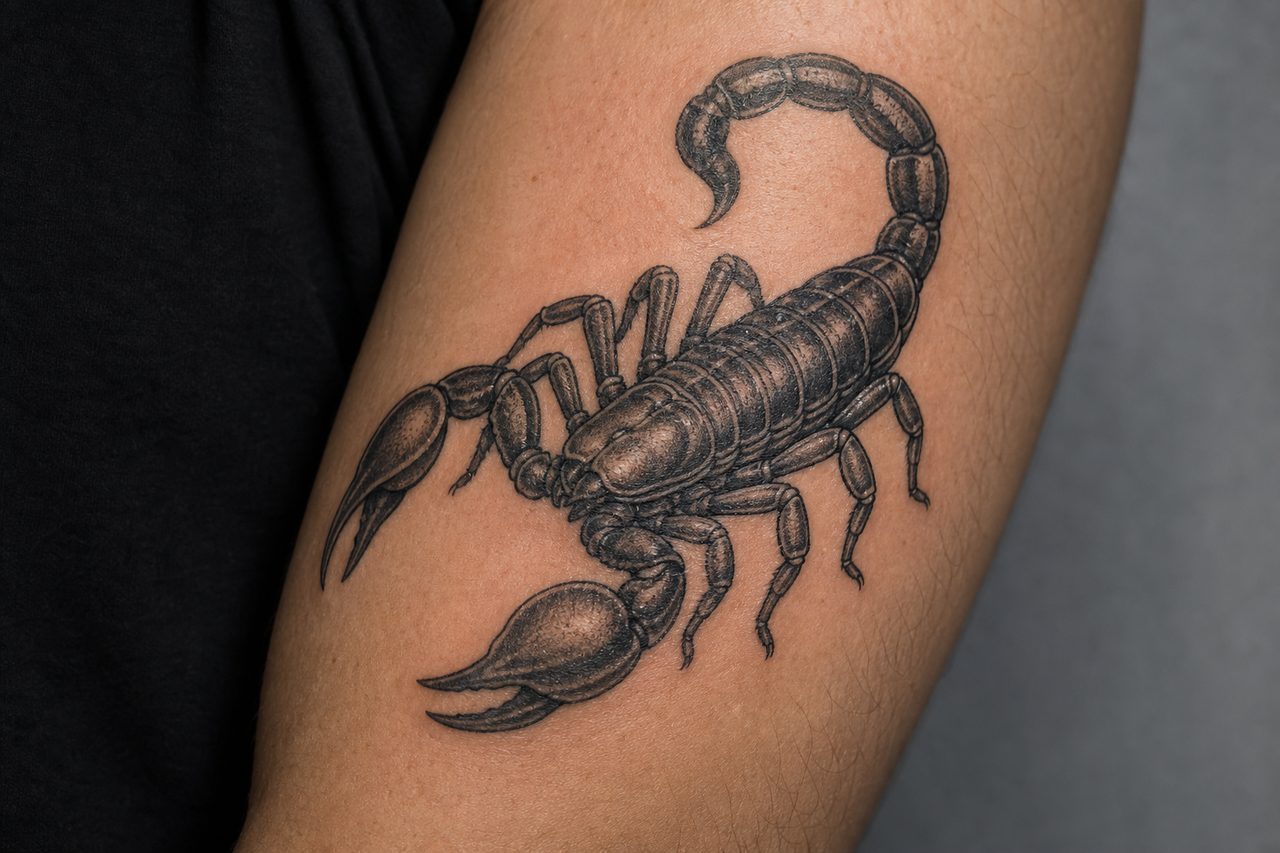
A scorpion tattoo most commonly signals protection, resilience, and the willingness to defend boundaries. The symbol also carries darker undertones, danger, revenge, and transformation through pain, that appeal to people who’ve survived difficult passages. The meaning tightens or loosens depending on how you render it: a geometric outline reads differently than a photorealistic stinger curled for attack.
History & Cultural Roots
The scorpion’s symbolic weight comes from genuinely old sources, not modern tattoo-shop invention.
Ancient Near East & North Africa
In ancient Egyptian practice, scorpion goddesses like Serqet protected the dead and guarded canopic jars. Her image appeared on coffins and amulets, not as a threat but as a sacred guardian. Some trace the scorpion’s protective association to these funerary contexts, where the creature stood watch rather than attacked. Berber and Tuareg traditions across North Africa also incorporated scorpion motifs into jewelry and textiles, often linked to survival in harsh environments.
Aztec & Mesoamerican Context
The Aztec calendar included a scorpion sign, Coatlicue’s associations sometimes merged with scorpion imagery in death-and-rebirth cycles. Warriors wore scorpion designs into battle, though the exact prevalence remains debated among scholars. What survives clearly is the creature’s place in a symbolic vocabulary where death and transformation intertwined.
- Mesopotamian boundary stones sometimes featured scorpions as protective markers
- Some trace the “scorpion man” guardian figure to Babylonian temple imagery
- Modern prison tattooing in Russia and Eastern Europe adopted the scorpion as a rank marker, specifically, time served or willingness to attack
The Russian prison context matters because it leaked into Western tattoo culture through the 1990s and early 2000s. Someone sporting a scorpion on the back of their hand might be referencing that lineage deliberately or accidentally. Context, placement, style, accompanying symbols, determines which lineage speaks.
Design Tips & Pairings
Scorpion anatomy gives tattoo artists a built-in structure: the segmented tail, the grasping pedipalps, the narrow body. But that structure can become a trap if you don’t think about how it sits on muscle and bone.
Working With the Form
The curved tail creates natural flow. Wrap it around an arm or leg, and the scorpion follows the body’s cylinder. Straighten it for a sternum or spine piece, and the tail becomes a vertical axis. The pincers spread wide for chest placements or collarbone spans. Small scorpions, under two inches, lose leg detail fast; the minimum readable size sits around three inches for black work, larger if you want segmented texture.
Common Pairings
- Rose: danger and beauty, the classic juxtaposition. Works best when the scorpion’s tail curves around the bloom rather than piercing it, too literal and it becomes clip art.
- Skull: mortality, the poison that kills. Placement matters: scorpion atop skull reads dominance; skull behind scorpion reads the creature as agent of death.
- Text or script: names, dates, phrases following the tail curve. Risky, text tattoos age poorly, and wrapping them around a curved form accelerates distortion.
- Desert landscape: cactus, dunes, moon. Grounds the symbol in habitat rather than abstraction.
Geometric and ornamental styles have surged for scorpions. Dotwork fills the segments; mandala patterns replace the stinger. These read more decorative, less aggressive. Neo-traditional with bold outlines and limited color palette splits the difference, recognizable form, stylized execution.
Similar & Related Symbols
Scorpion energy overlaps with several creatures, and choosing between them clarifies what you actually want.
The spider shares the venomous-arthropod territory but carries more web, patience, and feminine-coded symbolism. The snake offers transformation through shedding, less defensive aggression. The scorpion’s specific signature is its armor, exoskeleton, not skin, and its strike: fast, from a still position, with consequences that unfold slowly.
- Phoenix: rebirth through fire, not venom. More dramatic, less ambush.
- Wolf: pack loyalty, social hierarchy. The scorpion is solitary.
- Scarab: Egyptian protective insect, but solar and regenerative rather than defensive.
A scorpion paired with a phoenix might signal multiple survival modes, sudden defense and cyclical rebirth. With a wolf, the tension between solitary and social instincts becomes the point.
Best Placements
Scorpion tattoos reward placement thinking because the creature’s posture changes its emotional register.
High-Visibility Placements
Back of the hand, neck side, throat: these read as warnings. The Russian prison lineage lingers here, so consider if you’re comfortable with that association. Hand tattoos also face faster aging, constant movement, sun exposure, thinner skin. A scorpion on the hand needs bold lines to survive five years, let alone twenty.
Contained & Curved Placements
Outer forearm, calf, rib cage, shoulder cap: the scorpion’s curve follows natural body lines. The rib cage offers flat planes for detailed segment work but hurts more and shifts with breathing. The shoulder cap lets pincers spread toward collarbone and tail drop toward bicep. Calf provides a stable cylinder, good for medium-sized pieces that need leg detail to read.
Small behind-the-ear scorpions trended hard in the 2010s. They age poorly, too small, too much detail in a mobile area, frequently blurred within a few years.
Color vs Black and Grey
The scorpion’s natural palette, desert browns, blacks, occasional pale golds, maps naturally to tattoo ink choices.
Black and grey dominates for good reason. It ages cleaner, reads from distance, and suits the creature’s nocturnal, threatening associations. Greywash can build segment depth and shadow under the tail. Solid black silhouettes with white highlights for segment edges stay readable at small sizes.
Color introduces specific associations. Red accents on the stinger or eyes signal danger literally, blood, warning, the strike point. Desert yellows and ochres ground the image in habitat. Blue or purple scorpions read as fantasy, less naturalistic, more personal symbolism. Full color realism on a scorpion demands a large enough canvas; otherwise, the yellows and browns muddy together as they age.
One practical note: white ink on a scorpion’s segments, popular for “glow” effects, rarely holds. It yellows or disappears within months on most skin tones.
How It Ages on Skin
Scorpion tattoos face specific aging challenges tied to their anatomy.
The thin legs and tail segments blur fastest. A scorpion with twelve distinct leg joints at year one might read as fuzzy sticks at year ten. Artists compensate by building weight into the main body and tail, letting the legs be suggestive rather than anatomically precise. The stinger tip, often the finest point, spreads and softens. Some artists deliberately blunt it slightly at the design stage so aging doesn’t turn a sharp point into a blob.
Segmentation lines, those horizontal cuts across the tail, need consistent depth. Too shallow and they fade to solid; too deep and they scar white. Experienced artists vary needle grouping, not just pressure, to keep these lines stable.
Sun exposure darkens and blurs scorpion tattoos faster than many subjects because of their reliance on fine detail and contrast. A scorpion on the forearm or calf needs sunscreen commitment, or it becomes a dark smear a decade out.
The Takeaway
The scorpion works as a tattoo because its symbolism is specific: not just danger, but calculated defense; not just death, but transformation through pain. The design choices, curved or straight, colored or black, large or small, determine which facet dominates. Get the anatomy wrong and it becomes generic bug; get the placement wrong and it ages into unrecognizable darkness. Done well, it carries weight without needing explanation, a symbol that predates tattoo culture and will outlast trends.
Frequently Asked Questions
Does a scorpion tattoo always mean someone has been to prison?
No. The Russian prison association is real but geographically and culturally specific. Most scorpion tattoos in Western shops draw on older protective symbolism or personal meaning. Placement and style usually signal whether someone intends that reference.
How big does a scorpion tattoo need to be to keep its detail?
Three inches is the practical minimum for black work with leg and segment detail. Smaller than that, the artist must simplify dramatically, often just body, tail, and stinger with suggested legs.
What’s the most painful placement for a scorpion tattoo?
Ribs, sternum, and spine top the list because of thin skin over bone and constant movement. The sternum’s central placement, popular for straight-tail designs, combines high pain with difficult healing from breathing motion.
Can a scorpion tattoo be covered up easily if I change my mind?
Scorpions pose moderate cover-up difficulty. Their dark bodies and tails provide some existing density, but the spread legs and thin tail segments leave light areas that limit what can go over them. Laser lightening often helps before a major cover.