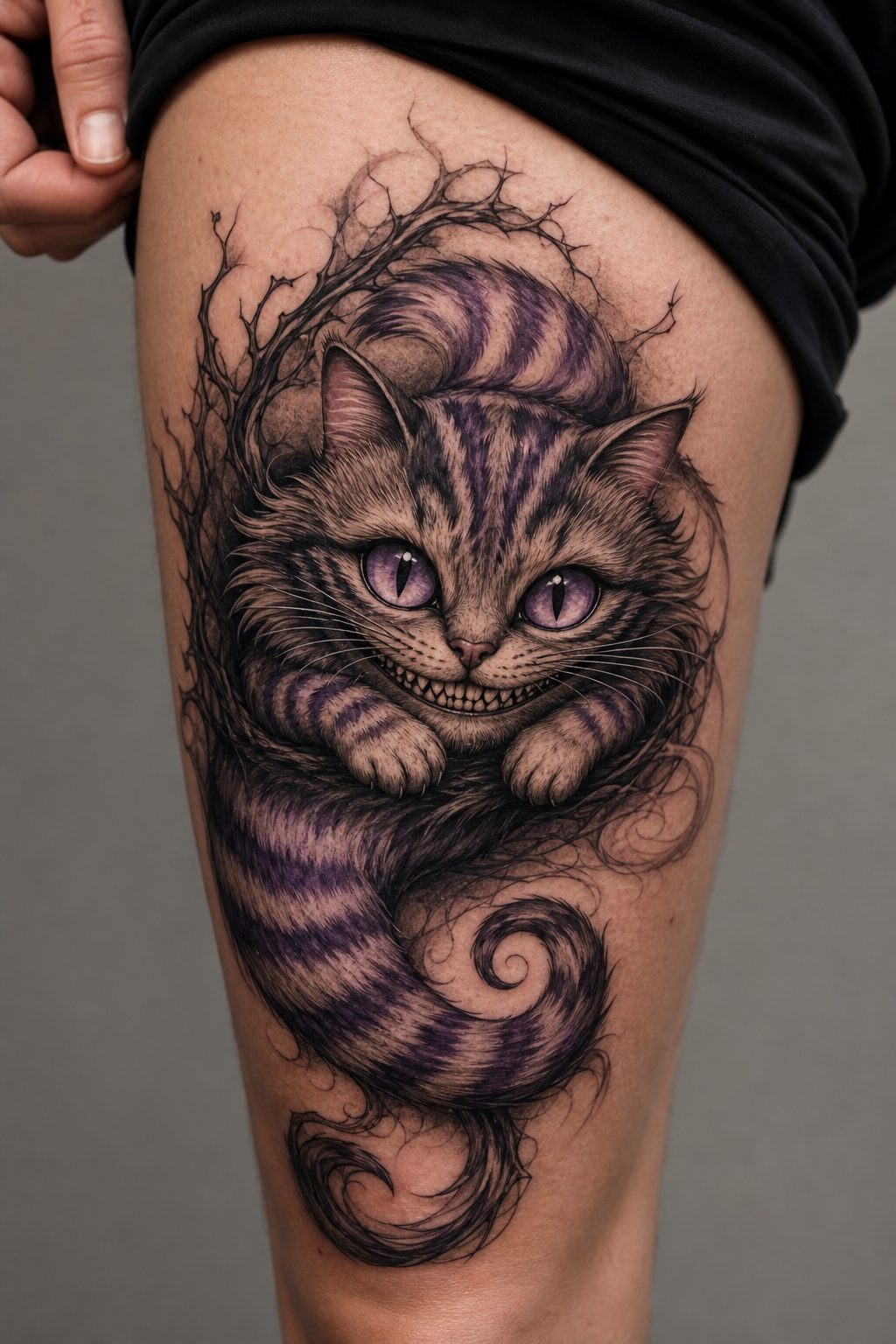
The Cheshire Cat tattoo carries a layered meaning built on mischief, hidden knowledge, and the refusal to take reality at face value. At its simplest, it signals someone who values their own counsel, keeps secrets, or moves through chaos with a grin. The cat’s famous vanishing act, leaving only the smile behind, also speaks to presence without vulnerability, the power of being seen without being caught.
Symbolism & Core Meaning
The Vanishing Grin
That disembodied smile is the image’s psychological anchor. It suggests someone who can exit any situation intact, who maintains composure when everything else dissolves. The grin persists after the body disappears, optimism, mockery, or self-possession surviving when the self is no longer visible. People drawn to this symbol often identify with being underestimated, with hiding sharpness behind apparent absurdity.
Controlled Chaos
Unlike the Mad Hatter’s unhinged energy, the Cheshire Cat operates with intention. It appears, disrupts, vanishes. The tattoo can mark someone who causes trouble deliberately, who questions rules without needing to break them openly. There’s a strategic quality here, knowing more than you reveal, guiding without leading.
Best Placements
Where the Grin Works Best
The forearm and calf handle the cat’s elongated features well, giving the grin room to stretch. A floating smile alone fits beautifully along the ribcage or collarbone, playing on the disembodiment. Upper arms and thighs work for full-body designs with the striped pattern wrapping around muscle. The back of the neck, visible when hair moves, echoes the cat’s habit of appearing unexpectedly.
Smaller placements demand simplicity. A single eye and smile behind the ear, or a minimalist outline on the wrist, keeps the reference clear without requiring detail that will blur. Finger tattoos of the grin rarely age well, lines feather within two years on high-movement skin.
Size and Aging Considerations
Striped fur patterns and fine whiskers are the first elements to soften as ink settles. Bold black outlines around the grin preserve readability longer than delicate grey shading. If you want the classic purple-pink coloration, plan for touch-ups; those pigments fade fastest in sun-exposed areas. A predominantly black-and-grey design with selective color in the eyes or smile holds its structure for years.
History & Cultural Roots
From Carroll to Counterculture
Lewis Carroll’s 1865 Alice’s Adventures in Wonderland created the character, though grinning cats appeared in English folklore earlier. The phrase “grinning like a Cheshire cat” predated the book, its origins unclear, some trace it to cheese molds shaped like cats, others to county heraldry. Carroll amplified the image into something metaphysical, a creature that exists in parts rather than wholes.
The tattoo’s popularity surged through 1960s psychedelia, when the Disney adaptation’s fluorescent palette aligned with acid culture’s visual language. Later, the character became a staple of goth, rave, and alternative fashion, the grin signaling insider status across subcultures. Tim Burton’s 2010 film pushed a darker, more skeletal interpretation that still dominates some tattoo portfolios.
Japanese and Anime Variations
In Japanese tattooing, the kaibyō or supernatural cat tradition offers a parallel, bakeneko and nekomata stories involve cats with uncanny abilities, shape-shifting, and vengeance. Some artists blend the Cheshire grin with maneki-neko form, creating a hybrid that speaks to Western and Eastern cat folklore simultaneously. Anime-influenced versions often exaggerate the eyes, adding sparkles or slit pupils that shift the tone from menacing to playful.
Religious & Spiritual Angles
Trickster Archetypes
The Cheshire Cat occupies trickster territory shared by Coyote, Loki, Anansi, and the Fox. These figures operate outside moral frameworks, teaching through disruption rather than doctrine. A tattoo here can signal spiritual allegiance to questioning, to refusing answers that come too easily. It marks comfort with paradox, being and not being, helping and hindering, simultaneously.
Buddhist and Zen Readings
Some interpret the cat’s vanishing as a metaphor for anatta, the non-self. The smile remains when the form dissipates, what persists when ego dissolves? Others see the character’s guidance of Alice as resembling the koan tradition, where questions matter more than resolutions. These readings are more interpretive than doctrinal, but they surface regularly in discussions of the symbol.
Design Tips & Pairings
Complementary Imagery
Pocket watches and teacups anchor the Wonderland context without overwhelming the cat. Playing cards, particularly spades, add narrative structure. Some pair the grin with a keyhole, suggesting hidden access or locked knowledge. Mushroom imagery risks cliché unless stylized unusually, perhaps as architectural forms rather than cartoon caps.
Script pairings work when brief and oblique. “We’re all mad here” is overdone; something like “only the grin remains” or Carroll’s original “imaginary” dialogue carries more weight. Latin phrases about appearance and reality (esse est percipi, though Berkeley’s, not Carroll’s) appeal to those wanting scholarly cover.
Stylistic Approaches
Traditional American builds the grin with bold lines and limited color, readable from distance. Neo-traditional allows the striped fur more decorative complexity. Blackwork and dotwork interpretations emphasize the uncanny, the cat emerging from stippled darkness. Watercolor backgrounds, popular a decade ago, now date quickly; geometric framing feels more current. Single-needle fine line suits small floating smiles but demands an artist with steady precision, any wobble in those curves destroys the expression.
Similar & Related Symbols
The grinning skull shares the death-and-humor combination but lacks the Cheshire’s strategic elusiveness. Schrödinger’s cat offers scientific paradox where Carroll offers literary nonsense, similar intellectual play, different cultural registers. The fox in Japanese tradition, or the coyote in Indigenous Southwest stories, occupies closer trickster kinship. Grinning masks from Commedia dell’arte, particularly Harlequin’s, parallel the performance of madness hiding calculation.
Modern pop alternatives include the Pusheen cat’s softer irony, or the Alien franchise’s xenomorph, another creature that appears, disappears, and grins with too many teeth. None quite replicate the specific combination of visible threat and actual harmlessness that defines the Cheshire’s appeal.
The Takeaway
A Cheshire Cat tattoo works best when the wearer actually identifies with the character’s mode, observing more than participating, exiting when convenient, maintaining composure that others misread as simplicity. The symbol fails when chosen purely for aesthetic; the grin demands some psychological alignment to carry weight. If you’re drawn to it, ask whether you want the tattoo to announce your strangeness or conceal your watchfulness. The best versions do both, which is exactly what the cat itself manages.
Placement, aging, and design choices should serve that duality. Bold enough to be recognized, elusive enough to keep something back. The smile without the cat, or the cat mid-vanish, often captures this better than a fully rendered portrait. Whatever version you choose, the ink will last longer than most of the situations you grin through, which may be the point.
Frequently Asked Questions
Does a Cheshire Cat tattoo always mean you’re into drugs or psychedelic culture?
Not anymore, though that association was stronger in the 1960s and 70s. Today the symbol carries broader meanings of mischief, intellectual play, and emotional guardedness. Context matters more than the image itself.
Will a colorful Cheshire Cat tattoo fade faster than black and grey?
Yes, particularly the purple-pink tones common to the Disney-influenced design. Those pigments break down faster under UV exposure. Black linework and grey shading preserve the structure for years longer.
Can a small Cheshire Cat tattoo still look good, or does it need to be large?
Small works if you simplify aggressively. A floating grin or single eye with minimal detail reads clearly at palm-size. Full-body designs with stripes need more space to avoid muddying as the ink ages.
Is the Cheshire Cat tattoo considered feminine or masculine?
Neither inherently. The symbol crosses gender lines in placement and styling choices. Traditional bold execution reads more masculine in conventional tattoo culture; fine line and watercolor approaches are coded feminine, though these distinctions blur increasingly.