Geometric dragon tattoos stay discreet when the silhouette, placement, and negative space are planned before the details. I learned that after watching a fine design lose its shape under crowded scales and heavy shading. You want something intricate but readable, even at a glance. Start small, then build with intention!
- ✓ Start With Small Geometric Dragon Tattoos
- ✓ Pick Intricate Geometric Dragon Linework
- ✓ Where Should Geometric Dragon Tattoos Sit Along Your Forearm?
Editor’s note: A discreet dragon can still feel striking, fierce, and meaningful. The smartest designs make one clear visual decision, then give every line a reason to stay.
- Start With Small Geometric Dragon Tattoos
- Pick Intricate Geometric Dragon Linework
- Where Should Geometric Dragon Tattoos Sit Along Your Forearm?
- Keep Geometric Dragon Scales Crisp and Balanced
- Plan Unique Geometric Dragon Tattoo Symmetry
- Choose Fierce Geometric Dragon Head Designs
- Shape Flowing Geometric Dragon Body Lines
- Meaning Over Ornament: Match Geometric Dragon Tattoos to Your Story
- Test Geometric Dragon Tattoo Pain, Healing, and Cost
- Add Symbolic Geometry to Dragon Wings
- Refine Bold Geometric Dragon Tattoo Details
1Start With Small Geometric Dragon Tattoos
Small geometric dragon tattoos work best when you simplify the outer silhouette first. The design should have a recognizable head, a controlled curve, and enough open skin around the body to preserve its shape. You’ll want the main gesture to read clearly before adding scales, horns, or symbols.
I’d keep the first draft close to a few inches wide if discretion matters. A compact silhouette can look minimal and sleek without losing the dragon’s identity. If you’re comparing ideas, browse these small dragon tattoos before your consultation so you can discuss the scale you’re considering.
Your artist should print or stencil the design at its intended size. Don’t judge it only on a phone screen, because details that look crisp digitally may crowd together on skin. A paper stencil placed on your body will tell you whether the open areas feel balanced or randomly scattered.
I made the mistake of approving a small design because the outline looked sharp on paper. Once reduced, the head and tail sat too close together. You’ll want at least one clear opening between major forms, especially if your dragon curls into a compact shape.
If you’re choosing a discreet placement, remember that clothing changes how you’ll see the tattoo every day. The thigh can keep the design private while still giving your artist enough surface for a graceful curve. That balance is understated, timeless, and worth protecting.
2Pick Intricate Geometric Dragon Linework
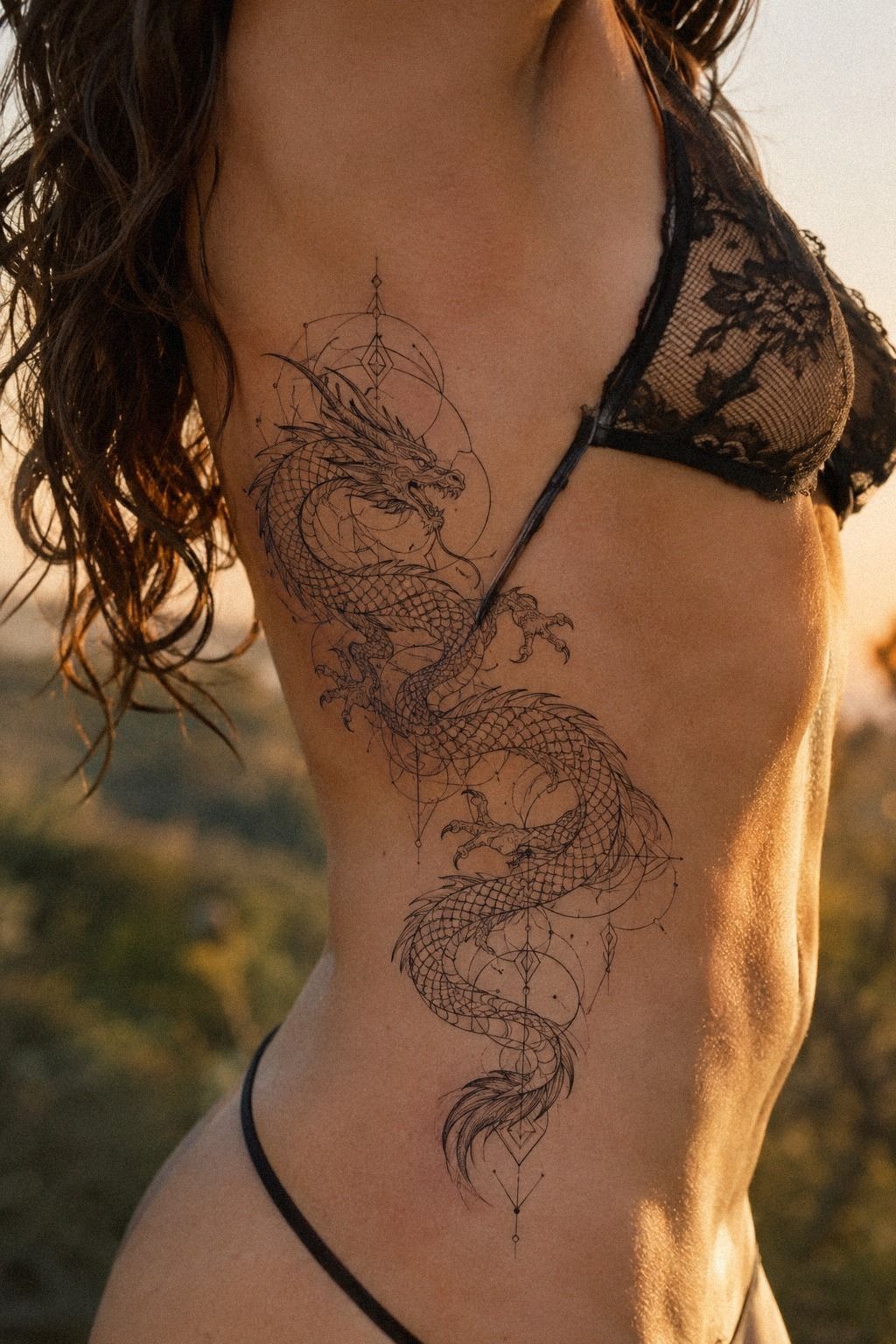
For ribs, intricate geometric dragon linework needs a strong spine and controlled spacing. Start with the central contour before deciding how many interior lines the design can support.
Rib skin moves as you breathe, so a crowded pattern may lose its crispness while the tattoo heals. I’d favor a delicate but decisive arrangement of lines, with one ornate section near the head and simpler geometry along the tail.
Ask your artist whether the design should use single-needle detail or a slightly stronger liner. A fine line can look elegant and understated, but it needs enough separation from nearby marks to stay readable.
You’ll also want to consider how the dragon turns across your ribs. A flowing curve can feel graceful without becoming decorative for its own sake. If the body crosses a natural crease, simplify the geometry there instead of forcing every scale into the design.
3Where Should Geometric Dragon Tattoos Sit Along Your Forearm?
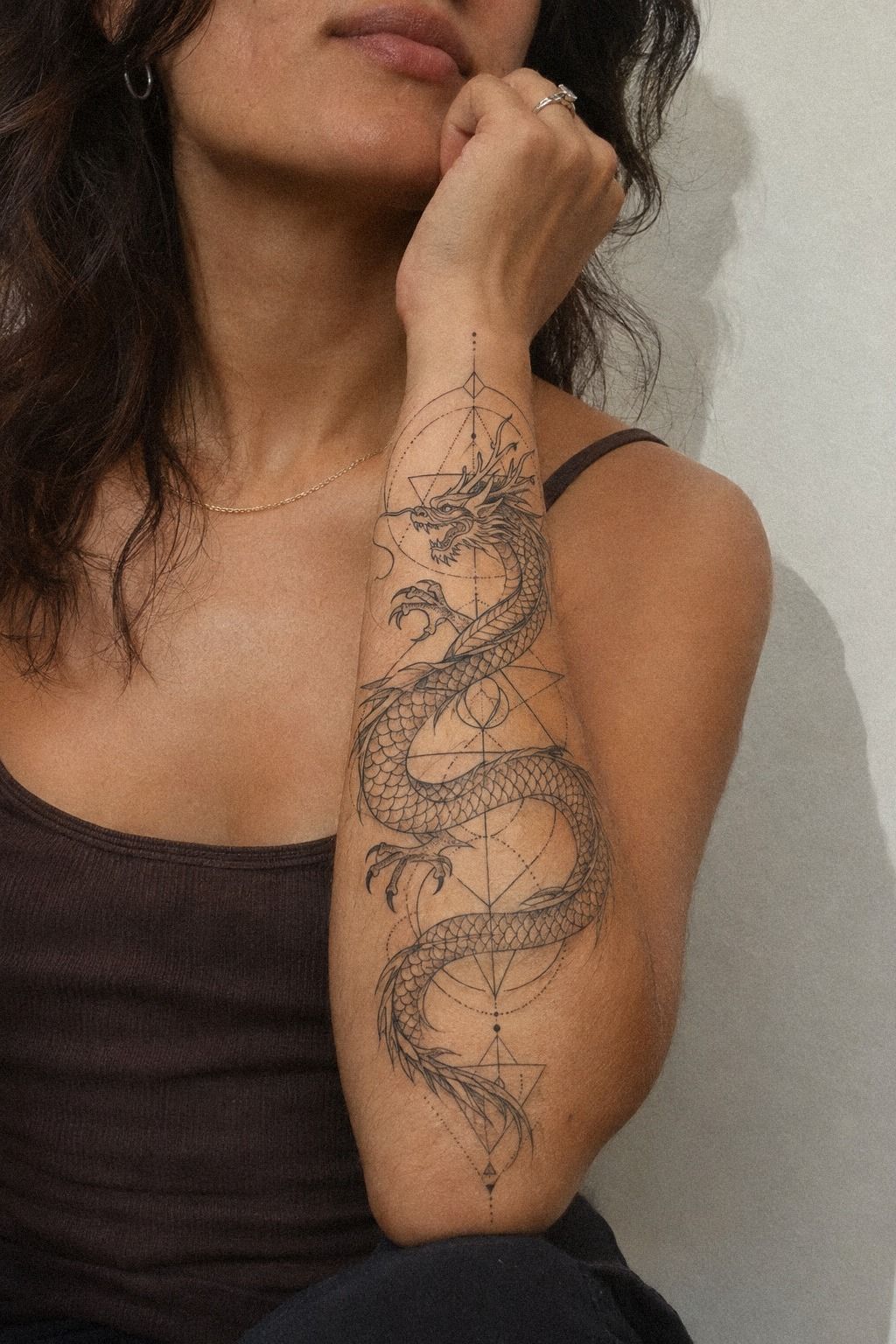
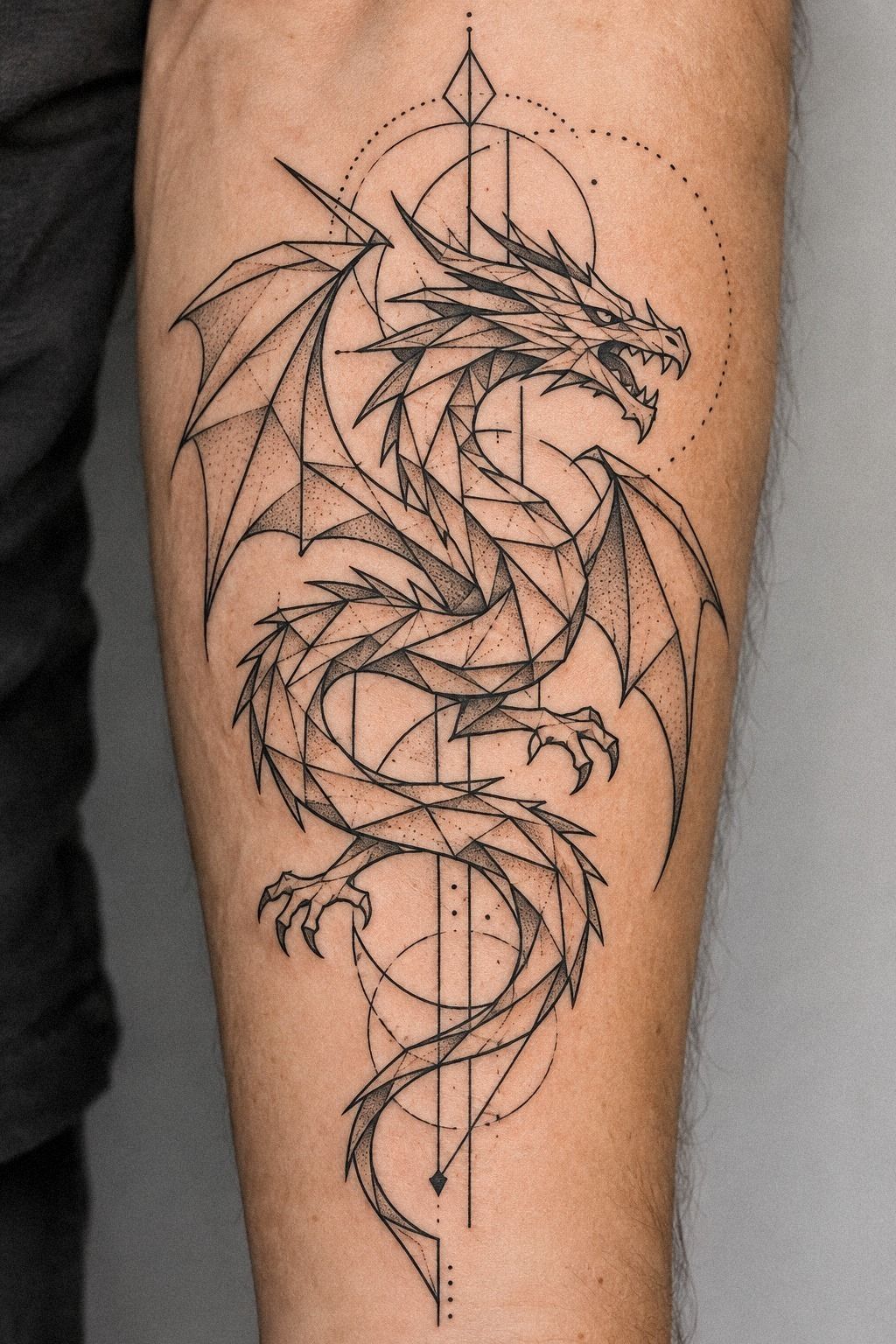
A forearm placement gives geometric dragon tattoos a natural vertical path. The dragon can curl along the limb with fins and a narrow body, so the shape follows the available length instead of sitting like a sticker. You’ll want the head, spine, and tail to move with your arm.
Start by deciding whether the dragon should face your hand or your elbow. Facing the hand can make the design feel more direct, while facing upward often creates a calmer and more flowing line. Ask your artist to show both orientations with a skin-safe stencil before choosing.
The forearm is usually more tolerable than ribs, feet, hands, or the sternum, but everyone’s experience differs. You’ll still need to sit steadily while the artist works around the inner and outer planes. A stencil helps you see how the design changes when your wrist turns.
If you want the tattoo to stay discreet at work, place the tallest section where a sleeve can cover it. The inner forearm is more visible during daily movement, while the outer forearm often reads more clearly from a distance. I’d skip a perfectly centered stripe because it can look rigid instead of flowing.
For more unusual animal geometry, compare the movement in these geometric snake tattoos. You’ll notice how a body can feel bold without becoming oversized. And if you’re worried about commitment, begin with a shorter body curve and leave space for a future extension.
4Keep Geometric Dragon Scales Crisp and Balanced
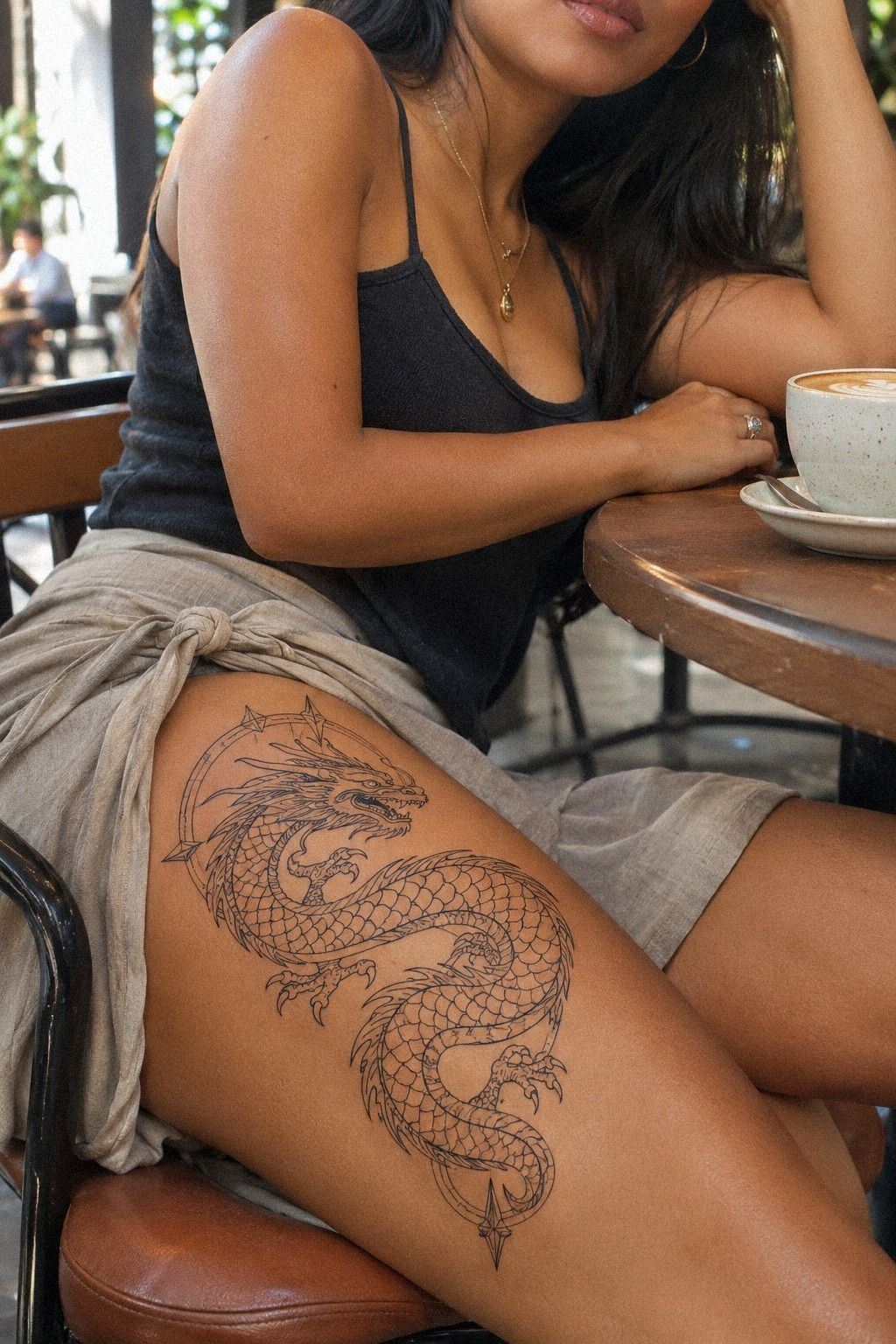
A thigh placement gives you enough room to show scales, but scale placement still needs discipline. The pattern should follow the body rather than form a row of unrelated diamonds. Each shape needs to support the dragon’s direction.
Use larger shapes near the spine and smaller marks near the edges. That change gives the dragon a more organic appearance without requiring solid shading. Your artist can test the pattern with a scale map, then adjust areas that look too dense before the appointment.
I’d avoid filling every visible section with scales. The blank skin between groups creates a negative-space pause, and those pauses help the dragon remain readable from several feet away. If your design is already busy, remove detail from the tail first, because tails tend to disappear when they become too narrow.
You can also ask for directional changes around the shoulder, hip, or thigh curve. Your body isn’t a flat sheet, so the geometry should wrap rather than float awkwardly. A short test drawing on transfer paper will show whether the scales stretch evenly when you move.
But don’t judge crispness on the day of the appointment alone. Fresh ink can look darker than healed skin. Follow your artist’s aftercare instructions, avoid unnecessary sun exposure, and give the lines time to settle.
The final result should feel polished and refined.
5Plan Unique Geometric Dragon Tattoo Symmetry
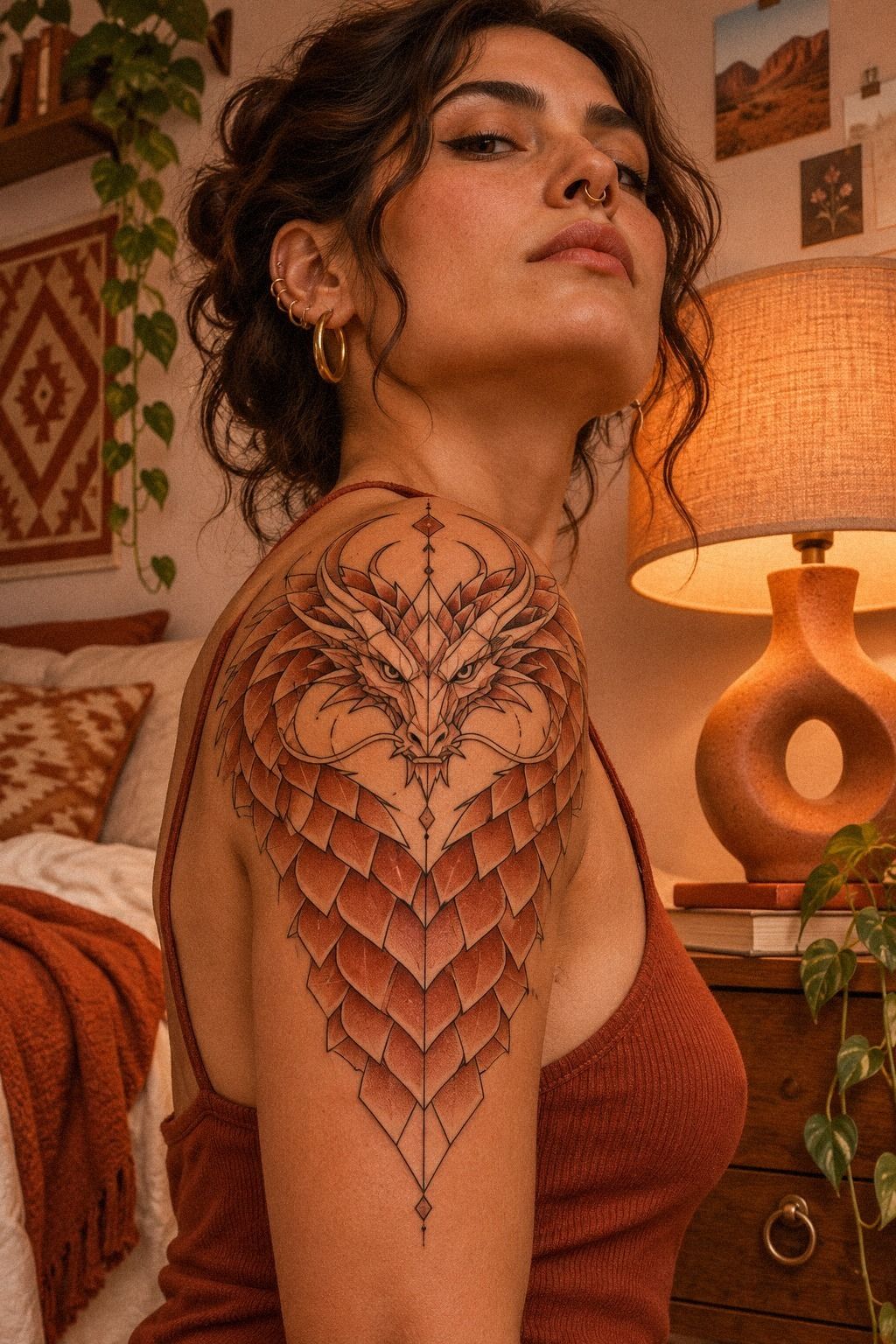
A flash sheet can help you compare silhouettes before committing, but symmetry shouldn’t become a trap. Mirror symmetry can make a dragon feel elegant, while a carefully placed interruption may give it more personality.
Decide which parts truly need to match. The wings, horns, or eye marks may benefit from balance, but forcing identical scales along a curved body can make the tattoo feel stiff. A slightly irregular detail can make the design feel more personal and expressive.
Bring your artist a simple reference for the symmetry line. It should guide the design without dictating every mark. If your dragon wraps around a limb, visual balance matters more than mathematical equality.
6Choose Fierce Geometric Dragon Head Designs
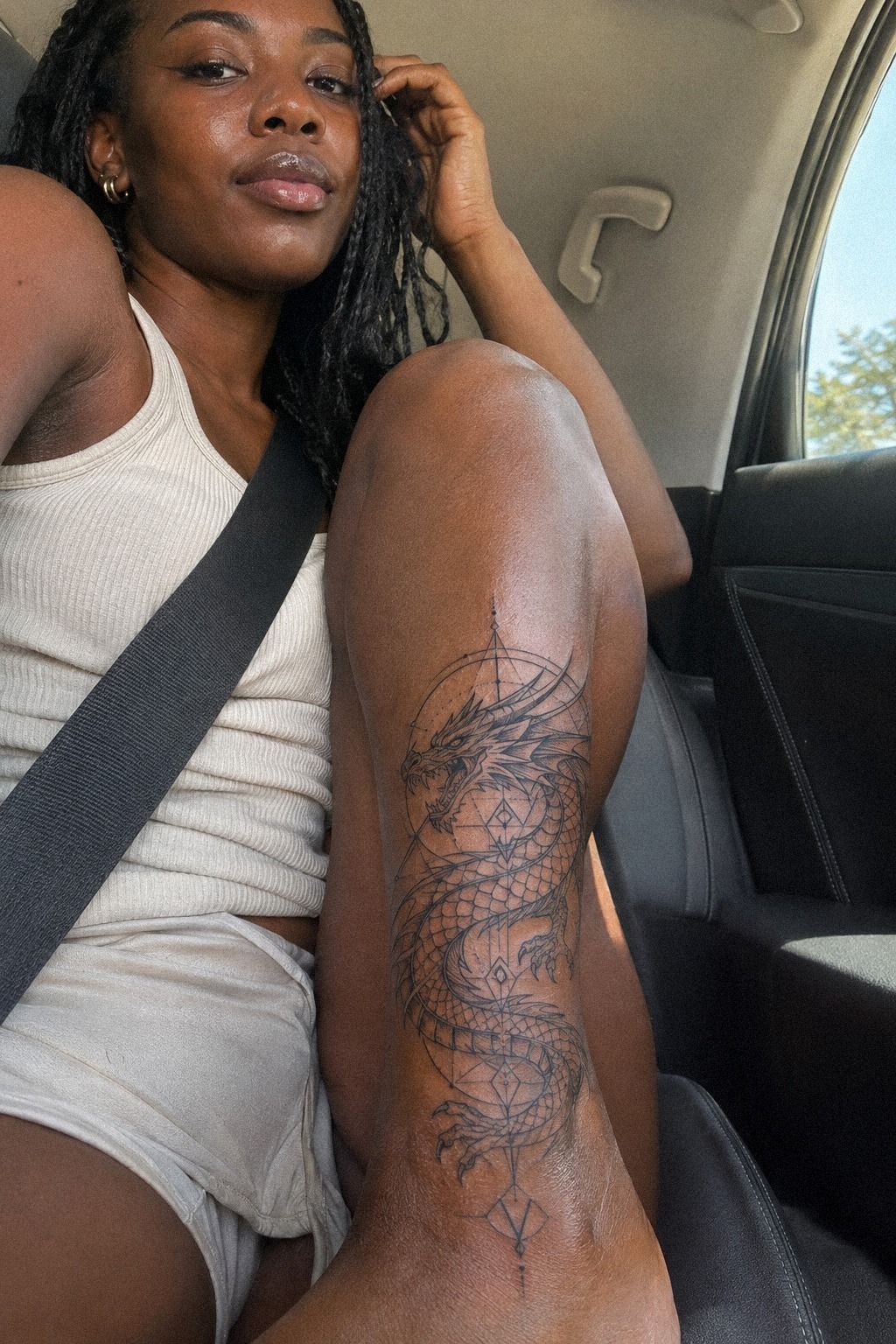
An ankle placement benefits from a compact dragon head with a clear profile. The snout, eye, and horn direction should remain visible at a small size. You’ll want the head to create recognition without becoming a dense patch of black.
Start with the head as a simple geometric mask. Use a triangle or angular oval for the skull, then add one eye mark and a controlled jawline. This keeps the piece edgy and iconic without turning it into a crowded field of ink.
The ankle has less forgiving space than the thigh or forearm, especially near the bone. Ask for a stencil that leaves a small buffer around the ankle crease so the design doesn’t fold into itself when you walk. You’ll also want to discuss how socks and shoes may rub the area during early healing.
I’d choose a strong profile over a front-facing head here. A front-facing dragon can require more symmetry and detail, while a profile reads faster and leaves space for a curling body. If you’re unsure, compare your options with a few tiny dragon tattoos and notice which silhouettes still make sense when viewed quickly.
And don’t let the word fierce force you into heavy shading. A clean eye, a pointed horn, and one dark contour can create a daring, vibrant expression. Your dragon doesn’t need to look aggressive everywhere to feel alive!
7Shape Flowing Geometric Dragon Body Lines
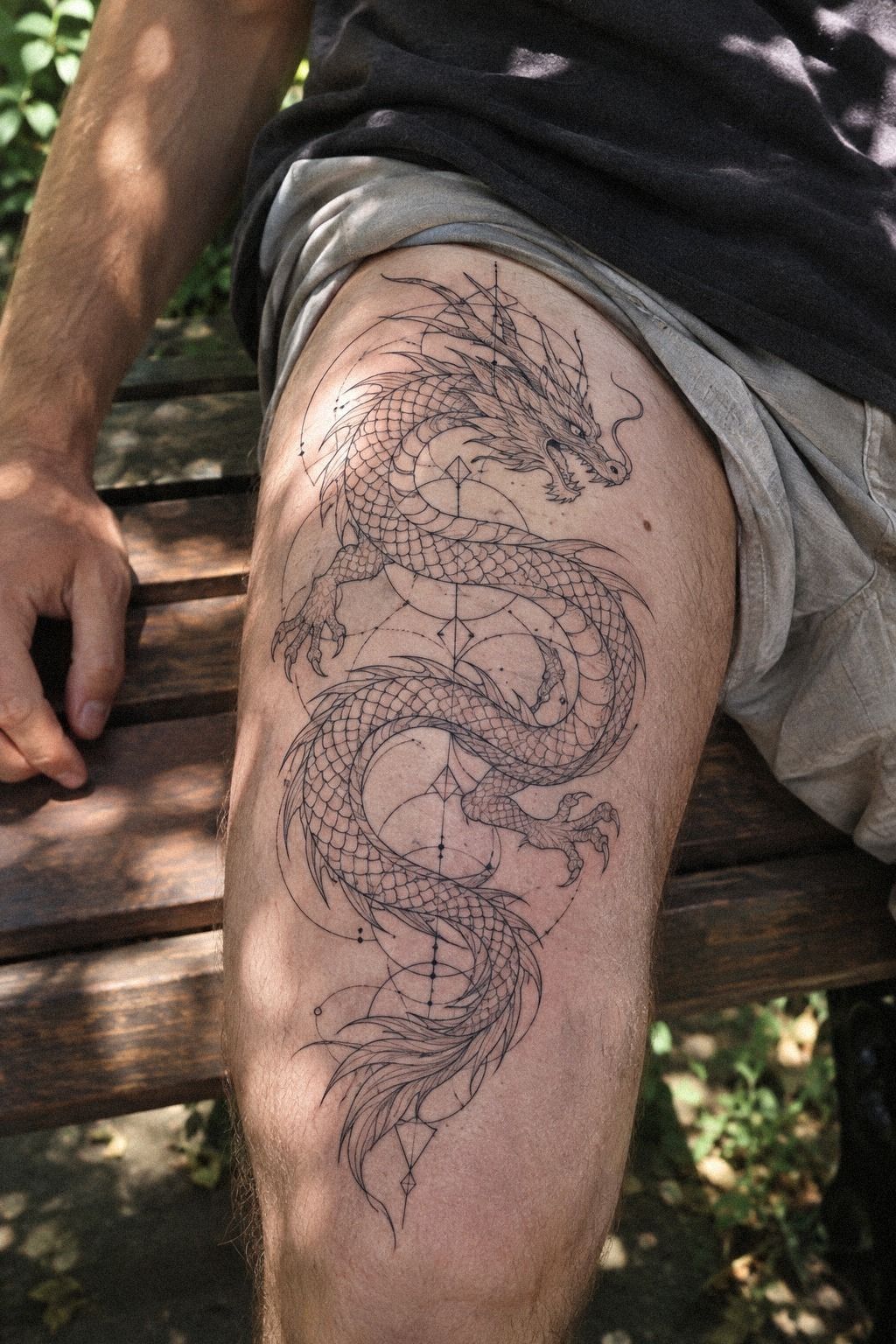
A thigh gives a long canvas for a dragon body, so use the curve as your main design tool. The spine should act as the visual road through the tattoo. Every secondary line needs to support that movement.
Draw the body as one continuous flowing contour before adding fins or scales. A graceful curve can make the tattoo feel ethereal, while abrupt corners may make it look stiff. Your artist should check the line from several positions because the thigh changes shape when you sit, stand, or bend.
Try a loose paper mockup first. You can place a transfer-paper sketch on your skin, walk around, and check it from the front and side. That small test often reveals whether the tail points toward a natural visual exit or ends in an awkward pinch.
I’d avoid placing the dragon’s narrowest section directly across a crease. Movement can distort a fine line, especially during the first few weeks. Instead, let the widest body section cross the most active area and keep the tail on calmer skin.
If you want another reference for body movement, browse watercolor dragon tattoos, even if you plan to stay fully geometric. Their flowing silhouettes can help you see how a dragon moves before you convert the shape into black linework. The finished design should feel romantic and expressive.
8Meaning Over Ornament: Match Geometric Dragon Tattoos to Your Story
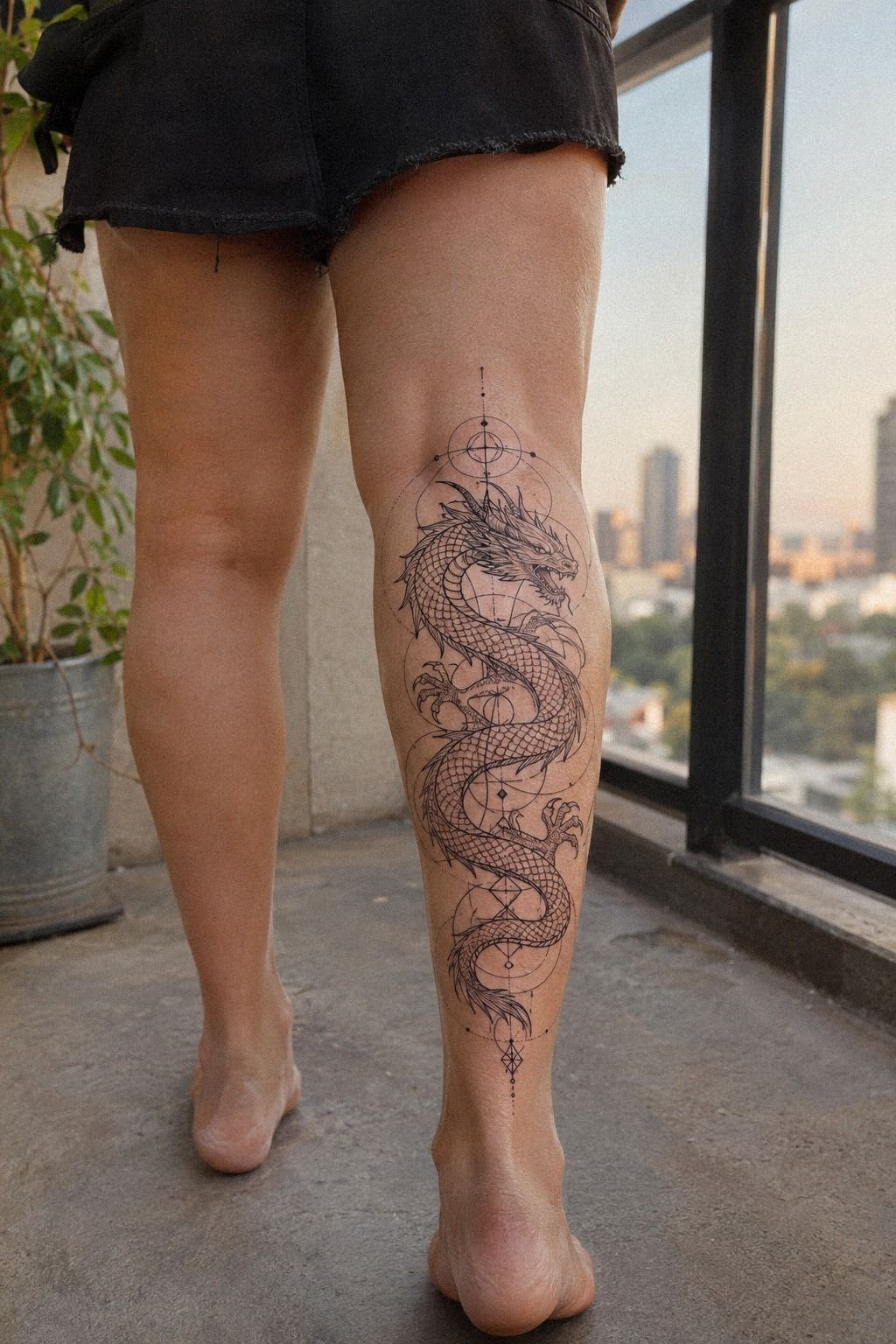
A calf placement can hold a dragon that feels personal without announcing the symbolism loudly. Personal symbolism might come from the dragon’s direction, one small mark, or the space between its wings.
Think about what you want the tattoo to represent before choosing decorative details. Protection, transformation, ancestry, courage, and independence can all lead to different shapes. A sacred meaning may call for restraint rather than a crowded collection of symbols.
I’d write down the one idea you want to remember when you see the tattoo years from now. Then let that idea guide the head, body, and wing structure. The result can feel meaningful, symbolic, and quietly powerful.
9Test Geometric Dragon Tattoo Pain, Healing, and Cost
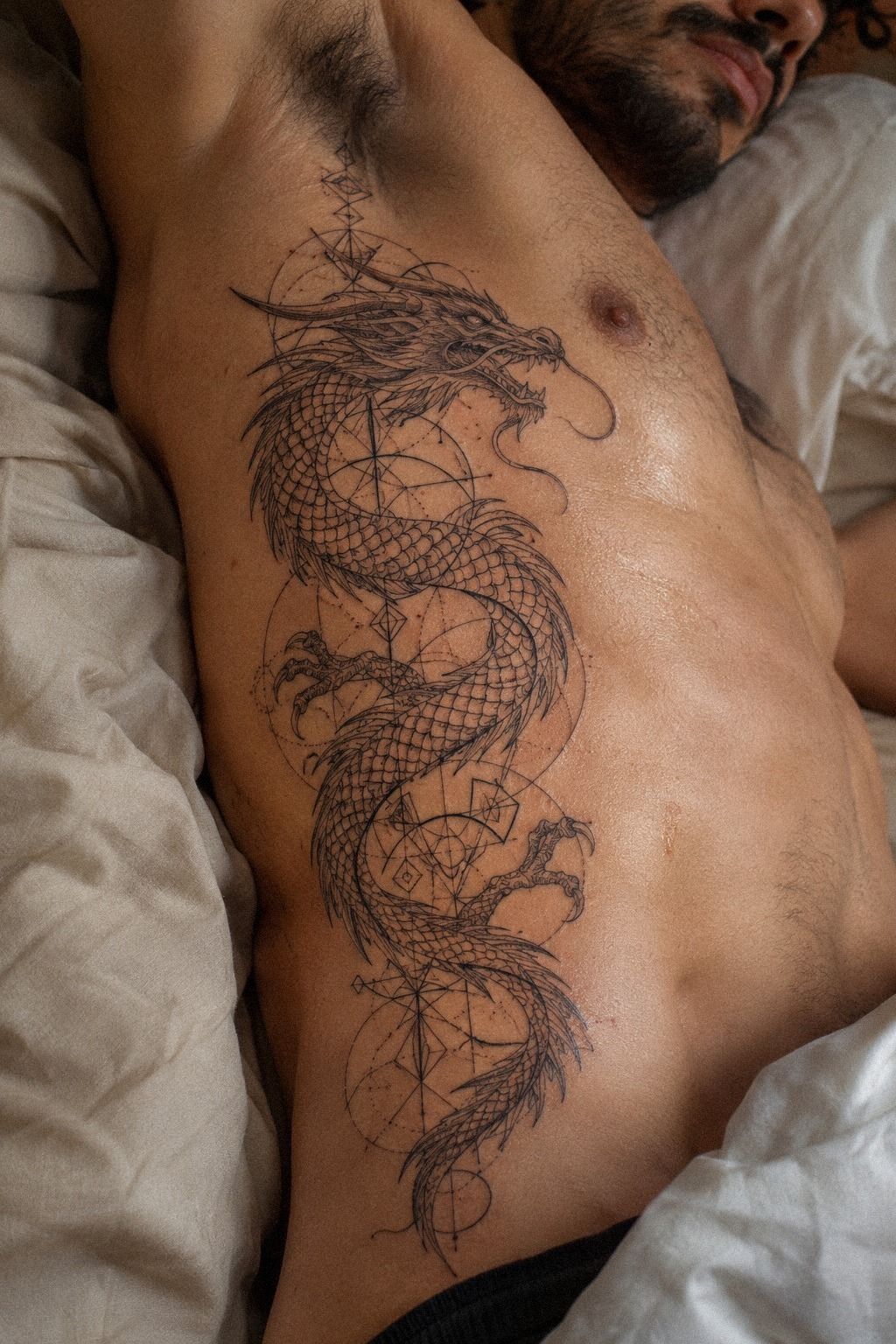
Rib placement can be more painful than the forearm, thigh, or shoulder because the skin is closer to bone and moves with breathing. A narrow design needs to be completed without forcing unnecessary detail into a sensitive area. Comfort matters when you’re judging whether the design is worth it.
Ask your artist how the session will be divided before you arrive. A healing-safe stencil should show where the body line sits, where the densest marks go, and which sections might take longer. You’ll want to eat beforehand, bring water, and wear clothing that won’t rub the area afterward.
Typical surface healing takes about two to three weeks, while complete healing can take about two to three months. Follow the studio’s instructions, wash gently, moisturize as directed, and avoid swimming and strong sun exposure while the skin recovers. Your body needs time, even when the tattoo looks settled.
I’d rather simplify a rib design than rush through an overly packed session. Fine lines can appear raw when fresh, but swelling may temporarily blur the spacing. Give yourself permission to pause if your focus or comfort changes.
Prices vary by artist, region, size, and complexity, so treat the table as a general reference rather than a quote. You’ll want to ask for the studio’s current price estimate before booking. Good aftercare protects the result you paid for.
10Add Symbolic Geometry to Dragon Wings
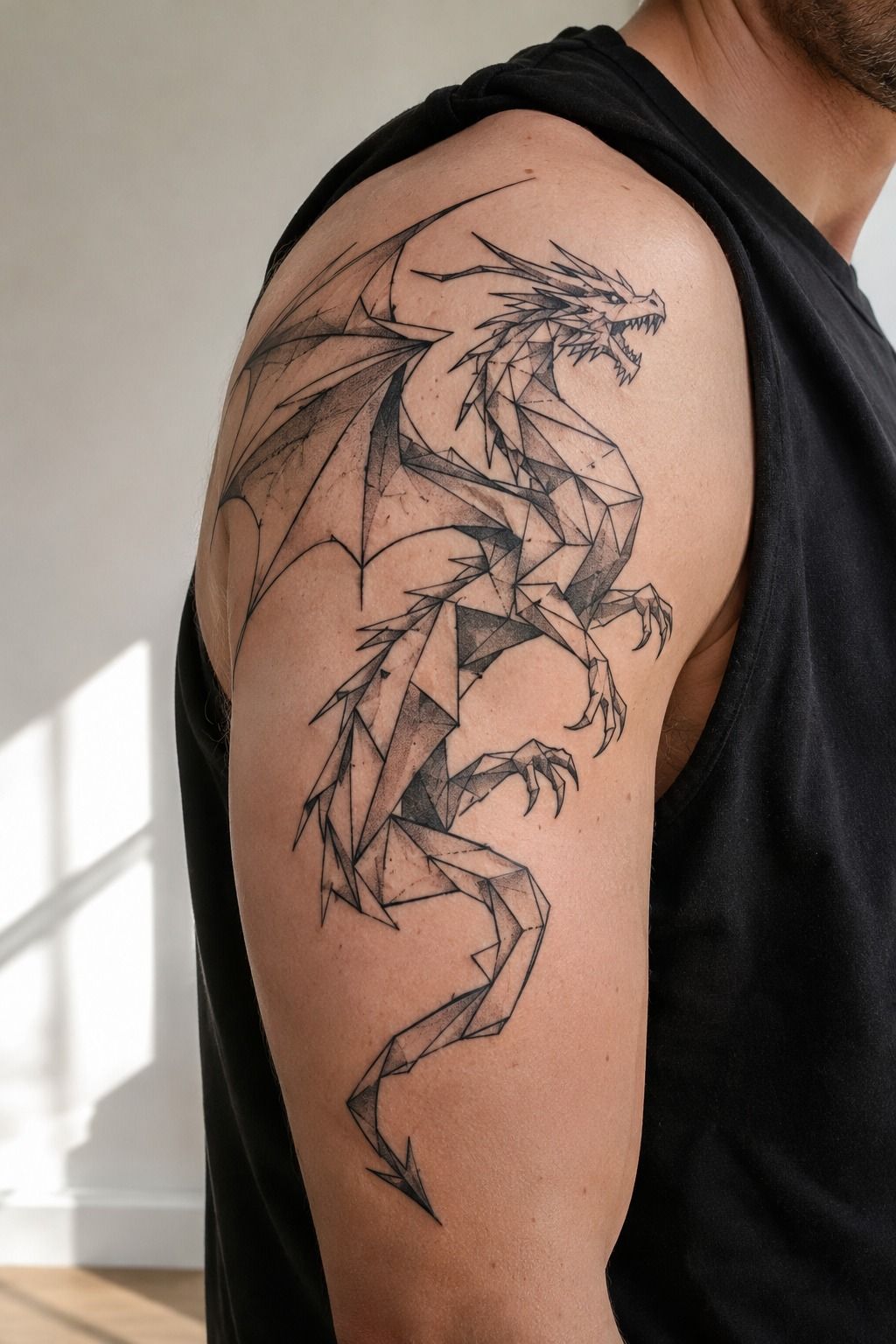
Wing shapes should echo the dragon’s body instead of competing with it. Triangles can create a bold skeletal structure, while curved interior lines can keep the wings graceful. Avoid adding every feather or membrane line if the design is small.
Ask your artist to show you the stencil beside a healed portfolio example. This is where you can see whether dark ink stays open after healing and whether the negative space remains visible. Your artist should be comfortable discussing healed work, not only fresh results.
I’d choose two or three symbolic wing sections instead of a full technical diagram. The dragon will read more clearly, and you’ll have space for the body to remain the main subject. If you want an ornate design, give the wings more space rather than squeezing them into a narrow placement.
You can compare the geometry with geometric unique butterfly tattoos to study repeated shapes. Butterfly wings show how a pattern can feel whimsical and controlled when spacing is consistent. Your dragon wings should support the silhouette first, then add symbolism.
For a softer direction, review watercolor dragon tattoos and focus on their wing movement. You don’t need to copy the color treatment. The useful idea is how an open wing can make a compact body feel larger without adding heavy structure.
11Refine Bold Geometric Dragon Tattoo Details
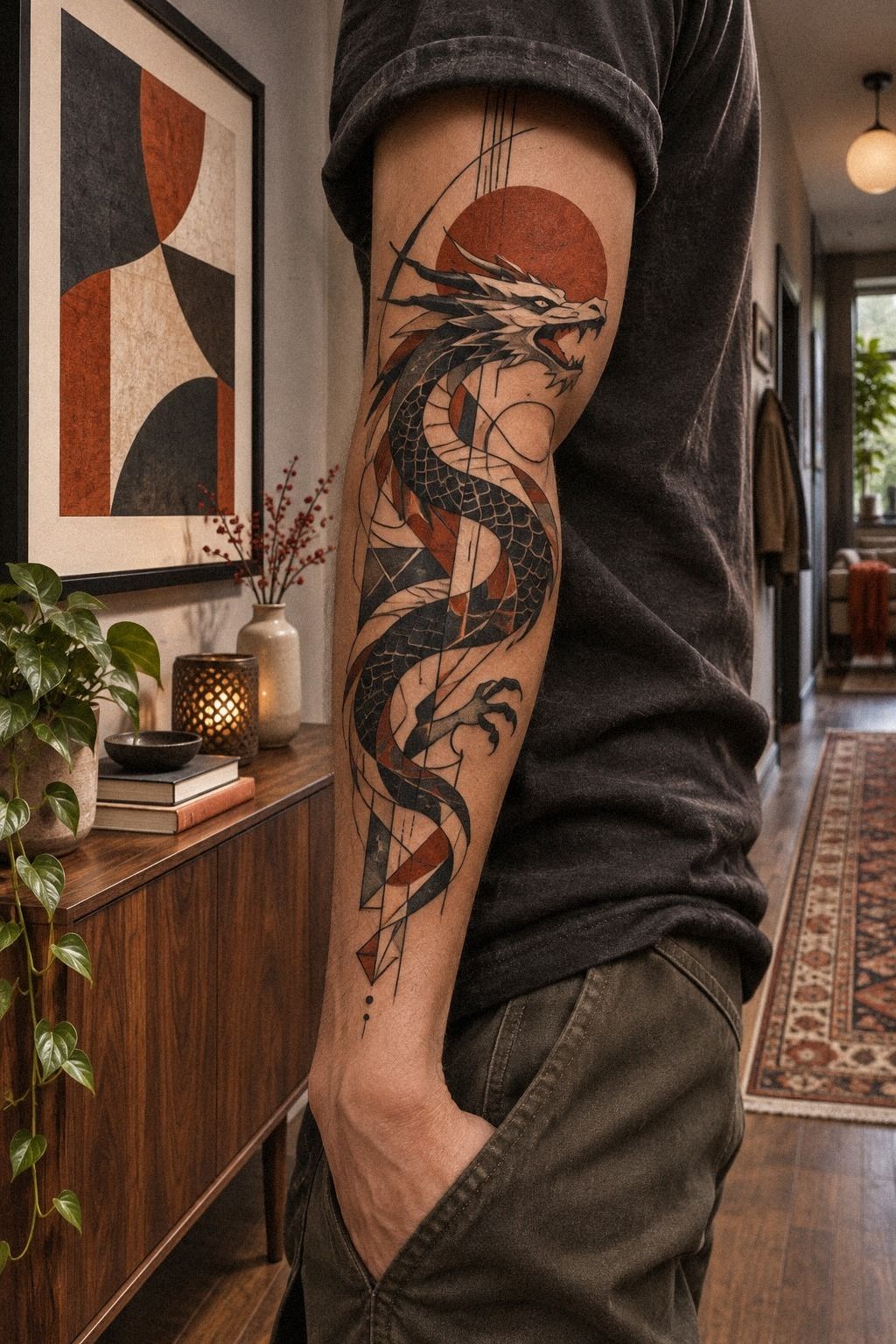
An inner forearm tattoo on deep brown skin with a warm undertone needs thoughtful contrast and placement. Your artist should consider how dark lines will read against your skin tone in both direct light and shade. The strongest result begins with an honest skin-tone discussion.
Ask to see healed examples on skin tones close to yours. A solid black contour may give the dragon a strong edge, while too many pale or extremely fine marks may soften more than you expect. You’ll want the artist to explain which details are essential and which can be removed.
Refine the design in passes: silhouette first, head second, body geometry third, and tiny scales last. That order keeps the tattoo sharp and stylish. If the design stops working after the smallest marks disappear, the structure needs another revision.
I’d skip last-minute additions that only fill empty skin. Negative space is part of the design, and it can make the dragon feel elegant and haunting without losing discretion. You’ll want to leave enough open area for the healed lines to remain distinct over time.
Fine lines may widen as a tattoo ages, while well-placed dark structure tends to hold its shape better. Protect your tattoo from UV exposure once it has healed, and follow your artist’s care guidance. Your final version should feel classic and finished without looking overworked.
Why Discreet Geometry Still Feels Powerful
I’ve changed my mind about small dragon tattoos more than once. At first, I thought the subject needed a large wingspan or a dramatic head to feel convincing.
Then I saw a compact design with one strong curve, a clean eye, and three open spaces around the body. It felt iconic beside several larger pieces I’d saved.
The reason is simple: discretion depends on control, not weakness. A small tattoo can carry a fierce silhouette if the artist protects the outer contour. It can feel gritty through a single broken line, or polished through measured geometry.
Size changes the editing process, but it doesn’t decide the emotional weight.
I also learned that placement matters more than trend language. A rib design can feel intimate, a forearm can feel direct, and a thigh can feel private until you choose to reveal it.
You’ll want to imagine the tattoo during ordinary movement, not only while standing still. What good is perfect symmetry if the design twists every time you walk?
My strongest preference is for one memorable decision. Maybe it’s an unusual tail curve, a small star beside the horn, or a wing built from three open triangles. That detail should have a reason.
If you’re planning a first tattoo, choose the feature you’ll still recognize when the ink has softened years later.
And I don’t think discreet has to mean timid. The best designs can be daring, meaningful, and quiet at the same time!
Start with the shape that carries your story, then let every scale, line, and symbol earn its place. A strong concept can feel empowering without becoming oversized.
If you want to compare compact approaches, revisit these small dragon tattoos and focus on the silhouette rather than the amount of detail.
Let Negative Space Do the Work
Negative space isn’t unfinished design. It’s the breathing room that keeps a small dragon readable. Open skin can separate the head from the body, clarify a wing, and prevent the tail from becoming a dark knot.
I’d protect the largest open areas during every revision. When you’re tempted to add another symbol, ask whether it improves recognition or merely fills space. That decision can save money and improve the long-term value of the tattoo.
A spacing map can help you mark the areas that must remain open. Your artist can use it while adjusting scales, fins, and interior lines. The result should feel understated, not empty.
For another example of controlled open structure, study geometric snake tattoos and notice where the body is allowed to disappear.
Before You Commit, Test the Silhouette
A stencil test gives you information that a digital sketch can’t. Wear the clothing you usually wear, move your arm or leg, and check whether the dragon still reads when your body changes position. You’ll catch awkward tangents early.
Take a few minutes to view the stencil from a normal distance. If the head disappears or the tail points toward a crease, speak up. A small adjustment before the appointment can create a much better final composition.
If you’re still comparing concepts, revisit tiny dragon tattoos and small dragon tattoos with one question in mind: which silhouette has the best value at its intended size? The answer may be simpler than your first draft.
Build a Realistic Tattoo Budget
The cost of a geometric dragon tattoo depends on size, placement, detail, artist experience, and session length. A tiny ankle head may fit a shop minimum, while a rib dragon with extensive geometry may require several hours. Ask for a written estimate when possible.
Your budget should include the design consultation, the tattoo itself, possible touch-up work, and aftercare supplies. That makes the investment easier to judge. A lower price isn’t always better value if the design needs major correction later.
I’d also budget for patience. Rushing toward the cheapest available appointment can limit your artist choice and reduce the time available for revisions. A discreet tattoo is worth planning carefully because every line has a visible job.
Questions Worth Asking Before You Book
Ask whether the artist has healed geometric work, how they approach fine lines, and how they adapt designs to different skin tones. You’ll also want to know the expected session length and the studio’s current price range. Review a healed portfolio before you decide.
Bring your references, but explain what you like about them. Maybe it’s the head profile, the open wing, or the unusual tail.
Your artist can create something more personal when they understand the design principle behind your reference. Watercolor dragon tattoos can be useful for studying movement, even when your final design stays geometric.
Ask how the artist handles revisions. A strong consultation should leave space to simplify, resize, or move the design before the stencil is applied. You’re allowed to say that a detail doesn’t feel right.
A Few Things Worth Answering
How much does a geometric dragon tattoo usually cost?
A geometric dragon tattoo typically costs about $50 to $100 at a shop minimum or around $100 to $250 per hour in the US. The final tattoo price depends on size, placement, artist, region, and detail. Ask for a current estimate before booking.
Are geometric dragon tattoos a good idea for a first tattoo?
Yes, especially on the forearm, thigh, or shoulder, where the placement is often more tolerable and the outline can remain clear. A controlled design gives you a meaningful first piece without requiring a large session. Start with a manageable placement.
How do I choose a tattoo artist for geometric dragon tattoos?
Review healed portfolio examples, clean linework, and geometric animal designs rather than judging only fresh tattoos. A specialist should explain spacing, aging, hygiene, and how the design will fit your skin.
That consultation helps you judge the artist’s value. You can also compare geometric unique butterfly tattoos for repeated-shape technique.
How much do geometric dragon tattoos hurt?
Ribs, feet, hands, and the sternum are commonly more painful, while the forearm, thigh, and shoulder are often more tolerable. Your own sensitivity matters, so ask how long the tattoo session may last and plan a calm day.
How long does a geometric dragon tattoo take to heal?
Surface healing usually takes about two to three weeks, while complete healing can take about two to three months. Gentle washing, approved moisturizer, and avoiding sun and swimming help protect the design. Follow the aftercare instructions your artist provides.
What’s the best placement for geometric dragon tattoos?
The forearm, thigh, and shoulder are strong choices for readability, while the ribs offer a more private placement with greater discomfort. Choose the area that matches your visibility, pain tolerance, and the dragon’s intended flow. A stencil can confirm the placement choice.
Where I’d Start First
If I had to pick one step, I’d start with the outer silhouette. A clean curve survives size changes, clothing, and softened lines better than extra scales ever will. Show your artist the silhouette, test it with a stencil, and let every detail prove it belongs.
The best geometric dragon tattoo isn’t the one with the most lines. It’s the one with the clearest shape, the strongest reason, and enough open skin to remain recognizable.
Give the design time to earn your trust. Worth the patience!