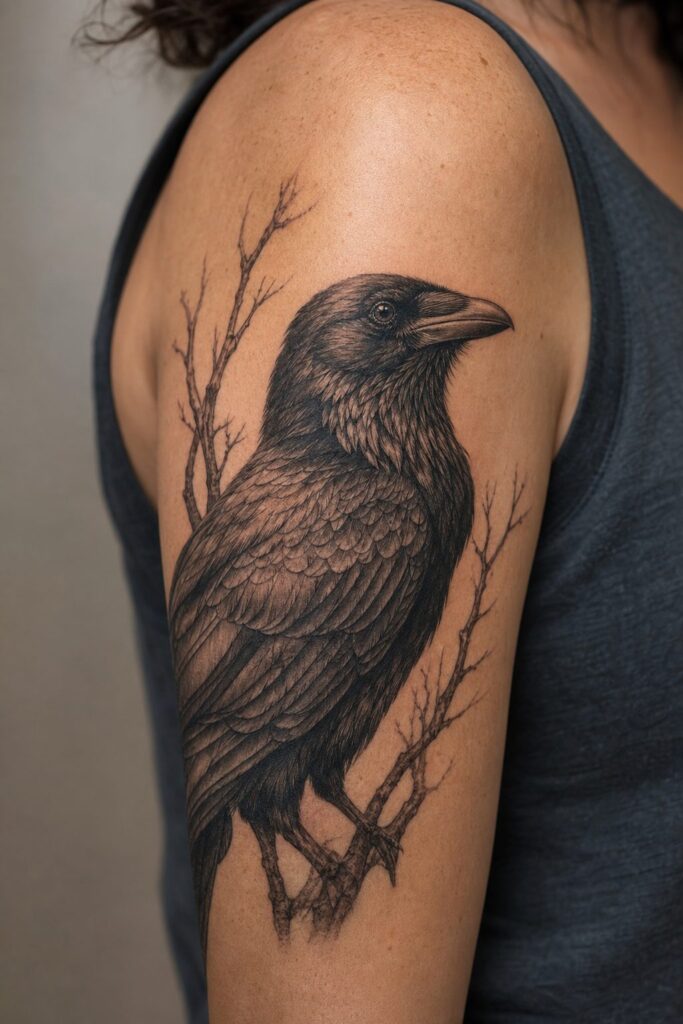
A raven tattoo most commonly signals death, mystery, and the threshold between worlds. But the symbol carries equal weight as a mark of intelligence, adaptability, and transformation. The bird’s black plumage and scavenger diet made it an obvious death omen in European tradition, while its problem-solving skills and complex social bonds gave it a very different reputation among peoples who observed ravens closely. What you emphasize, darkness or wisdom, finality or change, shapes the piece entirely.
Symbolism & Core Meaning
The raven operates as a dual symbol, and most strong designs pick a side or deliberately contrast both.
Death and the Shadow Side
Western folklore cemented the raven as a carrion-eater circling battlefields and gallows. A raven perched on a skull, gravestone, or withered branch speaks to mortality, grief, or personal reckoning with dark periods. This isn’t necessarily negative; many wear it to acknowledge survived trauma, lost relationships, or the acceptance that endings are part of living. The visual language here runs heavy: full black wings, red accent eyes, perhaps a clock or noose integrated.
Intelligence and Trickster Energy
Ravens solve puzzles, use tools, and engage in play, traits that shift the symbol toward cunning and mental sharpness. Norse mythology placed two ravens on Odin’s shoulders, gathering information across the world. A raven with a key, a scroll, or in flight carrying an object emphasizes this messenger or knowledge-bearer aspect. The design mood changes completely: lighter linework, more open composition, perhaps geometric elements suggesting pattern recognition.
Mythology & Folklore
Cross-cultural raven mythology is dense enough to anchor a tattoo in specific tradition rather than generic gothic aesthetic.
Norse and Celtic Threads
Huginn and Muninn, Thought and Memory, fly through Norse texts as Odin’s scouts, returning each evening to whisper what they’ve seen. A paired raven tattoo directly references this, often with subtle differentiation: one looking forward, one backward, or carrying distinct objects. Celtic tradition, often linked to the Morrígan, casts the raven as a battlefield goddess’s form, selecting the slain. Here the bird connects to fate, sovereignty, and the warrior’s acceptance of death as part of honor.
Pacific Northwest and Indigenous North American
For many peoples of the Pacific Northwest, Raven is a creator figure, a trickster who stole light and brought it to humanity. The visual tradition here is wholly distinct: formline design, ovoid shapes, bold formlines in black and red. This is not interchangeable with European raven imagery. If this tradition isn’t yours, appropriating its specific visual language is generally considered poor practice; the stories themselves, however, illustrate how dramatically the same bird flips between cultures, from death omen to culture hero.
Similar & Related Symbols
Understanding what sits adjacent to the raven helps clarify your intent and avoid muddled composition.
- Crow: Often conflated, but crows are smaller, more social, and carry slightly less mythic weight. A single large bird with heavier beak and shaggy throat feathers reads as raven specifically.
- Vulture: Shares the carrion association but lacks the intelligence and messenger dimensions. More purely about death and cleansing.
- Skull: Obvious pairing for mortality emphasis, but can tip into cliché unless the composition adds something specific, raven interacting with the skull rather than simply perched.
- Wolf: Both shadow animals, but wolf emphasizes pack loyalty and wildness where raven emphasizes mind and threshold-crossing.
- Moon: Night-time pairing that amplifies mystery and cycles; raven with full moon versus crescent changes the temporal feel.
- Key or lock: Plays the messenger/access angle, suggesting secrets, hidden knowledge, or boundaries crossed.
Best Placements
Raven anatomy, wingspan, beak line, tail shape, suits certain body contours better than others.
Flowing with the Body
The extended wing makes the raven natural for across-the-shoulder blade placement, wingtip reaching toward the deltoid. A raven in flight works down the outer forearm, beak pointing toward the wrist or elbow depending on whether you want forward or inward energy. The bird’s silhouette fits the calf’s vertical space well, especially with wings partially spread. Chest pieces allow for two ravens facing each other, creating a framed central space for additional elements.
Scale and Composition
Small raven tattoos (under three inches) lose the beak detail and feather texture that make the bird readable; it becomes a generic black bird. Minimum effective size for a recognizable raven with individual feather suggestion is roughly four inches in the longest dimension. Large pieces (ten-plus inches) can carry environmental context, storm clouds, bare branches, moon, which shifts the piece from symbol to scene.
How It Ages on Skin
Raven tattoos are predominantly black ink, which behaves predictably over time but has specific considerations.
Black Ink Longevity
Black holds better than any color, but heavy solid black areas can blur at edges over a decade, especially on high-movement spots like inner bicep or ribs where skin flexes constantly. A raven rendered as pure silhouette with no internal detail becomes a blob faster than one with feather texture created through negative space and varied line weight. The latter ages into a softer but still readable image; the former becomes an indistinct dark shape.
Contrast and Detail
White ink highlights (beak glare, eye catchlights) fade or yellow within two to five years and often require reinforcement. Gray wash shading for feather dimension lasts longer but can muddy if the original values were too close together. Ask to see healed photos of black-and-gray bird work from your artist, not just fresh pieces. The difference between day-one crispness and year-three reality is significant for this subject.
Who Chooses This Tattoo
There’s no single demographic, but certain patterns emerge in shop conversation.
People drawn to raven imagery often occupy some position between worlds, transitional life phases, subcultural spaces, or professions dealing with death and transformation. Funeral workers, therapists, writers, and military veterans show up disproportionately, though the tattoo certainly isn’t limited to these. The gothic aesthetic association means younger wearers sometimes arrive with band-album imagery in mind, while older clients more often reference specific mythological or personal narrative connections.
The choice between single raven and pair is meaningful. One suggests solitary energy, individual shadow work, perhaps a guardian or familiar. Two immediately invoke the Huginn/Muninn reference, or partnership, or the tension between two states of being. Three or more shifts toward murder (the collective noun) energy, more chaotic, less individually symbolic.
What to Remember
A raven tattoo succeeds when it commits to a specific symbolic direction rather than piling on every possible association. Death plus intelligence plus messenger plus trickster plus gothic aesthetic equals visual noise. Pick two threads maximum and let the design breathe. The bird’s form is distinctive enough to carry weight without excessive ornament; a well-drawn raven in simple flight often outperforms a crowded scene.
Consider the cultural source of your specific imagery. Norse-inspired knotwork carries different obligations than Pacific Northwest formline, which differs again from purely illustrative realism. The raven’s meaning isn’t universal; it shifts with the tradition you invoke, and your design should reflect that specificity rather than treating all black birds as interchangeable.
Finally, respect the aging reality. This is a black-dominant tattoo that will live in your skin for decades. Prioritize feather texture and negative space over solid black blocks, and place it where the body’s movement won’t accelerate the blur. A raven that remains readable at fifteen years carries more weight than one that impressed on Instagram day one.
Frequently Asked Questions
Does a raven tattoo always mean death?
Not necessarily. While European folklore heavily associates ravens with mortality, the same bird represents intelligence, messengers, and transformation in other traditions. Your specific imagery and accompanying elements determine which meaning dominates.
What’s the difference between a raven and crow tattoo?
Ravens are larger with heavier, more curved beaks and shaggy throat feathers. Crows have straighter, finer beaks and lack that throat texture. Mythologically, ravens carry more weight as individual symbols; crows tend toward group or omen imagery.
How much detail can a small raven tattoo hold?
Less than most people expect. Under three to four inches, feather texture disappears and the bird reads as generic black bird. For a recognizable raven with detail, plan at least four inches in the longest dimension, or accept a bold silhouette approach.
Is it cultural appropriation to get a raven tattoo?
The raven appears across many cultures, so the question is which visual language you use. Norse-inspired knotwork or European gothic styling generally raises fewer concerns than appropriating specific Indigenous formline designs from the Pacific Northwest if that tradition isn’t yours.
Leave a Reply