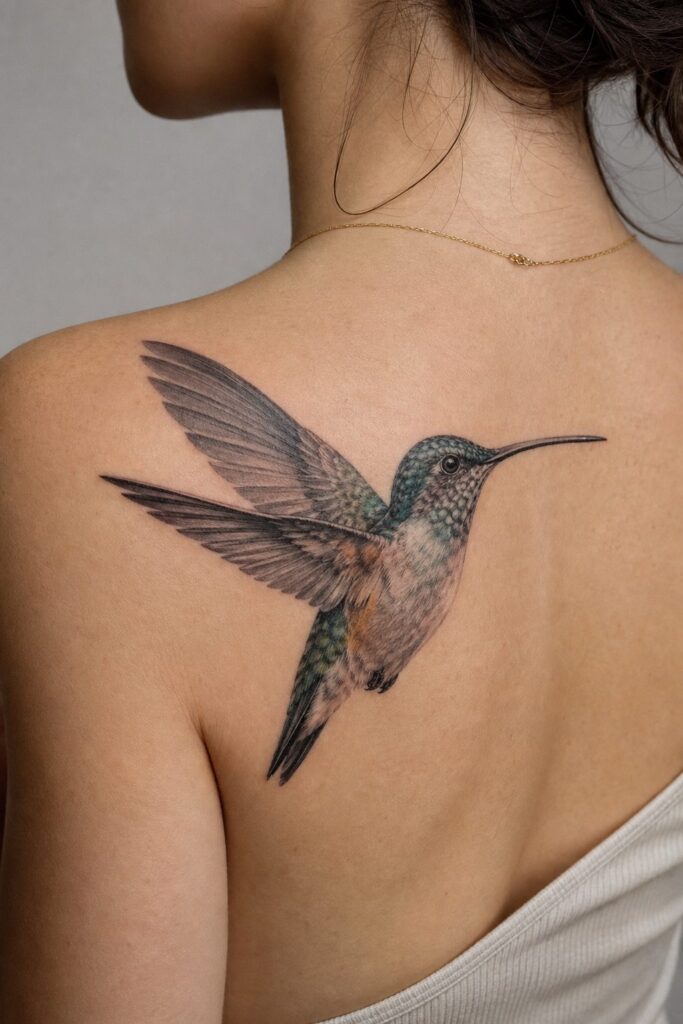
The colibri bird tattoo, depicting the hummingbird, centers on relentless energy and the capacity to thrive against physical odds. Its heart beats up to 1,200 times per minute; its wings blur at 50-80 beats per second. That biological reality translates into ink as a symbol of endurance, adaptability, and finding nourishment in unlikely places. Most people drawn to this image aren’t after decoration, they want a permanent marker of persistence through difficulty.
Similar & Related Symbols
Bird tattoos cluster around freedom and transcendence, but the colibri occupies a distinct niche. Where eagles project dominance and swallows signal safe return, the hummingbird’s symbolism runs tighter and more specific.
Overlapping Icons
Dragonflies share the colibri’s association with quick, almost magical movement and transformation. Both creatures hover, defy expected aerodynamics, and appear in contexts of personal change. Butterflies overlap on metamorphosis but lack the colibri’s aggression, hummingbirds fight, dive, and defend territory with surprising ferocity for their size. Bees match the colibri’s pollination role and work ethic, though the bee carries more collective/social weight while the colibri reads as individual striving.
What Sets the Colibri Apart
The specific biology matters. No other bird can fly backward, hover indefinitely, or sustain such metabolic extremes. That translates to tattoo meaning: not just general perseverance, but the kind that looks impossible on paper. Someone recovering from prolonged illness, rebuilding after collapse, or operating in a body that doesn’t cooperate often gravitates here. The image says this shouldn’t work, but it does.
Symbolism & Core Meaning
Across cultures, certain associations recur with remarkable consistency. The colibri’s meaning isn’t scattered, it’s focused.
Energy and Vitality
The visible blur of wings, the constant motion, the need to feed every 10-15 minutes, these biological facts shape the symbol. In tattoo form, this often shows up as dynamic linework: spirals, motion lines, wings caught mid-beat. Static, perched colibris read differently; they can suggest pause or reflection, but lose the core kinetic energy. Artists emphasizing vitality typically angle the body in flight, beak dipped toward a flower, tail feathers spread for braking.
Resilience and Endurance
The migration fact surprises people: ruby-throated hummingbirds cross 500 miles of open Gulf water in a single flight, beating nonstop for 18-22 hours. That specific feat underlies much of the resilience symbolism. Tattoo clients referencing this often choose Gulf Coast color palettes, deep blues, storm grays, sudden orange, or incorporate water elements beneath the bird. The meaning isn’t vague toughness; it’s documented, specific survival against distance and exhaustion.
- Flight through storm imagery: rain streaks, darkened backgrounds, the bird lit from within
- Worn or weathered wing details: not damage, but evidence of miles traveled
- Paired with clocks or hourglasses: the time-bound nature of extreme effort
Common Variations & Styles
How the colibri gets rendered changes what it communicates. Same bird, different dialects.
Traditional and Neo-Traditional
American traditional builds the colibri from bold outlines, limited color palette (typically greens, reds, blacks), and heavy saturation. The bird reads immediately, holds up for decades, and carries the style’s working-class resilience associations. Neo-traditional loosens the color range, iridescent throat patches rendered in purples, teals, copper metallics, while keeping readable structure. Both approaches age well; the heavy line weight prevents the fine detail from blurring into soup.
Realism and Watercolor
Photorealistic colibris demand technical precision: the structural color of gorget feathers (not pigment, but light refraction through feather structure) challenges even experienced artists. Successful pieces use reference photography of specific species, Anna’s, Costa’s, rufous, and replicate exact color patterns. Watercolor style abandons outline entirely, building form from color washes and negative space. It captures the bird’s seeming impossibility but requires more frequent touch-ups; the lack of black line means faster fade and blur.
Placement shapes style choice. Behind the ear or on the wrist, fine-line and minimal approaches work; the small scale reads as intimate, almost secret. Chest pieces or upper back allow full color realism with space for environmental context, flowers, feeders, specific landscapes that ground the meaning.
Religious & Spiritual Angles
The colibri’s spiritual significance varies by tradition, but certain threads appear across boundaries.
Indigenous Americas
In Aztec tradition, the colibri was often linked to Huitzilopochtli, the warrior god of sun and war, his name deriving from huitzilin, hummingbird. Warriors killed in battle were believed to be reborn as these birds. Some trace specific Mesoamerican royal insignia to hummingbird imagery. In Pueblo and Navajo contexts, the bird commonly serves as messenger, carrying prayers or souls between realms. Tattoo references to these traditions require care; the imagery can be respectful homage or clumsy appropriation depending on the wearer’s connection and the artist’s research.
Christian and Contemporary Spiritual
Within Christianity, the colibri’s constant motion and search for nectar sometimes maps onto seeking divine sustenance, “always hungry, always fed.” Some contemporary spiritual practitioners use the bird as a totem for presence: the hummingbird cannot store energy the way a bear fattening for winter does; it must find today’s food today. That translates to mindfulness practices, to tattoo meaning about staying present rather than hoarding or projecting.
Personal & Modern Meanings
Current tattoo culture has developed specific, often unspoken codes around the colibri.
Recovery and Survival
Eating disorder recovery communities have adopted the colibri with particular intensity. The bird’s need for constant fuel, its inability to go without, its thinness as functional rather than aesthetic, these resonate. The tattoo marks a body that has been at war with its own needs, now choosing to feed rather than starve. Similar patterns appear in addiction recovery: the hummingbird’s metabolism as metaphor for systems that require maintenance, not one-time fixes.
Queer and Trans Symbolism
The colibri’s defiance of expected aerodynamics, its body “shouldn’t” fly by standard physics, has been claimed by communities whose bodies and identities are told they shouldn’t exist, shouldn’t function, shouldn’t persist. The iridescent throat patch, shifting color with angle and light, reads as fluidity made visible. These aren’t universal meanings; they’re specific subcultural uses that have developed organically and spread through shared recognition.
Mythology & Folklore
Stories about the colibri predate tattoo culture by millennia, and those narratives still seep into contemporary choices.
Caribbean and South American Tales
Taino folklore often links the colibri to the creation of tobacco, the bird carrying a sacred plant from spirit to human realms. In some Andean stories, the hummingbird is the only creature able to pass between the three worlds, underworld, earth, and sky, making it the sole messenger capable of reconciling divided realms. Tattoo compositions referencing this sometimes show the bird at a threshold: window frames, doorways, the edge of water meeting land.
North American Folklore
Various Plains and Woodlands stories cast the colibri as trickster or transformer, often the one creature clever enough to solve what strength cannot. In some versions, the bird’s small size becomes advantage: it alone can fit where the problem lives, can extract what larger beings would crush. This maps neatly onto modern uses, the person underestimated who proves essential, the quiet persistence that outlasts loud force.
The Bottom Line
The colibri bird tattoo works because the biology is undeniable. This is not a symbol invented whole; it’s a creature that actually lives at the edge of physical possibility, that dies in hours without constant effort, that crosses impossible distances because the alternative is death. The meaning stays grounded in that reality whether rendered in thick black traditional lines or bleeding watercolor washes. Choose the style that fits your skin and your story, but understand what you’re claiming: not ease, not peace, but the specific triumph of continued motion against resistance. The best colibri tattoos look like they might vibrate off the skin, like the wings haven’t quite stopped. That’s the point.
Frequently Asked Questions
Does a colibri tattoo have to be colorful to work?
Black and grey colibri tattoos hold their own, especially in fine-line or illustrative styles. The bird’s recognizable silhouette, long beak, compact body, spread tail, reads clearly without color. That said, the iridescent throat is often the emotional center, so losing those greens and reds shifts the emphasis toward form over flash.
How well do detailed hummingbird tattoos age?
Fine feather detail and watercolor fades blur faster than bold traditional work. The gorget (throat patch) color complexity often softens into a general glow within five to seven years. Plan for touch-ups if you choose realism, or lean into styles where some blur enhances rather than damages the design.
What’s the most common placement mistake?
Wrapping a detailed colibri around a finger or too close to a joint. The bird’s long beak and spread tail need flat, stable skin to avoid distortion with movement. Wrists, forearms, shoulders, and ribs give the shape room to breathe without the geometry warping.
Can a colibri tattoo reference a specific person?
Absolutely. Many people choose the bird to mark a specific relationship, often a mother, grandmother, or child who embodied tireless care. Some add specific flowers the person loved, or render the bird in colors tied to birthstones, countries, or causes. The core symbol remains, but the personalization makes it singular.
Leave a Reply