A honey bee tattoo most commonly represents hard work, loyalty, and the strength of community. For many, it serves as a personal reminder to stay productive through difficult seasons, or to honor the interconnectedness of family, friends, or a team. The meaning can sharpen depending on placement and design choices, a single bee reads differently from a full hive, and a geometric rendering carries another tone entirely.
Common Variations & Styles
Not every bee tattoo lands the same way. The style you choose shifts the emotional weight and visual impact significantly.
Realistic vs. Traditional
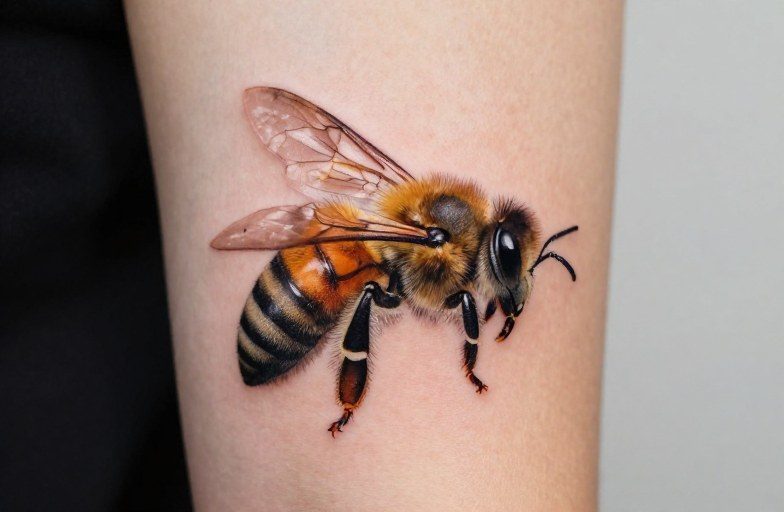
Realistic bees, with segmented bodies, translucent wings, and fine hair detail, suit larger placements like the upper arm or thigh where the artist has room to build depth. Traditional American or neo-traditional versions, bold black outlines, limited color palette, stylized wings, read more graphic and immediate. They hold up better at smaller sizes and on high-movement areas like wrists or ankles. Traditional bees also pair naturally with banners, flowers, or scrollwork if you want to add text or companion imagery.
Minimalist and Fine Line
Single-needle and fine-line bees have surged in popularity, especially behind the ear, on the collarbone, or along the finger. These rely on precise linework rather than shading. The trade-off: fine lines soften faster, and yellow ink (common in bee designs) fades quicker than black. If you go this route, plan for touch-ups and avoid heavy sun exposure on the area.
- Single bee: independence, personal diligence, a reminder to “keep going”
- Hive or swarm: family, community, collective strength
- Bee with honeycomb: structure, productivity, sweetness earned through effort
- Queen bee: leadership, maternal power, self-possession
History & Cultural Roots
The honey bee carries weight across multiple civilizations, though specific meanings vary and some origins remain debated.
Ancient Mediterranean
Bees were often linked to priestesses and oracles in ancient Greece. The priestesses of Delphi were sometimes called “bees,” and the insect was commonly associated with divine communication. In Egyptian symbolism, the bee was a hieroglyph representing Lower Egypt and, by extension, royalty and order. These associations make the bee a solid choice for anyone drawn to ancient symbolism without defaulting to overused motifs.
European Heraldry and Industry
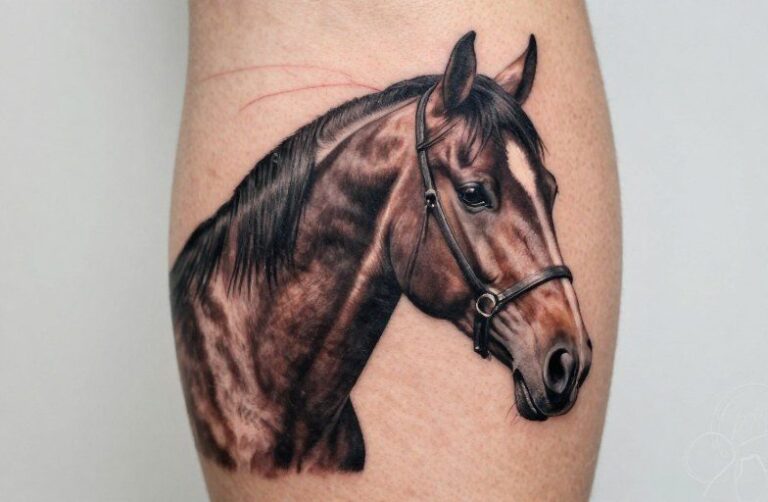
In Victorian England and later in American craft traditions, the bee became an emblem of industry and moral virtue. The phrase “busy as a bee” carried genuine social weight. This legacy persists in the tattoo’s continued association with work ethic and perseverance, meanings that feel especially relevant for people marking career transitions, entrepreneurial ventures, or recovery from burnout. The horse tattoo shares this territory as a symbol of unstoppable will and earned freedom.
Color vs. Black and Grey
The choice between color and black and grey affects both symbolism and longevity.
Yellow and gold inks are central to most people’s mental image of a bee, but they present technical challenges. Yellow sits lighter on the value scale and can look muddy or greenish as it ages, especially if applied over grey wash or near black lines. Solid, saturated yellow holds better than washed-out or pastel versions. Some artists build yellow over a white ink base to keep it bright longer.
Black and grey bees, by contrast, age with more predictability. The contrast between dark stripes and negative-space wings reads clearly even as lines soften. For a design that needs to stay legible on a small scale or in a high-friction area (hands, feet, inner arm), black and grey is the safer bet. That said, a well-executed color bee with strong black outlines can remain vivid for years if protected from sun and properly moisturized during healing.
Mythology & Folklore
Beyond the ancient Mediterranean, bees appear in folk traditions worldwide, often with liminal or sacred associations.
Celtic and Norse Threads
In some Celtic traditions, bees were believed to possess secret knowledge or to serve as messengers between worlds. The “telling the bees” custom, informing hive bees of a family death, survived into the 20th century in parts of rural England and Appalachia. This makes the bee a potent symbol for grief, memory, or honoring the dead without resorting to more obvious imagery like skulls or dates. For another bird connected to memory and the liminal, the crow tattoo symbolism covers similar territory of transition between worlds.
African and Diasporic Symbolism
Some Yoruba-derived traditions in the Americas associate bees with Oshun, the orisha of sweetness, love, and fresh water. A bee paired with honey, rivers, or gold tones can reference this connection. As with any cultural symbol outside your own lineage, research thoroughly and consider whether the specific combination respects its source rather than treating it as aesthetic texture.
Design Tips & Pairings
Placement and companion imagery shape how a bee tattoo reads to others and to you.
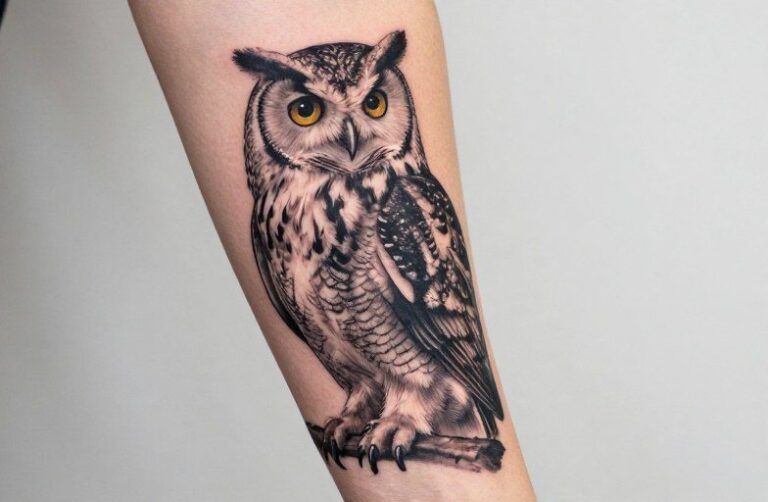
Bees fly. That motion makes them naturally suited to placements that follow the body’s flow, along the forearm pointing toward the hand, across the shoulder toward the collarbone, or up the calf. For comparison, the guardian owl tattoo handles stationary placement differently, relying on the eyes and branch perch to generate direction. Static, centered placements (dead center on the chest, flat on the lower back) can feel visually stuck unless the design incorporates surrounding elements that create implied movement.
Companion Imagery That Works
- Flowers: logical and visually balanced; the bee’s scale against a large bloom (peony, sunflower, wildflower cluster) creates natural contrast
- Honeycomb: geometric counterpoint to organic bee shapes; fills background cleanly
- Script or banners: best with traditional or neo-traditional styles; keep text short for legibility
- Skulls or hourglasses: “memento mori” twist, life is short, stay busy, produce while you can
Scale Considerations
A bee’s anatomy includes thin legs, antennae, and wing veins that blur if compressed too small. For readable detail, plan on at least 2, 3 inches in the longest dimension. Smaller than that, and the artist must simplify dramatically, often to the point of silhouette or icon, which is fine if that’s the aesthetic you want, but disappointing if you expected realism.
How It Ages on Skin
All tattoos change, but bee designs have specific vulnerabilities.
The wing membranes, whether rendered as negative space or light grey wash, tend to disappear first as surrounding ink bleeds slightly and skin texture changes. Bold black stripes hold their edge longer. If your design relies on subtle gradation between the thorax and abdomen, expect that transition to soften into a more uniform tone within five to ten years.
Yellow ink, as mentioned, fades faster than black. Some brands of yellow also carry higher risk of allergic reaction, though this varies by individual and ink batch. Discuss pigment choices with your artist if you have sensitive skin or prior reactions.
Areas with frequent friction or sun exposure, the top of the foot, outer forearm, back of the neck, will show age faster. A bee on the inner bicep or upper thigh, protected by clothing, maintains crispness longer. Plan your touch-up schedule realistically: most bee tattoos benefit from a refresh at year five, especially if color-heavy.
The Bottom Line
A honey bee tattoo works because its symbolism is immediate without being rigid. It can mark loyalty to a group, a personal commitment to productivity, or a connection to specific cultural or familial traditions. The design succeeds or fails on technical specifics, line weight, color saturation, placement relative to movement and sun, more than on conceptual complexity. Choose a style that matches your pain tolerance for touch-ups, pair it with imagery that earns its space rather than cluttering the composition, and trust the bee’s long visual history to carry meaning without heavy-handed explanation.
Frequently Asked Questions
Does a honey bee tattoo always mean hard work?
Not necessarily. While industry is the most common association, many people choose bees for loyalty, community, or personal connections to beekeeping family members. The meaning depends on your own context and any companion imagery.
How painful is a bee tattoo compared to other designs?
Pain depends on placement, not the image itself. A bee on a bony area like the ankle or collarbone hurts more than one on the thigh or outer arm. Small, detailed bees can also require longer sessions of fine-line work, which some find more irritating than bold shading.
Will a yellow bee tattoo fade to green?
Some yellow inks can shift toward a greenish or muddy tone as they age, especially if applied thinly or mixed with nearby black during healing. Using high-quality pigment and keeping the tattoo out of sun helps preserve the original tone.
Can a bee tattoo be covered up easily if I change my mind?
Small, dark bees are challenging to cover because black ink is dense. A larger bee with open wings and light areas offers more options for a cover-up artist to work with. Always plan for the long term, even with small designs.