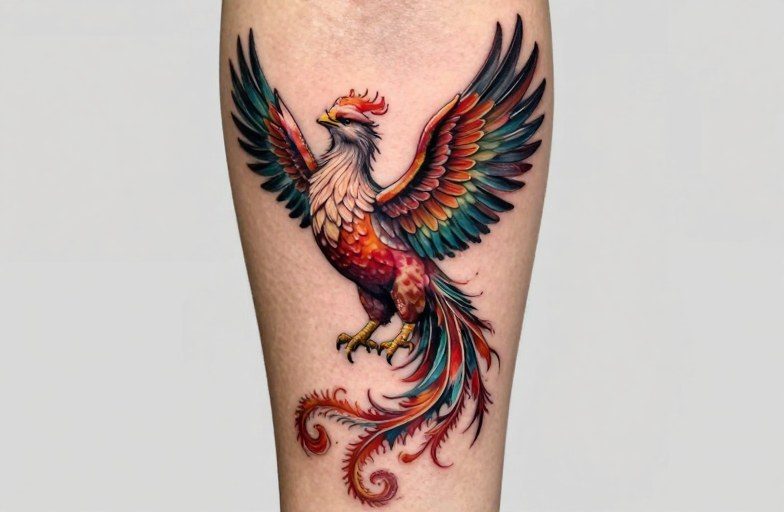
Phoenix tattoos have dominated shop floors for decades, but the realistic approach separates flash art from something that earns double-takes. The challenge is biological accuracy colliding with mythological fire. You are not etching a known species; you are convincing the eye that feathers scorched by flame could exist. That tension demands precise decisions about placement, scale, and how ink behaves as it settles into skin.
For First-Timers
First realistic phoenix usually means first large piece. The subject demands space. Wingspan, flame trailing, head in profile or three-quarter view, compression destroys the illusion. Budget for multiple sessions from the start. A rushed realistic bird at small scale reads as a smudged eagle with orange accents.
Placement That Supports the Form
Back pieces and full thighs offer the natural horizontal stretch for wings. Ribs work for ascending poses with trailing tail feathers, though the canvas twists with breath. Upper arms and outer calves suit vertical compositions, perched or launching upward. Avoid the temptation to wrap a phoenix around a limb early in your collection; the form fractures and the realism collapses at the seam.
What Heals Differently
Realistic work relies on smooth gradients. White ink highlights and pale yellow flame tips fade fastest. Plan for a touch-up at eight to twelve weeks, especially in areas that see sun or friction. Moisture management during healing matters more with color realism than with black-and-grey; scabbing pulls pigment unevenly from saturated fields.
Trending Variations
Current floors favor hybrid creatures and environmental storytelling. Pure fire-bird realism still anchors the genre, but artists are pushing boundaries.
- Charred transition: One wing intact, the other reduced to ember and bone, showing the rebirth cycle literally rather than symbolically.
- Ornithological accuracy: Golden eagle or harpy eagle anatomy as foundation, with flame replacing standard plumage at primary feather tips.
- Environmental collapse: Phoenix rising from ash that incorporates actual landscape, burnt forest, collapsed architecture, volcanic terrain.
Motion Studies
Static perched phoenix reads as taxidermy. Shops are executing more launch and descent poses: talons extended, wings at full spread asymmetrically, body torqued. The twist creates shadow play across the breast and underwing, which feeds the realism. Reference photographs of red-tailed hawks stooping or golden eagles snatching prey provide the anatomical honesty that makes the fantasy believable.
Popular Styles
Realistic phoenix work clusters into technical approaches that define the final look. Understanding the distinction helps you communicate with artists who may specialize in one path.
Photorealistic Color
Airbrush-style gradients, no visible linework, feather barbs rendered individually. Requires an artist with portrait or wildlife specialization. Heals softer than it appears fresh; expect some loss of the hyper-crisp detail that exists day one. Best on pale skin with minimal sun damage. The orange-to-crimson spectrum needs neutral or cool undertones in the surrounding skin to avoid reading as pure warmth.
Black-and-Grey with Selective Warmth
Charcoal and soot tones for the body, flame rendered in sparse orange or left as negative space with only the hottest points colored. Holds longer. Suits collectors building a predominantly monochrome body of work who want one controlled color exception. The limited palette also ages more gracefully; there is less pigment to shift and muddy.
Neo-Traditional Structure with Realistic Rendering
Strong black outlines defining major forms, but interior shading approaches photographic. Compromise for those who want the readability of traditional tattooing with the impact of realism. The outline prevents the “blur into surrounding skin” that pure realism can suffer after five years.
Color Choices
Fire color is not universal. The phoenix palette ranges from candle-flame yellow through forge-orange to arterial crimson and smoke violet. Your skin tone dictates what registers as luminous versus muddy.
- Cool undertones: Lean crimson and magenta for the core flame, with orange as secondary. Avoid yellow-heavy palettes; they sallow against pink or olive skin.
- Warm undertones: Gold and tangerine read as genuine light emission. Crimson can bruise visually; use it sparingly at the heart of the fire.
- Deeper skin: White and pale yellow struggle to stay visible. Concentrate saturation at orange and red, use black for smoke and ash contrast, and place the brightest highlights where they will not be lost to melanin density.
Smoke and ash deserve equal attention. Blue-grey smoke against warm flame creates temperature contrast that sells the illusion. Flat grey reads as unfinished; it needs the same gradient attention as the fire itself.
Matching & Pairing Ideas
Phoenix composition demands respect for negative space. Cramming secondary elements around it diminishes both.
Complementary Solos
A single realistic phoenix carries sufficient weight to anchor a major placement. Pairing with a separate element on the same limb or torso segment usually competes. Exception: moon or sun discs positioned behind the bird, sharing the light source. The celestial body simplifies to gradient circle, becoming environment rather than second subject.
Actual Pair Tattoos
Two people collecting matching or complementary phoenix work requires asymmetry to succeed. One ascending, one descending. One at the moment of ignition, one fully formed. Same artist essential for stylistic coherence. Do not attempt to merge two different shops’ interpretations of “realistic” and expect them to relate visually.
Tips for Choosing
Selecting an artist for this subject narrows quickly. Wildlife or bird specialists with color experience outperform generalists who list “everything” on their books. Review their healed work specifically; fresh photography flatters every approach.
Evaluating Portfolios
Look for feather texture in other birds they have rendered. Can they show the difference between down, contour, and flight feathers? Do their flames have depth or read as flat orange shapes? Ask to see a piece they completed three or more years ago. Pigment settling and sun exposure reveal whether their color theory holds.
Consultation Red Flags
Artists who dismiss your size minimum without explanation, who suggest “we can always add more later” for a composition that needs simultaneous planning, or who cannot articulate why they recommend specific placement for the pose you want, these indicate limited experience with complex avian forms. A realistic phoenix is not a learning piece for an artist. It is advanced work requiring solved problems before your skin.
Final Thoughts
The realistic phoenix endures because it merges technical ambition with personal resonance. It is not a small commitment, nor should it be. The best examples in shop portfolios share common traits: patient clients, adequate canvas, artists who understand both ornithology and pigment behavior. Your piece will sit in that collection if you respect the prerequisites. Start with the body, find the artist whose healed birds you cannot stop examining, and build the fire from anatomical truth outward.
Frequently Asked Questions
How large does a realistic phoenix tattoo need to be?
Minimum six to eight inches in one dimension to render feather detail and flame gradients without merging into indistinct color fields. Smaller attempts lose the realism that defines the approach.
Do realistic phoenix tattoos fade faster than other color work?
Orange and yellow pigments fade quickest, especially with sun exposure. Strategic placement away from constant UV, plus diligent sunscreen use, preserves the palette longer than average color tattoos.
Can a realistic phoenix work on darker skin tones?
Absolutely, with adjusted palette emphasis. Saturated crimson and deep orange replace pale highlights; smoke and ash in black provide contrast that pale yellow cannot achieve.
How many sessions should I expect for a full back piece?
Typically three to five sessions depending on detail density, your pain tolerance, and the artist’s packing style. Large color fields require healing between passes to assess saturation accurately.
Leave a Reply