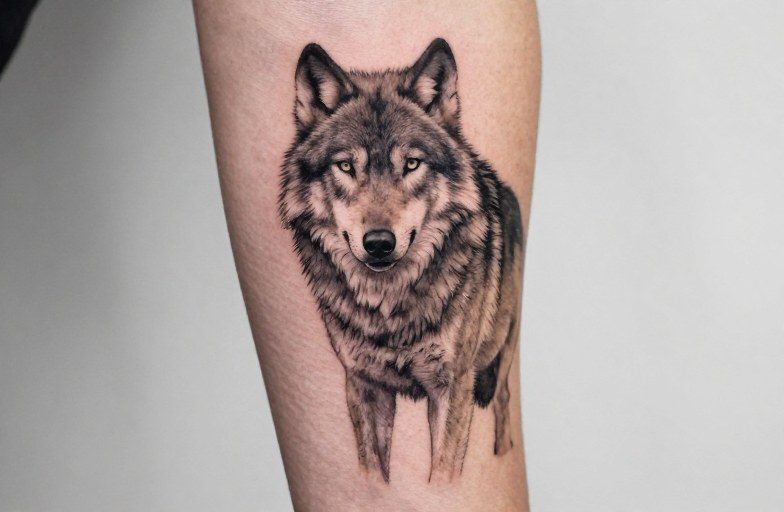
A wolf tattoo most commonly symbolizes loyalty, fierce independence, and the survival instinct. The image carries tension, between belonging to a pack and walking alone, between raw power and quiet watchfulness. That duality is what keeps it relevant across decades of tattooing.
Symbolism & Core Meaning
The wolf operates on two registers that rarely coexist in other animal imagery. It is simultaneously the loyal pack animal and the lone hunter, the nurturing parent and the relentless predator. This isn’t contradiction, it’s complexity, and that’s what people respond to.
Pack Loyalty and Family Bonds
Wolves maintain social structures with genuine care for offspring and injured members. A howling wolf paired with smaller silhouettes, or a parent with pups, speaks to chosen family and protective drive. These designs often sit on the chest, upper back, or forearm, places where the wearer can see the reminder or show it deliberately.
The Lone Wolf Archetype
Conversely, the solitary wolf crossing a ridgeline or standing in snow represents self-reliance, exile by choice, or survival outside group approval. This resonates with people who’ve left hometowns, families, or belief systems. The imagery reads differently based on placement: a lone wolf on the inner bicep feels private, while across the shoulder reads as declaration.
Who Chooses This Tattoo
There’s no single demographic. You’ll find wolves on military members referencing unit cohesion, on people recovering from isolation who’ve rebuilt connection, on outdoor workers who identify with harsh-climate endurance. The through-line isn’t biography, it’s identification with struggle that demands both toughness and social intelligence.
Some arrive with specific pack imagery: birth flowers, children’s initials, coordinates worked into fur texture. Others want the opposite, minimal silhouette, no identifiers, stripped to essence. Neither choice is more authentic. The difference lies in whether the wearer wants to commemorate bonds or claim solitude.
Religious & Spiritual Angles
Norse and Germanic Traditions
The wolf appears prominently in Norse cosmology, Fenrir bound until Ragnarök, Sköll and Hati chasing sun and moon, Geri and Freki accompanying Odin. These associations often drive requests for Nordic knotwork integrated into fur patterns, runic borders, or Mjölnir paired with wolf imagery. The connection is genuine for practitioners of Ásatrú and equally common among people with Scandinavian heritage seeking ancestral reference.
Native American and Indigenous Contexts
Many tribes hold the wolf as teacher, pathfinder, or spirit guide. However, this territory requires care. Generic “spirit animal” framing flattens specific tribal relationships into commodity. If you’re drawn to Indigenous wolf symbolism, research whether your own heritage includes those traditions, or commission from an Indigenous artist who carries the right to that imagery. Appropriation in wolf tattoos is common and avoidable with basic respect.
Christian Symbolism
The wolf carries mixed Christian associations, predator imagery in pastoral metaphors, but also St. Francis of Assisi’s tamed wolf, and the she-wolf as nurturing figure in early Roman Catholic iconography. Some wearers incorporate the wolf into larger pieces referencing Psalm 23’s “valley of the shadow,” emphasizing protection through danger rather than danger itself.
Best Placements
Scale and detail requirements shape placement more than symbolism does. A wolf’s face demands room for eye expression, the slight angle of the brow, the catchlight that separates alive from decorative. Too small, and it becomes generic canine.
- Thigh and calf: Excellent for full-body running poses, fur detail, environmental context like forest or moon. These areas handle dense black well and allow future expansion into larger scenes.
- Upper arm/shoulder: Classic for howling poses, chest-forward portraits. The natural curve of the deltoid suits the wolf’s arched neck. Be cautious extending below the shirt sleeve line unless workplace permits visibility.
- Back piece: Required for complex pack scenes, narrative elements, or integrated landscape. The broad flat planes let artists build atmospheric depth, mist, moonlight, snow texture.
- Forearm: Better for simplified silhouettes, geometric interpretations, or single bold heads. Limited space rewards restraint rather than cramming detail.
- Ribc/side: Painful, but the vertical format suits standing wolves, tree-line compositions. The stretch and compression of this area challenges long-term clarity in fine fur lines.
Color vs Black and Grey
Black and Grey Realism
The dominant approach for wolf portraits. Grey wash builds the layered depth of fur, darker at spine and shoulders, lighter at belly and muzzle. The technique relies on smooth transitions; rough shading reads as dirty rather than dimensional. Over time, black and grey ages gracefully on wolf imagery because the subject itself is monochrome. Fading softens without betraying the concept.
Color Applications
Color enters wolf tattoos strategically, not descriptively. Blue eyes are common, striking against grey fur, though the specific blue of wolf eyes is actually amber or yellow in nature. Artistic license prevails. Some pieces use blood-red accents for violent or powerful scenes. Full-color fur is rare and risky; wolves aren’t meant to read as rainbows, and saturated pigments in fur texture tend to blur together as they age. Watercolor-style splashes behind the wolf, leaving the animal itself in black and grey, offer a compromise that preserves recognizability.
How It Ages on Skin
Wolf tattoos face specific aging challenges. Fine fur lines blur faster than bold geometric work. The distinction between individual hairs disappears; what remains is value contrast and major shape. Plan for this by ensuring the underlying structure reads without detail.
Eye detail is critical and vulnerable. A pinpoint catchlight, the dark rim of the iris, these elements carry expression but require periodic refresh. Discuss with your artist how the design reads if reduced to silhouette: does the posture still communicate? If yes, the tattoo will age well. If the pose depends on whisker-thin lines, expect significant softening within five to seven years.
White ink highlights in fur age poorly, shifting to cream or disappearing entirely. Better to build brightness through negative space, letting skin tone read as moonlight on fur, than to rely on white pigment longevity.
Before You Decide
Consider which wolf you’re actually drawn to: the social animal or the solitary figure, the realistic predator or the stylized icon. These aren’t interchangeable. A howling wolf in geometric form carries different weight than a photorealistic snarl. The mismatch between intended meaning and chosen style produces tattoos that feel off without the wearer knowing why.
Reference quality matters enormously. Wolves are not dogs with pointy ears, the muzzle length, eye placement, and shoulder structure differ significantly. Poor reference produces lupine-looking dogs, and knowledgeable viewers notice. Insist your artist work from multiple wolf-specific photographs, not generic canine stock.
Finally, the moon pairing is optional, not mandatory. Wolves howl for communication, not lunar worship. If the moon resonates with your personal symbolism, include it. If you’re adding it because you assume it’s required, leave it out. The animal holds sufficient weight alone.
Frequently Asked Questions
Does a wolf tattoo always mean I’m a ‘lone wolf’ person?
Not necessarily. Many wolf tattoos emphasize pack loyalty, family protection, or teamwork. The meaning depends entirely on which imagery you choose, group compositions versus solitary figures, aggressive postures versus watchful stillness.
How painful is a wolf tattoo compared to other animal designs?
Pain depends on placement and session length, not subject. A wolf thigh piece spans less sensitive skin than a ribcage wolf, regardless of the animal depicted. Large fur-detail work requires longer sessions, which compounds discomfort through duration.
Can a wolf tattoo be easily covered up if I change my mind?
Wolf heads with heavy black in the eye and nose areas offer cover-up artists solid dark masses to work with. Light, scattered fur-only designs are harder. Plan ahead by requesting your artist leave strategic dark zones for future modification options.
What’s the difference between a wolf and a werewolf tattoo symbolically?
Wolf tattoos generally celebrate the animal’s actual traits, loyalty, instinct, wilderness. Werewolf imagery adds transformation, duality, and the horror of uncontrolled change. The latter reads more as personal struggle narrative; the former as identification with natural qualities.
Leave a Reply