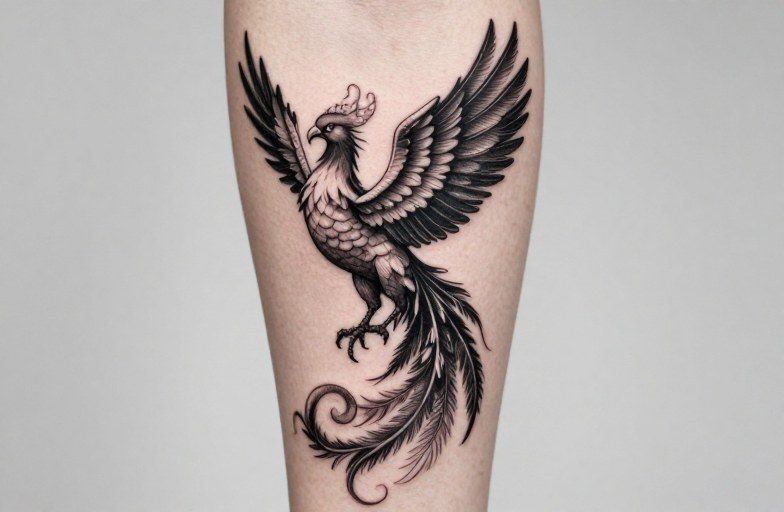
A black and grey phoenix tattoo carries the same core meaning as its colorful counterparts: rebirth, transformation, and survival through destruction. What changes is how that message reads. Without saturated reds and oranges insisting on fire, the eye moves to structure, movement, and the bird’s impossible return from ash. The monochrome treatment tends to attract people who want the symbolism without spectacle, or who simply prefer how black ink sits on their particular skin tone.
Color vs. Black and Grey
Full-color phoenix tattoos dominate shop portfolios for a reason. The myth demands flame, and saturated oranges, yellows, and deep reds deliver that visual punch. But color phoenixes also age faster, require more touch-ups, and can blur into indistinguishable warmth on skin that does not hold pigment well.
Why Artists Sometimes Prefer Black and Grey
Black and grey work relies on contrast, negative space, and graduated washes to suggest heat rather than depict it literally. A skilled artist can make the bird’s wings read as scorched air through careful whip-shading and dense black packing. The result often holds crisper lines at five, ten, or fifteen years. For larger pieces, full backs, thighs, or ribs where the phoenix needs room to spread, black and grey also allows the eye to rest. Color everywhere overwhelms; strategic greyscale creates depth without chaos.
Related reading: Japanese phoenix tattoo design | phoenix silhouette tattoo | phoenix with cross tattoo | minimalist phoenix tattoo
How Placement Shapes the Choice
Small phoenix tattoos, those under four inches, rarely work well in full color. The detail required for feather texture and flame overlap turns indistinct as the ink settles. Black and grey line work with minimal shading survives better on wrists, ankles, or behind the ear. Larger canvases, shoulder caps, full sleeves, or back pieces give both approaches room to breathe, but black and grey particularly suits rib and side placements where the natural shadows of the body already play with light and dark.
Religious and Spiritual Layers
The phoenix predates most organized religions, but it has been absorbed, reinterpreted, and sometimes suppressed by them. Understanding these layers helps explain why someone might choose this bird for reasons beyond the familiar narrative of rising from ashes.
Early Christian Adoption
Some early Christian writers, including Clement of Rome, used the phoenix as a metaphor for resurrection and the soul’s immortality. The bird’s cyclical death and rebirth mapped onto Christ’s resurrection, and medieval bestiaries often included it as natural proof of divine promise. A black and grey phoenix can nod to this tradition without the gothic excess of a crucifix or the explicit iconography of a sacred heart. For people with Christian roots who want something more oblique, the monochrome treatment feels less theatrical, more like a cemetery statue: quiet, permanent, weathered.
Eastern Interpretations
In Chinese tradition, the Fenghuang, often translated as phoenix though visually distinct, represents virtue, grace, and the union of yin and yang. Paired with the dragon, it symbolizes marital harmony and imperial authority. A black and grey Western-style phoenix tattoo is not the Fenghuang, but some wearers blend these traditions intentionally or unconsciously. The monochrome palette can read as more Eastern to Western eyes accustomed to colorful Chinese dragon tattoos, though this is aesthetic association rather than accurate cultural translation. If you want actual Fenghuang symbolism, you should research the specific visual conventions: the five colors, the twelve tail feathers, the pairing with dragon or cloud motifs.
History and Cultural Roots
The phoenix myth circulates across cultures with enough variation that pinning down a single origin proves impossible. Greek sources often receive credit through Herodotus and later writers, but similar birds appear in Egyptian, Persian, and possibly Indian traditions.
From Ancient Accounts to Medieval Europe
Greek historian Herodotus described a bird he heard about from Egypt, the benu, though his account was already secondhand and likely garbled. Roman poets Ovid and Martial gave the phoenix its familiar details: self-immolation, rebirth from ash, a lifespan of centuries. Medieval and Renaissance Europe kept the symbol alive through alchemical texts, where it represented the powerful stages of matter. Cities adopted it later, Chicago and San Francisco among them, as symbols of rebuilding after fire. Military units followed. Tattoo culture proper absorbed the phoenix through the Japanese-inspired work that spread West in the 1980s and 1990s, typically rendered in full color.
Modern Tattoo Lineage
In tattooing, the phoenix became a staple of the Japanese or Asian style popularized by artists including Don Ed Hardy and later refined by specialists in large-scale back pieces. These traditional versions are typically full color. The black and grey phoenix as a distinct sub-style emerged more recently, often linked to the realism and photo-realism movements of the 2000s, where artists trained in portrait work applied their shading techniques to mythological subjects. Some trace it to Chicano black and grey traditions, where religious and mythological imagery has long been rendered in graduated monochrome, though this connection remains more suggested than documented in published tattoo histories.
How It Ages on Skin
All tattoos fade. The question is how, and whether the design anticipated it.
Black Ink Behavior
Black pigment, carbon-based typically, breaks down slowest under skin. In a black and grey phoenix, the darkest areas, wing tips, eye, and talons, may actually soften and look more natural as they age, while the lighter grey washes disappear faster. This creates a gradual shift from detailed to silhouetted, which suits the phoenix’s theme of transformation better than most subjects. A color phoenix, by contrast, often turns muddy as reds fade to pink and oranges to mustard yellow.
Line Weight and Long-Term Clarity
Feather details in phoenix tattoos tempt artists toward fine lines, but skin does not cooperate long-term. Lines below a certain threshold, roughly 3RL or equivalent single needle work, blur within a few years on high-movement areas. The best aging black and grey phoenixes use bold outlines for major wing structures, with finer interior detail that can fade without destroying the overall form. Ask to see healed photos from your artist, not just fresh work. Fresh grey wash looks smooth and creamy; healed, it should read as distinct values, not one flat tone.
Design Variations Worth Considering
Not every phoenix needs to look like a 1980s airbrush T-shirt. The black and grey palette opens possibilities that color can obscure.
Geometric and Abstract Approaches
Some artists break the wing structure into polygonal segments, using black saturation to create the illusion of feathers without drawing each one. Others reduce the bird to negative space, a white silhouette surrounded by dense black smoke or ash. These approaches work especially well in black and grey because the limited palette forces structural clarity. The risk is abstraction so severe that viewers cannot identify the subject; the reward is a tattoo that reads as contemporary art rather than mythological illustration.
Minimalist and Single-Needle Work
Minimalist phoenixes, rendered with single continuous lines or sparse dotwork, have gained popularity through social media. These suit small placements and fair skin that holds fine detail well. However, the phoenix’s complexity, its wings, tail, and flame halo, resists reduction more than simpler symbols. A minimalist phoenix can look like a generic bird if the artist lacks specific ornithological knowledge. If you choose this route, verify that your artist has healed examples of similar work, not just fresh photographs.
Similar Symbols and How They Differ
People considering phoenix tattoos often weigh alternatives with overlapping meanings. Understanding the distinctions helps clarify whether the phoenix genuinely fits.
- Ouroboros: The snake eating its own tail also cycles through death and rebirth, but leans more toward eternal return and wholeness than triumphant emergence from disaster. More compact, suits smaller placements, carries less narrative weight.
- Koi dragon: In Japanese tattooing, the koi swimming upstream and transforming into a dragon represents perseverance and elevation. More water, less fire; more journey, less dramatic reversal.
- Rising sun with rays: Simpler, more abstract, but lacks the agent, the bird doing the work of resurrection. Good for people who want optimism without mythology.
- Crow or raven: Often chosen after loss or trauma, but these birds carry death associations the phoenix avoids. The phoenix dies to return; the corvid watches, survives, remembers.
Black and grey treatment works for all these alternatives, but the phoenix benefits most. Its feather texture and wing spread give artists more opportunity to show off graduated shading technique.
Who Chooses This Tattoo
Certain patterns show up in consultation chairs, though every reason is individual.
Recovery and Survival
Addiction recovery, cancer remission, divorce, prison release: these life transitions drive phoenix choices more than almost any other tattoo subject. The black and grey version specifically often appeals to people who want the symbolism without the celebratory brightness of color. There is a seriousness to monochrome that matches the gravity of what was survived. Placement often reflects this: ribs, hidden and personal; upper back, visible when chosen and covered when needed; thighs, private acknowledgment.
Artistic Preference
Some people simply prefer how black and grey looks on their skin tone. Darker skin can make color work harder to read; black and grey creates contrast without fighting melanin. Others come from aesthetic traditions, photography, film noir, certain music subcultures, where monochrome carries inherent value. The tattoo extends an existing visual identity rather than declaring a new transformation.
What to Remember
A black and grey phoenix tattoo means rebirth rendered in restraint. The symbolism does not need color to function, but the style choice says something separate about the wearer: a preference for endurance over announcement, for structure over spectacle. The monochrome palette ages differently, often better, but demands an artist who understands graduated shading and how it heals. The myth itself is old enough to have outlived every culture that touched it, which means your tattoo joins a lineage rather than inventing one. Choose placement that respects the design’s need for space, line weight that will survive a decade, and an artist whose healed work you have seen in person. The phoenix rises regardless, but a well-executed black and grey rendering ensures the tattoo itself does not need its own rebirth through cover-up or removal.
Frequently Asked Questions
Does a black and grey phoenix tattoo have the same meaning as a colored one?
The core symbolism, rebirth and transformation, remains identical. The monochrome palette shifts the emphasis toward structure, endurance, and quiet gravity rather than fiery spectacle.
Will a black and grey phoenix last longer than a color version?
Black pigment typically fades slowest and most predictably. While all tattoos age, black and grey work tends to blur less dramatically than color, which can turn muddy as reds and oranges shift unpredictably.
What skin tones work best for black and grey phoenix tattoos?
Black and grey creates readable contrast across most skin tones, though it is particularly popular among people with deeper melanin where color saturation can be harder to achieve and maintain.
How large should a black and grey phoenix tattoo be?
The phoenix requires room for wing structure and feather detail to read clearly. Smaller than four inches risks loss of definition; full backs, thighs, ribs, and upper arms provide the canvas the design needs.
Can a black and grey phoenix include religious meaning?
Yes. Early Christian writers used the phoenix as a resurrection symbol, and the monochrome treatment can nod to this tradition with less explicit iconography than a crucifix or sacred heart.
Leave a Reply