
Delicate unique butterfly tattoos can stay readable for years when you plan scale, placement, and contrast before adding decoration. I once watched a meaningful idea lose its clarity because the wings were too crowded for the chosen spot. Start with the silhouette, then build the personal story. That’s the difference!
Editor’s note: a butterfly can be dainty without being forgettable. Your strongest design usually has one unmistakable shape, one personal detail, and enough skin breaks to keep the pattern readable.
- Start With Small Delicate Butterfly Linework
- Which Wing Pattern Feels Like You?
- Place Your Butterfly Along the Collarbone
- Keep Fine Details Crisp and Readable
- The Behind-the-Ear Balance
- Can Color Carry the Meaning?
- Sketch Flowing Butterflies Across the Shoulder
- Ornate or Minimal?
- Protect Delicate Ink During Healing
- One Butterfly, Three Accents
- The Three-Angle Proof
1Start With Small Delicate Butterfly Linework

Begin with an open-wing silhouette across the sternum, where symmetry can feel striking and intentional. Ask your artist to keep the outer contour as muted terracotta linework, then reserve the center for a few crisp veins. Your skin tone, natural curve, and preferred visibility should guide the final scale.
The Small-Scale Readability Rule is simple: every line needs a job. If you’re drawn to a minimal, delicate tattoo, don’t squeeze intricate details into a tiny outline.
I’d skip miniature text inside the wings because it blurs first and competes with the butterfly’s shape. A readable silhouette should lead the design.
A sternum tattoo can feel more intense than an outer forearm because bone sits close to the surface. You’ll want to discuss breaks, breathing, and placement before the stencil touches your skin. For compact ideas, compare tiny unique butterfly tattoos and decide whether your version needs more negative space.
2Which Wing Pattern Feels Like You?

A wing pattern can be symbolic without looking obvious. You might choose a fierce thorn-like edge for survival, a flowing vein pattern for change, or a graceful symmetrical design for balance. Your favorite detail should mean something to you, even if nobody else recognizes it.
I’d start with three references and circle the parts you genuinely love. Perhaps one has a bold outer edge, another has ornate spots, and the third has a playful break in one wing.
Combine those ideas carefully. More detail doesn’t always create more value.
A clay-toned accent keeps the process focused.
If your budget is limited, spend it on drawing and placement before extra decoration. A clean stencil is worth it!
Make that budget priority clear during your consultation. For more variations, browse small unique butterfly tattoos and note which patterns still read clearly at a glance.
3Place Your Butterfly Along the Collarbone
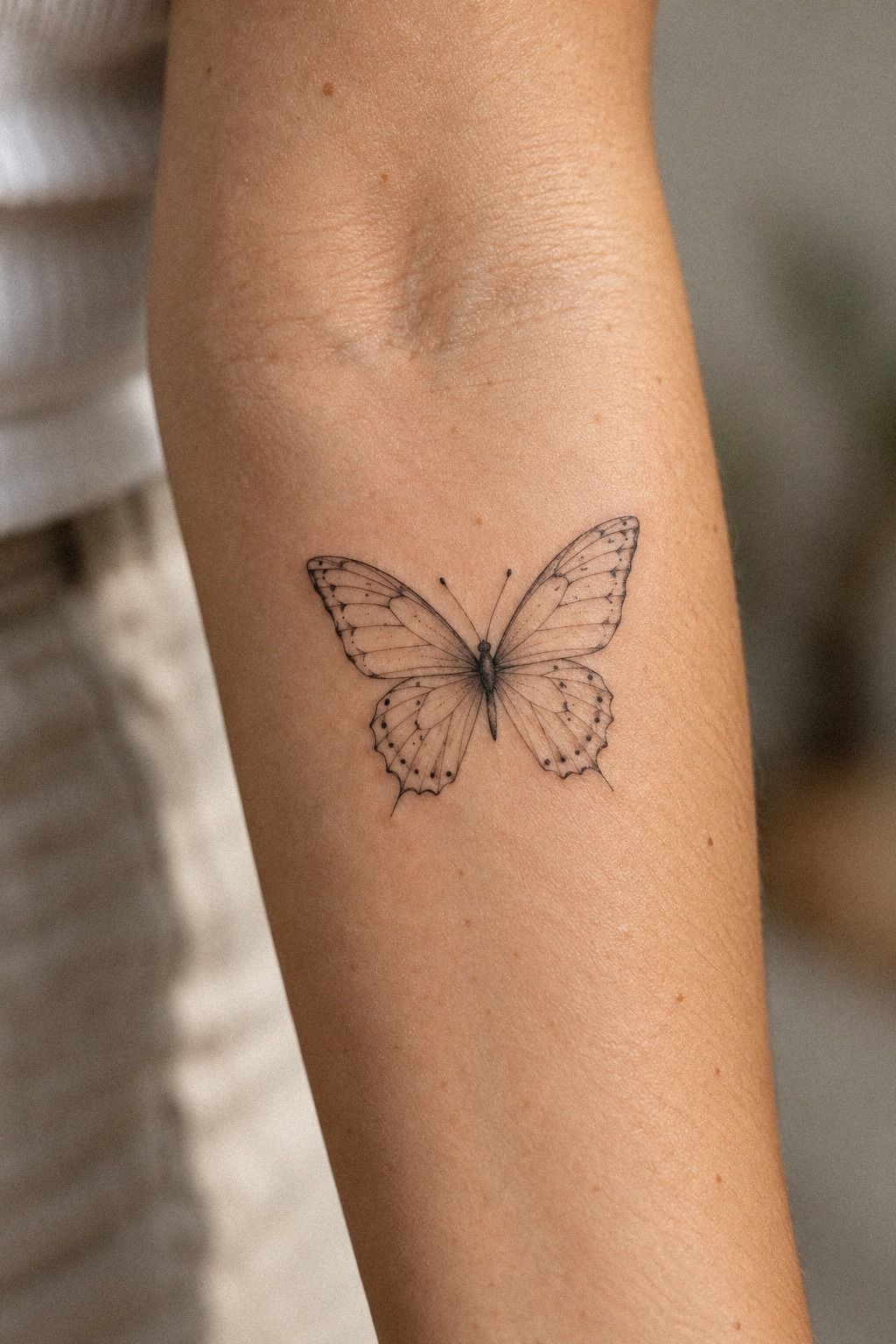
Follow the collarbone’s natural line instead of forcing the butterfly into a flat horizontal position. The collarbone curve can guide the lower wings while the body stays centered. Your artist should stencil both sides before you approve the exact angle.
The Collarbone Echo is the choice I’d make here: let the lower wing edges repeat the curve of your bone, but keep the body centered. A butterfly pointing too sharply toward the shoulder can look accidental. A graceful, flowing angle feels intentional when your arm moves.
The collarbone can be more sensitive than a fleshy upper arm, so you’ll want an honest conversation about discomfort. I wouldn’t choose dense fill for a first visit. Selected plum pigment and deliberate skin breaks can create a crisp, understated result.
For another placement comparison, save tiny unique butterfly tattoos that follow the body’s natural lines. Notice how the best designs curve with the skin instead of fighting it.

4Keep Fine Details Crisp and Readable

Work from the inner forearm outward and simplify anything that won’t survive a smaller stencil. Your artist can test the width of each gap, the thickness of each vein, and the distance between the body and wing edges before the needle begins. The inner forearm position gives you a useful balance between visibility and control.
Fine-line tattoos reward restraint. I’d rather see four expressive marks than twelve crowded ones. A delicate design needs enough contrast to remain visible, especially if the butterfly is small or placed where clothing repeatedly rubs.
Ask how the artist expects the negative space to behave after healing. If you want a meaningful reference with a crisp outline, compare delicate butterfly tattoo examples and look for healed work, not only fresh appointments.
5The Behind-the-Ear Balance

Behind the ear, a compact emerald-accented butterfly can look sleek, intimate, and partly private.
6Can Color Carry the Meaning?

Color can make your butterfly vibrant, romantic, or haunting, but it should support the idea rather than hide a weak silhouette. You might choose forest green for renewal, rust for endurance, or a symbolic shade connected to a person, place, or memory. A single forest-green accent often feels more personal.
I’d keep the body and outer contour dark enough to anchor the design. A soft rust note inside one wing can feel more expressive than filling every section. If you’re uncertain, ask your artist to show how the outer contour may soften after healing.
A controlled accent can be gorgeous! The cost may rise with additional color and time, so ask for a clear price estimate before you approve the final palette. For compact color references, compare small butterfly tattoos with healed examples.
7Sketch Flowing Butterflies Across the Shoulder
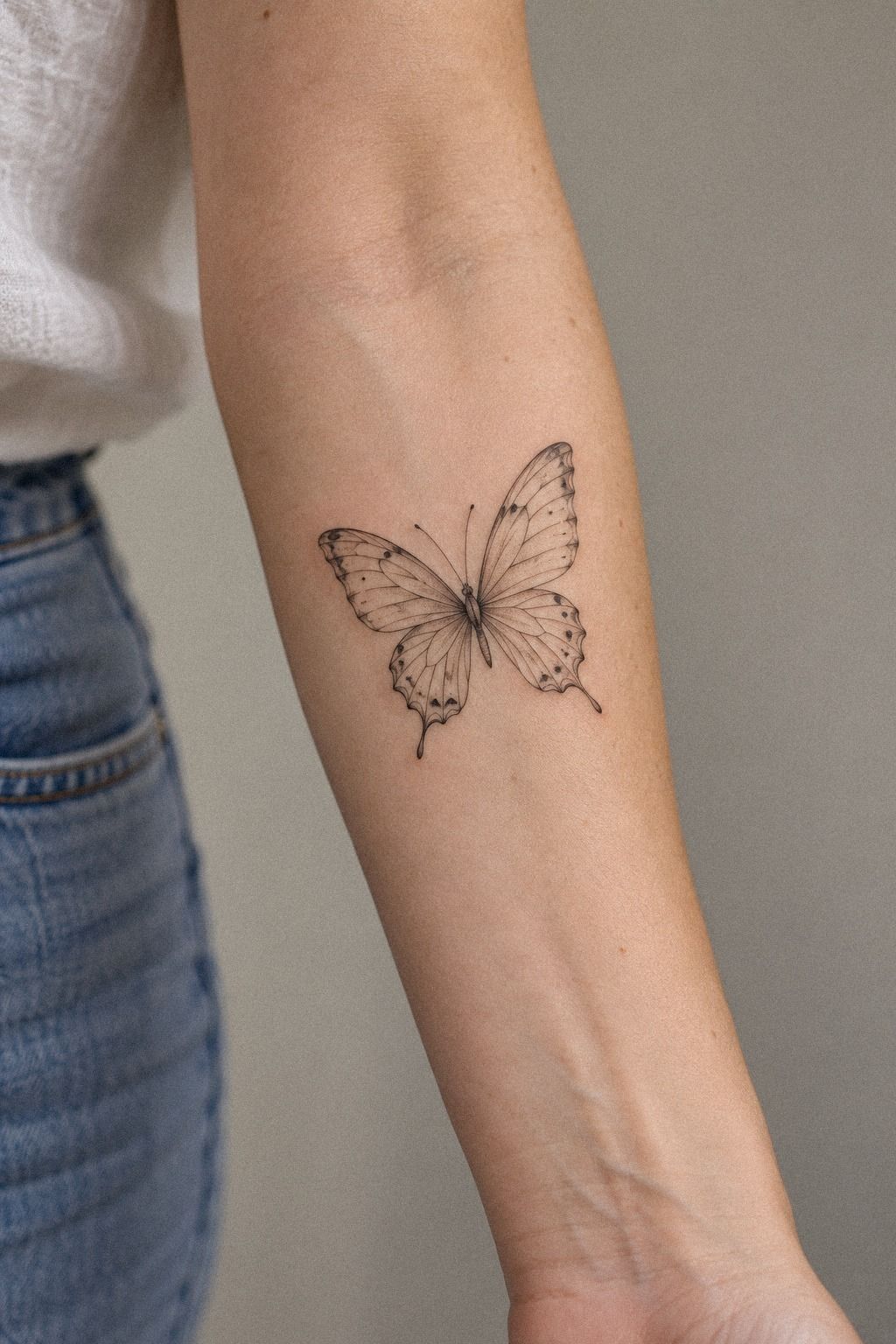
Let the shoulder’s curve guide the movement instead of treating the butterfly like a sticker. Your body’s shape should decide whether the wings open toward the upper arm, back, or collarbone.
A flowing direction can make the design feel graceful and alive. The shoulder curve should control the angle.
The Shoulder Drift is my favorite approach: place the body near the shoulder’s natural center, then let one wing angle slightly toward the back. A perfectly rigid butterfly can look formal. Controlled asymmetry feels raw, personal, and expressive without losing recognition.
Use stencil transfer to test the movement before the needle begins. Raise your arm, lower it, and check the design in both positions. I’d keep this version simple in concept, then add only one small accent if your eye still wants more.
If you prefer a more delicate direction, compare delicate butterfly tattoo references that follow a curved shoulder line. The strongest examples feel connected to the body.
8Ornate or Minimal?

A richer pattern can feel powerful and iconic, especially when you have enough skin area on the calf, thigh, or upper arm. Think of lace-like veins, tiny stars, jewel shapes, or a meaningful symbol hidden near the body.
Every mark should reinforce your story. The lace-like vein pattern needs breathing space.
A minimal butterfly can be equally bold. Its strength comes from proportion, contrast, and a memorable outline rather than quantity. If your reference looks impressive only because it contains dozens of details, it may not offer good long-term value.
Your artist should help you compare both directions at the actual size. Ask which choice will age more cleanly and which one fits your budget.
In many cases, a striking medium-sized design is worth it because it preserves more skin breaks. For ideas, revisit tiny unique butterfly tattoos and inspect their visual clarity.
9Protect Delicate Ink During Healing

Follow a clear healing plan that protects both the fine lines and the meaning behind them. The surface commonly settles in about two to three weeks, while complete healing can take roughly two to three months. Your artist’s written instructions should lead every decision.
The Healing-First Rule is plain: wash gently, moisturize as directed, and avoid direct sun and swimming while the skin recovers. Don’t pick flakes, rub the area, or cover it with anything your artist hasn’t approved. Peeling is part of the process, not a flaw.
A fragrance-free cleanser may help when your artist approves it.
Your spine, ankle, and shoulder all move with clothing, sleep, and exercise. During the early days, loose contact helps. A fragrance-free moisturizer may be appropriate if your artist recommends it, but adding products without guidance can create unnecessary problems.
For placement ideas that account for visibility and healing, compare delicate butterfly tattoo examples before you book.
10One Butterfly, Three Accents

One butterfly can carry the entire design, while three small accents create a more personal composition. You could add a tiny star, a broken vein, or a single dot sequence.
Keep the accents subordinate so the main silhouette remains instantly recognizable. The three small accents should support the butterfly.
I’d place those marks according to movement rather than filling empty skin automatically. A small detail near the wrist might make sense for a memory about freedom.
A mark near the body could represent family, recovery, or a private promise. Follow the movement line instead of decorating at random.
If you’re watching the cost, choose the butterfly first and make the accents optional. You can always return later if the healed piece genuinely needs another note. That staged appointment protects your budget and gives you time to live with the design.
For compact layouts, browse small unique butterfly tattoos and notice how little details remain subordinate to the main shape.
11The Three-Angle Proof

Your finished butterfly should read from above, from the side, and while the ankle, wrist, or shoulder flexes. Take photographs only after your artist approves the healing stage.
A design that looks balanced in one position can shift when your body moves. The healed stage gives you the clearest evidence.
The Three-Angle Proof catches problems your first glance misses. Check the outer silhouette, body alignment, wing spacing, and relationship to the nearest bone.
I’d choose plain daylight over a dramatic filter every time because it reveals the real contrast. Make a daylight check before judging the result.
Fine lines can widen with age, and UV exposure can fade contrast faster. Ask how this particular design may age, especially if the wings are very small.
A healed terracotta outline with sensible spacing usually holds better than crowded pale details. Take your time!
Before You Book: The Practical Questions
Ask whether your artist has healed examples of delicate butterflies in the size and placement you want. Fresh work can look incredibly sharp, but healed work tells you more about spacing, contrast, and line stability.
Your decision should rest on evidence, not a single flattering photograph. Request healed examples during the consultation.
You’ll also want to ask about minimum charges, touch-up policies, appointment length, and aftercare support. A lower price isn’t always better value if the design needs repeated corrections.
A transparent quote helps you protect both your skin and your budget. Clarify the minimum charge before you reserve the appointment.
For more visual references, save delicate butterfly tattoo examples with similar size and placement.
Mariposa, Moth, or Something More Personal?
A butterfly feels familiar, but your interpretation can still be distinctive. You might borrow the symmetry of a mariposa, the nocturnal mood of a moth, or the delicate movement of a night-flying species.
The key is choosing a form that feels personal rather than randomly exotic. A mariposa silhouette can be an elegant starting point.
If the species matters to you, research its symbolism before committing. A species reference can guide wing shape, antennae, and pattern without forcing you into a literal copy. Your artist can then make the design more stylish and wearable.
Compare small unique butterfly tattoos if you want to see how artists simplify familiar wing shapes into something more personal.
Placement Versus Visibility
Visible placement gives your tattoo an expressive, social quality. The forearm, wrist, and shoulder let you enjoy it often and show it naturally.
More private placements, such as the sternum or behind the ear, can feel sacred and meaningful without becoming a daily announcement. Visible placement changes how often you interact with the tattoo.
I’d decide how often you want to see the butterfly before choosing its size. A personal tattoo may be worth keeping partly hidden, while a commemorative piece may deserve a location you can reach with your eyes.
Neither choice is more correct. A private placement can still feel empowering.
For a quick comparison, browse tiny unique butterfly tattoos and note how scale affects visibility.
The Budget Conversation
Tattoo costs vary by artist, city, size, detail, placement, and studio minimum. A small design may fall near a minimum charge, while a larger ornate piece is usually priced by time. Ask whether the quote includes the consultation, stencil adjustments, and a possible touch-up.
Confirm the studio minimum before approving the sketch.
Your budget should include aftercare supplies and, if needed, travel. Paying slightly more for an artist whose healed work matches your goal can offer better value than choosing the cheapest available appointment. The right question isn’t only “What does it cost?” but “What result am I buying?” Include the total budget in your planning.
For design comparisons at different sizes, browse small butterfly tattoos before discussing the quote.
What Makes Fine Linework Last?
Longevity depends on contrast, spacing, placement, sun exposure, and your individual skin. Fine-line work may soften, but a well-planned design can remain graceful rather than becoming unreadable.
Your artist should explain the tradeoff between a whisper-thin line and a stronger long-term contour. Ask about line weight in the finished design.
I’d protect a new tattoo from unnecessary UV exposure and avoid judging the final result while the skin is still changing. A broad-spectrum sunscreen belongs in your long-term routine once the area is fully healed and your artist says it’s safe.
For examples of readable fine-line layouts, compare delicate butterfly tattoo references with healed photographs.
Tiny Details That Earn Their Place
A single meaningful detail can make a butterfly feel iconic. Consider a tiny initial, a missing wing spot, a date translated into dots, or a small symbol known only to you.
I’d avoid text when the design is extremely small because letters can lose clarity. A meaningful detail should survive without explanation.
Ask yourself whether the detail would still matter if nobody noticed it. If the answer is yes, keep it. Personal tattoos don’t need to explain themselves to strangers.
The most empowering mark may be the one you understand immediately. Choose a private symbol that feels true.
For small-scale inspiration, browse tiny unique butterfly tattoos and remove any detail that overwhelms the silhouette.
When to Choose a Larger Design
Choose a larger butterfly when the wing pattern is central to the meaning or when you want graceful movement across a curved area. More skin area gives your artist space for intricate marks, controlled contrast, and deliberate skin breaks. A larger wing pattern can preserve more visual information.
A larger design can also offer stronger long-term readability, though it may increase the cost and appointment time. Compare the value of extra space with your budget before you book. I’d rather see a confident medium-sized tattoo than a tiny version of an idea that needed room.
Consider the appointment time as part of the decision.
If you’re unsure whether your idea needs more scale, compare small unique butterfly tattoos with larger examples and judge the wing spacing.
The Meaning Has to Survive the Trend
I like butterfly tattoos because they can carry change without announcing every detail. That’s also why I’m wary of copying a design simply because it’s popular this month.
A striking silhouette might catch your eye online, but your tattoo has to keep its meaning after the trend disappears. Don’t let a trend reference make the decision for you.
My preference is a small, elegant design with one unexpected interruption. It might be a missing vein, a tiny color note, or an uneven edge connected to a real memory.
That choice makes the tattoo expressive without turning it into a diary entry. An unexpected interruption can make the design unmistakably yours.
I’ve learned that delicate doesn’t mean conceptually fragile. A powerful butterfly can have a thin outline.
An empowering tattoo can use quiet imagery. The best designs hold two feelings at once, perhaps peaceful and fierce, or understated and iconic.
That contrast can feel timeless.
Before you book, ask yourself what must remain visible if the smallest details soften. Your answer might be the open wings, the placement, or one meaningful symbol. Keep that element strong, then let everything else support it.
Protect the core symbol first.
For ideas with a personal rather than trendy feel, revisit tiny unique butterfly tattoos and mark the details you’d still love years from now.
A Few Things Worth Answering
How much do delicate unique butterfly tattoos usually cost?
A delicate unique butterfly tattoo often costs about $100 to $300 in the United States, depending on size, placement, artist, and region. Some studios charge a minimum of about $50 to $100, while hourly rates may reach $100 to $250. Ask for the full quote before booking.
Are delicate unique butterfly tattoos a good first tattoo?
Yes, they can be a thoughtful first tattoo when you choose a readable design and a placement you can tolerate. Your forearm, thigh, or shoulder may feel easier than ribs, feet, hands, or sternum. A clear silhouette also gives your first piece strong visual structure.
How do I choose an artist for delicate butterfly tattoos?
Review healed portfolio photos and look for consistent spacing, clean contours, and thoughtful placement. Your artist should explain the stencil, answer questions about aging, and use single-use needle cartridges with clear aftercare guidance. Their communication matters almost as much as their portfolio.
How painful are delicate butterfly tattoos?
Pain varies by person and placement. Ribs, feet, hands, and sternum are often more sensitive, while the forearm, thigh, and shoulder may feel more tolerable. Tell your artist if you need breaks.
Staying relaxed can make the appointment easier for you. Placement sensitivity is personal.
How long do delicate butterfly tattoos take to heal?
The surface usually settles in about two to three weeks, while complete healing can take roughly two to three months. Follow gentle washing, approved moisturizing, and sun and swimming restrictions until your artist says the skin is ready. The surface healing period is only one part of recovery.
What’s the best placement for a delicate butterfly tattoo?
The forearm is a strong choice for visibility and readable lines, while the shoulder offers more room for flowing movement. The sternum, ankle, feet, and hands can look striking but may bring more sensitivity or friction during healing. Choose based on your priorities and desired visible lines.
For more placement ideas, compare delicate butterfly tattoo references that show different body contours.
Where I’d Start First
If I had to pick one step, I’d start with the outer silhouette. It’s the part that must remain readable when fine details soften, and a clean open-wing shape gives every personal mark room to matter. The outer silhouette should earn your trust first.
Save your favorite reference, compare tiny unique butterfly tattoos, and ask your artist to redraw the idea for your skin. The best final design won’t simply be pretty.
It’ll feel unmistakably yours. Trust that feeling!

