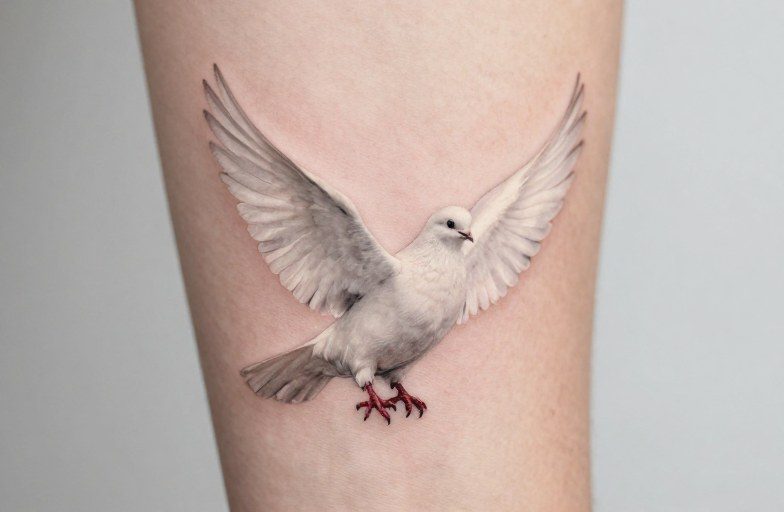
A white dove tattoo most commonly signals peace, hope, or spiritual presence. For many, it also functions as memorial ink, a visible marker of loss, transition, or the memory of someone specific. The symbol travels across cultures and contexts, which means the same image can read as devotional, political, or deeply personal depending on placement, pairing, and execution.
Best Placements
Where you put a white dove changes how the image reads and how well it holds up. These birds depend on clean edges and negative space; muddy them in a spot that sees heavy wear or distortion, and you lose the silhouette that makes the symbol recognizable.
High-Retention Areas
The outer upper arm, shoulder blade, and outer thigh all preserve detail well. Skin stays relatively stable here, so fine line work in the wings and tail feathers remains legible for years. The upper back, between the scapulae, offers a flat canvas that suits a dove in flight with spread wings, probably the most requested composition.
- Forearm: High visibility, but expect faster fading on the inner side where skin flexes and rubs against the torso.
- Ribcage: Dramatic canvas, significant pain, and the skin stretches with breathing and torso movement. Best for simpler silhouettes, not intricate feather mapping.
- Ankle/wrist: Small dove tattoos here trend toward minimalism. The risk is blowout, ink spreading under thin, mobile skin, and the image blurring into a grey blob within five to ten years.
- Behind the ear: Popular for tiny doves. Works only if the design stays bold enough to read at a glance; detail gets lost fast.
Scale and Flow
A dove needs room for the wings to read as wings, not abstract shapes. At under two inches, the beak and eye merge into unrecognizable dark spots. Three to four inches minimum preserves the bird’s proportions. For a dove descending with an olive branch, a classic composition, allow vertical space so the branch doesn’t crowd the body.
How It Ages on Skin
White ink dominates this design, and white ink ages differently than black. It yellows, it fades, and it sometimes disappears entirely into the skin’s undertone. Understanding this before you commit prevents disappointment later.
The White Ink Problem
White pigment sits less densely than black. On fair skin, fresh white ink looks crisp; on medium to deep skin tones, it can read as raised scar tissue rather than pigment. Over time, white ink often settles into a cream or light yellow tone as the body breaks down the titanium dioxide. Some artists now skip white ink entirely in dove tattoos, using negative space, untattooed skin, to represent the white feathers, surrounded by grey shading or a soft black outline.
Line Weight and Shading Longevity
Bold black outlines around the dove’s silhouette survive decades better than fine-line versions. Grey wash shading in the wing feathers creates depth but requires a skilled hand; patchy or uneven grey ages into a mottled, dirty look. Solid black silhouettes with minimal internal detail last longest and remain readable even as they soften at the edges.
Who Chooses This Tattoo
The appeal crosses demographics, but the motivation usually clusters around a few specific life events. Memorial doves, often with dates, names, or initials, appear after the death of a parent, child, or partner. The bird functions as a release symbol, a representation of the departed spirit ascending.
Religious clients sometimes reference the dove as the Holy Spirit, particularly in Christian iconography. This version often pairs with crosses, scripture references, or light rays. The design tends toward traditional or neo-traditional styling rather than photorealism.
Political and peace-movement adoption exists too, though less common in contemporary tattooing than in previous decades. A simple dove silhouette with an olive branch still carries that lineage for people involved in anti-war or reconciliation work.
Common Variations & Styles
The dove adapts to nearly every tattoo genre, though some styles suit the subject better than others.
Traditional and Neo-Traditional
Thick black outlines, limited color palette, stylized feathers. The traditional dove reads instantly as a tattoo rather than an illustration. Neo-traditional allows more gradient in the grey tones and slightly more naturalistic proportions while keeping the bold, graphic punch.
Realism and Black and Grey
Photorealistic doves require an artist who understands avian anatomy, wing structure, the curve of the breast, how light falls on white feathers. These pieces work best at larger scale, four inches or more, and need regular touch-ups to maintain the subtle gradations that sell the illusion.
- Minimalist/line art: Single needle or fine line, often no shading. High risk of aging poorly; best reserved for areas with minimal sun exposure and friction.
- Geometric: The dove’s form broken into triangles or polygonal shapes. Visually striking, but the symbolism gets abstracted, viewers may not recognize the bird immediately.
- Watercolor: Splashes of blue, grey, or soft color behind or around the dove. The bird itself usually stays in black and grey or solid black to preserve readability as the color background fades and shifts.
Design Tips & Pairings
What you place near the dove changes its meaning and its visual balance.
Text Integration
Names, dates, and short phrases fit naturally below a descending dove or beside one in profile. Script needs to be large enough to age, tiny lettering inside a banner or scroll becomes illegible. Consider placement carefully: text curving with the body’s contours often looks awkward within five years as skin shifts.
Common Pairings
- Olive branch: The classical addition. Keep it simple; detailed botanical rendering competes with the bird.
- Broken chain or open cage: Freedom, release from struggle, recovery from addiction or abuse.
- Rosary or cross: Explicitly devotional context.
- Sun rays or halo: Spiritual presence, blessing, protection.
- Two doves: Partnership, marriage, twin loss, parent and child.
One effective approach: let the dove carry the visual weight while the secondary element stays smaller and subordinate. A massive cross with a tiny dove perched on it reads backwards in hierarchy.
Color vs Black and Grey
The choice affects longevity, cost, and emotional temperature.
Black and grey doves dominate the market for good reason. They age cleanly, work on all skin tones, and maintain the solemnity many clients want for memorial or spiritual pieces. Grey wash allows subtle feather texture without the maintenance burden of color.
Color introduces specific associations. A blue-grey dove references the sky; soft pink or peach tones suggest dawn, new beginnings. All-color doves, attempting to render actual white plumage through pale yellows, greys, and soft browns, require an artist with advanced color theory knowledge and a client committed to touch-ups. Without that commitment, the colors muddy within a few years.
One practical compromise: black and grey dove with a single accent color in the olive branch (green) or a small heart (red). The accent draws the eye and carries symbolic weight without overwhelming the composition or accelerating the aging problem.
Before You Decide
Spend time looking at healed photos, not just fresh work. White ink and fine lines look pristine on Instagram the day they’re done; search for the same artist’s work at two years, five years. Ask specifically about how they handle the white-feather problem, whether they use white ink, negative space, or a combination.
Consider the direction your dove faces. Ascending reads differently than descending. Profile differs from three-quarter view in emotional weight. These choices matter more than most clients realize until the stencil is on their skin.
Finally, resist the urge to over-detail. A dove that reads clearly from ten feet away, with clean edges and solid contrast, outlasts the intricate feather-study that looks stunning in the artist’s portfolio and blurry in your bathroom mirror five years later. The symbol carries meaning because people recognize it. Clarity serves that purpose better than complexity.
Frequently Asked Questions
Does white ink actually show up on darker skin tones?
White ink often reads as raised scar tissue or disappears entirely into melanin-rich skin. Many artists now use negative space, leaving the skin untattooed, to create the white dove effect, surrounded by grey or black shading for contrast.
How much does a white dove tattoo typically cost?
Pricing varies by size, detail, and artist experience. A small, simple silhouette might run $150, 300, while a realistic, palm-sized piece with custom elements can reach $500, 800 or more at established shops.
Can I add a name or date later without ruining the design?
Yes, if the original artist plans for it. Leaving structured negative space or designing the composition with an anchor point for text makes future additions cleaner. Retrofitting text around an existing dove often forces awkward spacing.
How often will a white dove tattoo need touch-ups?
Expect a first touch-up at one to two years, especially if white ink was used. After that, every five to seven years maintains crisp edges. Sun exposure accelerates fading significantly, SPF 50 on the area extends the life of the work.
Leave a Reply