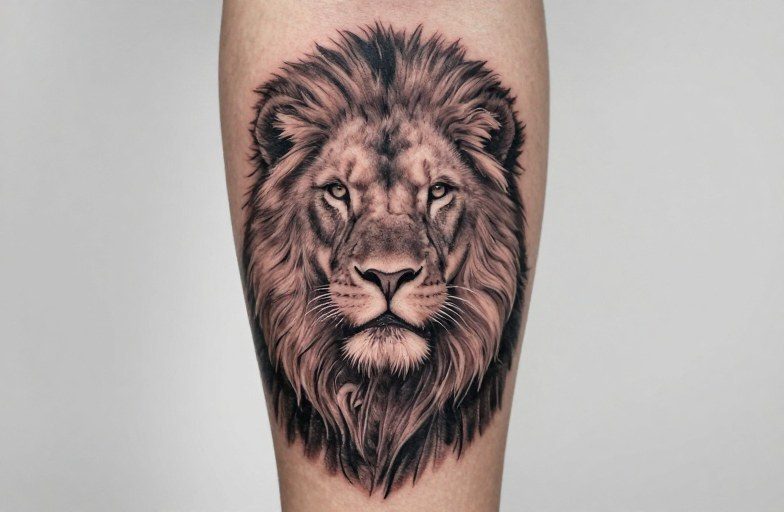
A lion tattoo most commonly signals courage, dominance, and unwavering loyalty. Beyond generic “strength,” the symbol carries specific weight: protective fatherhood, controlled aggression, and the burden of leadership. The meaning shifts noticeably depending on whether you choose a roaring male, a serene lioness, or a full pride scene.
Symbolism & Core Meaning
The Male Lion: Authority and Guardianship
The male lion’s mane functions as natural armor and visual intimidation, making it a fitting emblem for those who see themselves as shields for others. In tattoo form, a maned lion often represents the weight of providing and defending, less about personal glory, more about responsibility accepted. The mane itself offers tattooers excellent terrain for texture work: individual hair groupings can be rendered with whip shading or fine line clusters, and the contrast between dark mane and lighter muzzle creates natural focal points.
The Lioness: Stealth and Sustained Power
Lionesses do the majority of hunting and cub-rearing, and their tattoo symbolism reflects this pragmatic ferocity. A lioness design suits someone who values endurance over display, the long pursuit over the single dramatic clash. Placed on ribs, thigh, or outer forearm, the leaner silhouette reads as active and alert rather than statically powerful. Line weight matters here, thinner, more directional strokes suggest speed and muscle tension under hide.
- Roaring: Uncontrolled expression, warning, or grief, often chosen after significant loss or confrontation
- Resting: Confidence without need to perform; the power already established
- Paw on cub: Explicit parental devotion, sometimes memorializing children
- Profile vs. three-quarter: Profile reads as heraldic and timeless; three-quarter view adds dimensionality and emotional immediacy
Design Tips & Pairings
What Actually Works on Skin
Black and grey lion portraits age more gracefully than full color in most cases. The natural grey values of a lion’s coat translate directly to ink wash, and healed black-and-grey maintains readability longer than saturated color, especially on areas with sun exposure. That said, golden amber eyes done in concentrated yellow or orange can survive as accent points even when surrounding mane softens over years.
Common pairings carry specific combined weight:
- Crown: Not merely “king”, the crown adds human institution to animal instinct, suggesting earned authority rather than inherited status
- Clock or hourglass: Mortality and the finite nature of dominance; popular for memorial pieces
- Rose: The soft-hard contrast, but also the English tradition of lion-and-rose heraldry
- Compass or map: Directional purpose, often for those who’ve moved countries or careers
- Geometric framing: Modern abstraction that contains the organic; the contrast keeps both elements sharp
Placement Realities
Thigh and outer calf provide the flat planes a detailed mane needs. Chest placement over the heart converts the lion into guardian emblem, historically common in military and firefighter tattooing. Hands and neck demand simplified, bold designs; fine detail here blurs within months. Upper back between the shoulder blades offers a natural throne-like position, but requires the client to accept they won’t see it regularly without mirrors.
Religious & Spiritual Angles
Judeo-Christian Context
The lion of Judah appears in Genesis and Revelation both, marking it as a symbol spanning promise and apocalyptic return. In tattoo form, this often incorporates Hebrew script, a cross, or the specific stylized lion emblem associated with Rastafari. The Christian tradition also uses lion imagery for Mark the Evangelist and for resurrection, Christ as the “Lion of Judah” who overcomes death. These designs tend toward the iconic rather than realistic: stylized mane, direct frontal gaze, sometimes halo or nimbus.
Hindu and Buddhist Associations
Narasimha, the man-lion avatar of Vishnu, represents divine intervention at the edge of impossibility, when conventional forms fail. Tattoos of Narasimha require familiarity with specific iconographic rules: the mane, the posture of destruction, the presence of Prahlada. Less niche but still significant, the lion throne (simhasana) in Buddhist tradition indicates the seat of teaching. A lion supporting a dharma wheel or lotus carries this association without demanding full narrative depiction.
Common Variations & Styles
Style choice dramatically alters how the symbolism reads:
- Photorealism: Emotional immediacy, specific reference (often a particular photograph of a real lion or a pet)
- Traditional/Americana: Bold outlines, limited palette, reads as emblematic, timeless, slightly aggressive
- Neo-traditional: Expanded color range, decorative elements, more narrative context allowed
- Japanese (irezumi): Lion-dog (shishi) distinction matters; the shishi is mythic, often with curly mane, associated with protection of temples and warding off spirits
- Blackwork/dotwork: Abstracted texture, meditative quality; the lion becomes pattern as much as creature
- Minimalist/line: Requires extreme confidence in single stroke quality; any waver destroys the face
The roaring lion, heavily detailed and dramatic, peaked in popularity around 2010-2015 and now carries slight period-marker status. Current preference leans toward calmer expressions or unexpected angles, looking upward, in profile, eyes closed, suggesting interiority rather than display.
Who Chooses This Tattoo
Parental lion tattoos, especially lioness with cubs or male with paw on young, represent a major category, often the first large piece for someone who previously wore only small work. The military and first-responder connection persists: lion imagery appears in unit insignia globally, and veterans sometimes carry that forward into personal skin.
Less commonly discussed: the lion as recovery symbol. The controlled return to strength after injury, illness, or addiction maps onto the animal’s capacity for apparent laziness punctuated by decisive action. A sleeping or waking lion captures this specifically.
Leo sun-sign tattoos overlap this territory but deserve distinction. A Leo piece may incorporate constellation, glyph, or birth flowers; the symbolic lion stands independent of astrology. Some clients blend both, but the pure zodiac version typically reads as more decorative, less personally claimed.
Mythology & Folklore
Mediterranean and Near Eastern Roots
The Nemean lion of Greek mythology provided Hercules his first labor and his characteristic pelt, impenetrable, taken by strangling since weapons failed. This specific narrative often appears in classical-inspired pieces, the lion defeated rather than triumphant, which carries its own meaning about overcoming what seems invincible. Some trace the lion-gate guardians of Mycenaean Greece to even older Near Eastern protective figures.
African and Persian Threads
The Ethiopian tradition of the lion as imperial symbol, seen on the old flag, in Haile Selassie’s imagery, feeds into Rastafari and broader pan-African lion usage. Persian tradition offers the lion and sun motif, complex in political history, sometimes chosen by diaspora communities for cultural connection. The Simurgh, though bird-like, shares composite creature territory with lion-bodied guardians in older Iranian art.
These mythological layers matter for tattoo selection because they offer specific visual vocabulary. A client wanting Nemean lion reference might include broken sword or serpentine mane details. Someone drawing on Ethiopian tradition might specify particular mane rendering or accompanying script.
Final Thoughts
The lion tattoo endures because it accommodates both declaration and quiet self-definition. A small lion on the inner wrist functions differently than a full back piece, yet both draw on the same symbolic reservoir. The key to a successful piece lies in specificity: which lion, which moment, which tradition, which personal parallel. Generic roaring lion flash still fills shop binders, but the tattoos that hold meaning over decades tend to come from particular choices, particular reference photos, particular cultural hooks, particular emotional moments that the image anchors. Work with an artist who asks which lion, not just whether you want one.
Frequently Asked Questions
Does a lion tattoo always have to be large and detailed to look good?
No. Small, simplified lions work well in traditional, minimalist, or geometric styles. The critical factor is bold readability at the chosen size, fine detail in a tiny space will blur into indistinct grey within a few years.
How well does a lion face age compared to other animal portraits?
The mane’s natural texture actually helps camouflage aging. As fine details soften, the overall shape remains recognizable. The nose and eye areas need the most careful initial execution since smooth skin there shows blowouts and fading most clearly.
Is there a difference between getting a lion versus a lioness?
Yes, and it’s more than gender. The lioness carries connotations of active hunting, sustained effort, and maternal defense. The male emphasizes display, territorial guardianship, and the visible burden of status. Choose based on which narrative fits.
Can a lion tattoo work with religious symbols without looking cluttered?
Absolutely, but placement and scale hierarchy matter. The lion should dominate as primary subject with religious elements integrated as secondary framing, crown of thorns woven into mane, cross positioned as background element, or script as banner beneath. Avoid competing focal points at equal visual weight.
Leave a Reply