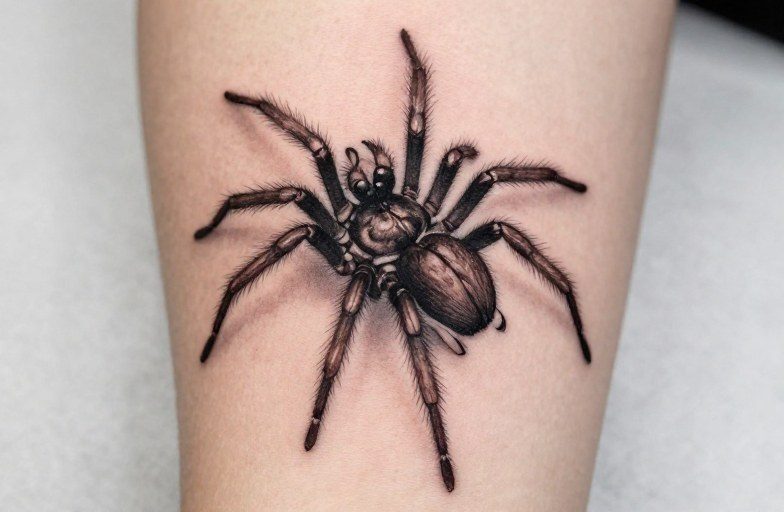
A spider tattoo most commonly represents patience, creativity, and the intricate weaving of fate, though darker interpretations of danger, entrapment, and mortality run just as deep. The meaning shifts dramatically based on species depicted, stylistic choices, and cultural context. Some wearers connect to the spider as a symbol of feminine power and creation; others gravitate toward its predatory nature and association with venom, threat, and the macabre.
Symbolism and Core Meaning
Spiders occupy a unique symbolic space: builders and destroyers, patient artisans and lethal hunters. This duality makes them unusually versatile tattoo subjects.
The Web as Metaphor
The web itself carries distinct weight. It suggests interconnectedness, the complexity of relationships, and the idea that actions ripple outward in unexpected directions. A web tattooed across an elbow or knee, places that bend and flex, can emphasize how life’s structure shifts with movement and choice. Dense, highly detailed webbing reads as deliberate construction; broken strands suggest loss, resilience, or the passage of time.
Predator and Protector
Not all spider symbolism is gentle. The creature’s hunting methods, ambush, paralysis, liquefaction, inspire visceral reactions. Tattoos emphasizing fangs, dripping venom, or a spider mid-strike lean into intimidation and self-defense. Plenty of people want a tattoo that broadcasts a warning. The black widow specifically carries this charge, her hourglass marking instantly recognizable and gendered in ways that resonate with women claiming their own dangerousness.
- Patience and strategic waiting
- Creative construction (weaving, artistry, craft)
- Fate, destiny, and interconnected lives
- Feminine power and independence
- Danger, threat, and self-protection
- Entrapment, being caught or catching others
History and Cultural Roots
Spider mythology spans continents with surprising consistency, though specific interpretations vary significantly. Where historical certainty is thin, I have noted it.
Indigenous North American Traditions
The Spider Woman or Grandmother Spider figure appears across numerous Pueblo, Navajo, and Hopi stories, often linked to creation, storytelling, and the weaving of the universe itself. In these contexts, a spider tattoo can honor heritage and carry spiritual weight. The trickster Spider character also appears in some Southeastern tribal traditions, clever and morally ambiguous rather than purely benevolent. If you are not from these nations, consider whether your tattoo references respectfully or appropriates.
African Diaspora and European Folklore
Anansi, the West African spider trickster, traveled with enslaved peoples and became central to Caribbean and African American storytelling traditions. Anansi tattoos often reference wit, survival through intelligence, and cultural continuity. European folk traditions, meanwhile, frequently associated spiders with luck, killing one was considered unwise, and with female domesticity, the “spinster” connection running deep. The Greek myth of Arachne, often linked to transformation into a spider after challenging Athena, adds threads of artistic defiance and eternal craft, though Ovid’s telling is our primary source and later interpretations vary.
Japanese folklore offers the tsuchigumo, giant spider yokai, and the jorōgumo, a spider that transforms into a beautiful woman to lure prey. These figures complicate any straightforward reading of spider tattoos, adding layers of deception and supernatural danger.
Color versus Black and Grey
Color choices fundamentally alter how a spider tattoo reads and how it holds up over time.
Black and Grey Realism
This remains the dominant approach for spider tattoos, and for good reason. Spider anatomy, hairs, segmented legs, the glossy carapace, translates beautifully through careful greyscale shading. Black widows particularly benefit: the stark contrast of black body against red hourglass loses impact when color is applied poorly. Solid black saturation in the abdomen creates visual weight that anchors compositions. The downside: black ink spreads slightly over decades, so extremely fine leg details may soften. Artists compensate by building texture through stippling and whip shading rather than relying on hair-thin lines alone.
Color Applications
Jewel-toned jumping spiders with their iridescent chelicerae, golden orb-weavers, or the blue tarantula species offer natural reference points that justify bold palettes. Color also enables symbolic coding: red for danger or passion, purple for mystery, green for toxicity. The practical reality is that color fades faster than black, especially on high-friction areas like hands and forearms. Yellows and light greens particularly struggle. A color spider tattoo demands either committed touch-up planning or placement on protected skin.
Common Variations and Styles
Specific spider species carry distinct associations that shape design choices.
Black Widow and Recluse
The hourglass-marked black widow dominates spider tattoo imagery, particularly among women reclaiming the “dangerous woman” archetype. Placement matters: sternum and throat placements amplify the vulnerability-threat tension. Brown recluse tattoos are rarer but appear in medical and dark humor contexts, the necrotic bite association lending genuinely grim undertones.
Tarantula and Orb-Weaver
Tarantula tattoos often emphasize scale and texture, huge, hairy, physically imposing. They suit those wanting substantial pieces with organic, almost landscape-like detail. Orb-weavers, with their geometric web patterns and often vivid abdominal markings, bridge natural history and decorative art. Traditional Japanese or illustrative styles treat these spiders almost as botanical specimens, precise and beautiful rather than threatening.
Web-Only Designs
Some people skip the spider entirely, tattooing just the web. Elbow and knee “spiderweb” tattoos have prison and working-class associations in American tattoo history from the mid-twentieth century, though these meanings have shifted as the imagery spread mainstream. A web on the throat or face still carries harder edge connotations than one on the shoulder or calf. Negative-space webs, inked background with skin-tone lines, create subtle, contemporary effects but require excellent healing and consistent sun protection to maintain readability.
How Spider Tattoos Age
Spider tattoos present specific technical challenges that affect long-term appearance.
Leg Details and Fine Lines
Spider legs are long, thin, and numerous, eight opportunities for blur and blowout. Single-needle or very fine line work looks crisp for months but often degrades within five years, becoming fuzzy or disappearing entirely. Slightly bolder outlines (three-liner or tight whip shading) preserve leg definition longer. Artists often build leg texture through short, directional strokes rather than continuous lines, creating the suggestion of hair and segmentation that reads clearly even as it softens.
Web Geometry
Concentric web patterns with radial lines are notoriously difficult to execute evenly on curved body parts. The natural stretch of skin over muscle and joint means perfectly symmetrical web tattoos almost always distort with movement. Experienced artists account for this, designing asymmetry that looks intentional or placing webs on relatively flat, stable areas like the upper back or outer thigh. Over time, web lines spread; the “dewdrop” dots some artists add to intersections help maintain the pattern’s readability as lines thicken.
Black Saturation versus Delicate Work
Black-heavy spider bodies age better than delicate webwork. The solid abdominal saturation holds its depth for decades, while fine radial lines may require reinforcement after ten to fifteen years. This is worth discussing during consultation: will your artist guarantee touch-ups, and at what cost?
What to Remember
A spider tattoo rewards careful thought about which aspect of the creature you want to claim. The same image reads as patient craftsman or patient killer depending on context, and you cannot fully control which interpretation others land on. Cultural associations, particularly Indigenous and African diaspora meanings, deserve respect and research if they are not your heritage. Technically, this subject demands an artist comfortable with fine detail, texture building, and the compromises of aging skin. Bold choices in placement and color carry consequences: throat webs signal hard edges, color fades, fine lines blur. The spider’s great symbolic strength is its refusal to be one thing only. Your tattoo will inherit that complexity. Make sure it is complexity you want to wear.
Frequently Asked Questions
Do spider tattoos always mean prison time?
No. Elbow and knee spiderweb tattoos have historical associations with incarceration and working-class identity in twentieth-century American tattooing, but these meanings have broadened significantly. A web on the shoulder, back, or combined with a specific spider species carries no prison connotation. Context and placement matter more than the image itself.
Are spider tattoos more painful because of the leg details?
The pain depends on placement, not the design. Spider legs require long, thin lines, which means more needle passes and concentrated irritation in the same area. Ribs, sternum, and inner arm locations hurt more than outer thigh or upper back. The fine-line technique itself is not more painful than bold work, but the time spent on delicate areas can feel more intense.
What is the best spider species for a small tattoo?
Jumping spiders and black widows work well at smaller scales. Jumping spiders have compact, rounded bodies and large front eyes that remain readable when reduced. Black widows rely on the iconic hourglass shape, which simplifies effectively. Avoid tarantulas and orb-weavers for very small pieces; their detail depends on size and will blur or lose definition.
Leave a Reply