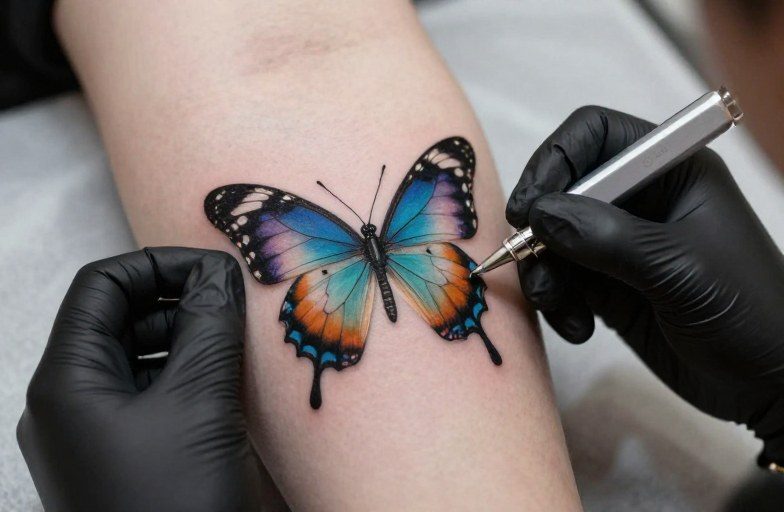
An artistic butterfly tattoo typically signals personal transformation, the acceptance of change, or a memorial to someone who lived brightly but briefly. Beyond generic rebirth clichés, the butterfly’s specific visual language, wings that are both delicate and structurally precise, a life cycle that depends on total dissolution, gives artists and wearers genuine symbolic material to work with. The “artistic” modifier matters: these aren’t flash-sheet copies but compositions where wing pattern, body position, and surrounding elements carry deliberate weight.
History & Cultural Roots
Pre-Modern Associations
Butterfly imagery in body art predates contemporary tattooing by millennia. In Aztec tradition, the butterfly was often linked to fallen warriors and the souls of women who died in childbirth, appearing in codices with flame-like wing patterns. Japanese monshō family crests sometimes incorporated butterflies as symbols of joy and marital happiness, particularly the swallowtail species. European folk art connected moths and butterflies to the souls of the dead, a association that persisted in Victorian mourning imagery. These roots matter because they explain why a butterfly paired with specific elements, flames, cherry blossoms, memento mori objects, reads differently than one floating alone.
Modern Tattoo Lineage
The butterfly entered Western tattooing through sailor and circus traditions, typically rendered small and blue or yellow for quick, affordable work. The shift toward “artistic” treatment began with the 1970s-1980s Japanese influence on American tattooing, where larger, more anatomically considered insects appeared as back pieces and sleeves. Today’s artistic butterfly tattoos draw from scientific illustration, Art Nouveau linework, and abstract expression, sometimes simultaneously.
Design Tips & Pairings
Line vs. Shading Approaches
Butterfly wings offer two fundamentally different technical paths. Fine-line, single-needle work emphasizes the insect’s fragility and can achieve remarkable detail in antennae, wing veins, and body segmentation. The tradeoff: fine lines blur faster, particularly in high-movement areas like wrists and ankles. Bold traditional or neo-traditional approaches use heavier outlines and saturated color blocks; these hold longer but sacrifice some of the species-specific detail that makes a monarch distinct from a morpho.
Shading strategy changes the symbolic temperature. Heavy black and grey shading reads more somber, more mortality-aware. Bright color, especially iridescent blues, oranges, and yellows, pushes toward vitality and celebration. Negative-space highlights within wings can suggest light passing through, a effect that requires skilled execution to maintain through healing.
Common Pairings and Their Effects
- With florals: Botanical context grounds the butterfly in natural cycles; peonies and cherry blossoms specifically reference Japanese irezumi tradition.
- With geometric frames: Creates tension between organic form and structure, often reading as transformation made deliberate rather than passive.
- With skulls or timepieces: Direct memento mori statement; the butterfly’s short lifespan becomes explicit.
- Multiple butterflies in sequence: Suggests passage, movement through stages, or the presence of multiple souls/people.
Symbolism & Core Meaning
The Metamorphosis Element
Caterpillar-to-butterfly transformation is the most cited meaning, but the specifics matter more than the general concept. The biological reality is violent dissolution: the caterpillar’s body literally breaks down into imaginal cells before reorganizing. A tattoo that shows partial transformation, one wing still crumpled, chrysalis fragments attached, carries different weight than a fully spread specimen. This nuance separates artistic butterfly tattoos from decorative ones.
Fragility as Strength
Butterfly wings are structurally remarkable: thin membranes supported by micro-scale trusswork that achieves strength through lightness rather than mass. Tattoo compositions that emphasize this architecture, visible wing veins, transparency effects, contrast between dark body and light wings, can symbolize resilience that doesn’t read as aggression. The butterfly survives by evasion and adaptation, not defense.
How It Ages on Skin
Butterfly tattoos present specific aging challenges. Wing edges, where color meets skin, are prone to blowout and fading; the outline acts as a containment barrier that weakens over time. Detailed wing patterns, eyespots, vein networks, gradient color, tend to muddy together as lines spread and ink particles disperse. A butterfly that reads clearly at five years often becomes a colored blob by fifteen, especially in sun-exposed placements.
Color choice affects longevity predictably. Black and grey hold structure longest. Saturated reds and oranges fade to workable earth tones. Blues and greens, particularly lighter values, can shift toward grey or disappear against darker skin tones. The metallic blues of morpho butterflies are especially hard to replicate; they require white ink underlays that yellow, or heavy black bases that limit the luminous effect.
Technical countermeasures exist: slightly oversized design (more room for detail loss), strategic use of black vein lines as structural scaffolding, and placement away from high-sun areas. Touch-ups are nearly inevitable for detailed color work.
Best Placements
Flat Surfaces for Wing Display
Butterflies need relatively flat planes to avoid the wing distortion that occurs over curved muscle. The shoulder blade, upper back, thigh front, and sternum area work well for spread-wing compositions. These placements also allow the bilateral symmetry that most butterfly designs assume; asymmetrical body positioning can work but requires deliberate artistic choice rather than accidental distortion.
Smaller Scale Options
Wrist inner surface, ankle, and behind the ear accommodate smaller butterflies but force simplification. A wrist piece has perhaps two square inches of effective canvas; at that scale, species identification becomes impossible and the image reads as generic butterfly shape. This isn’t inherently bad, simplicity ages better, but it’s a different symbolic register than a detailed Danaus plexippus with visible wing damage and migration wear.
One consideration specific to butterflies: wing direction implies movement. A butterfly placed on the shoulder with wings vertical suggests just landed or about to depart. Horizontal wings read as at rest or in display. This body language is subtle but affects how the tattoo interacts with the wearer’s own posture and motion.
Personal & Modern Meanings
Contemporary wearers often layer personal narrative onto traditional symbolism without displacing it. Recovery from addiction or illness, gender transition, immigration, creative reinvention, all map onto metamorphosis differently. The butterfly’s particular suitability is its combination of total transformation with retained identity: the imago is still the same organism, genetically continuous, yet unrecognizable.
Some modern designs incorporate scientific accuracy as meaning-making. A species-specific butterfly, monarch for migration and return, mourning cloak for longevity, cabbage white for ubiquity and resilience, carries information that generic forms don’t. Tattoo artists with biology backgrounds or reference libraries can execute this; flash-sheet butterflies cannot.
The “artistic” designation also signals refusal of the butterfly’s sometimes dismissive reputation as a “basic” or purely feminine choice. Complex composition, technical ambition, and personal specificity reclaim the image from its commercial overuse.
Final Word
An artistic butterfly tattoo succeeds when its specific visual choices, species, posture, technical approach, pairing elements, align with what the wearer actually wants to mark. The symbolism is available, historically grounded, and flexible enough to bear individual weight, but only if the design escapes generic execution. Work with an artist who builds from reference, who understands wing structure as functional anatomy rather than decorative pattern, and who will tell you honestly which details will survive a decade of skin metabolism. The meaning is in the making, not just the motif.
Frequently Asked Questions
Does an artistic butterfly tattoo always mean transformation?
Not necessarily. While metamorphosis is the most common association, species choice, accompanying elements, and wing position can shift meaning toward memorial, freedom, fragility, or scientific appreciation. Context matters more than the single image.
How much detail can realistically fit in a small butterfly tattoo?
Less than most reference photos suggest. A butterfly under two inches wide will lose most wing patterning within a few years. Effective small butterflies rely on strong silhouette, limited color blocks, and strategic black lines rather than fine detail.
What’s the difference between a butterfly and a moth in tattoo symbolism?
Moths traditionally carry nocturnal, death-associated, or attraction-to-flame meanings, while butterflies suggest daylight, transformation, and joy. However, artistic treatment can blur or deliberately complicate this distinction, luna moths specifically are often chosen for their beauty rather than traditional moth symbolism.
Can a butterfly tattoo be done effectively in black and grey?
Yes, though it requires strong value contrast to suggest the luminosity we associate with butterfly wings. Without color, texture variation, stippling, whip shading, negative space, becomes essential to prevent a flat, graphic appearance that loses the insect’s delicate quality.