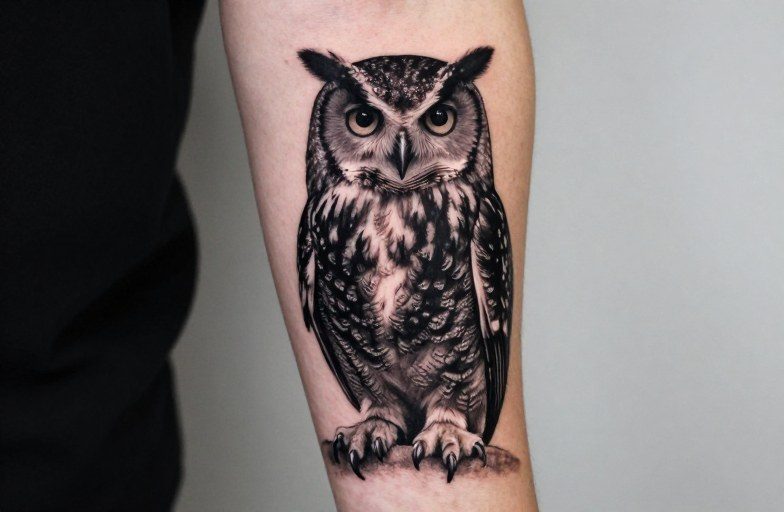
A black owl tattoo most commonly signals wisdom, mystery, and the ability to see through darkness, literal and metaphorical. The color black amplifies the bird’s nocturnal nature, pushing symbolism toward shadow work, the unknown, or protection rather than the lighter, more academic associations of brown or grey owls. For many, it becomes a marker of intuition sharpened by difficult experience, not book learning alone.
Best Placements
Where the Body Changes the Reading
Placement reshapes how a black owl tattoo reads. A chest piece, especially over the heart, leans into guardianship and vigilance, owls as silent watchers. The upper back or between the shoulder blades suits the wingspan, letting artists stretch the primary feathers across bone structure for mechanical accuracy. Forearms and calves work well for perched, compact compositions; the cylindrical muscle there mimics the trunk or branch the owl grips.
Thighs and ribs allow larger, more detailed blackwork, but ribs demand commitment. The skin there shifts heavily with breathing, so fine lines in black owl faces often blur within five to seven years. Hands and neck, while bold, compress the image to a size where feather texture becomes mush; you’re left with a silhouette, which can be intentional but limits detail.
- Chest: guardian symbolism, space for spread wings
- Upper back: natural wing alignment with scapulae
- Forearm: perched compositions, visible but coverable
- Ribs: large scale, high movement, faster aging
- Thigh: generous canvas, lower pain, easy healing
Flow and Movement
Owls carry visual weight in the head and eyes. Smart placement accounts for this. A head-heavy composition facing forward on a vertical surface (outer bicep, calf side) creates natural balance. Profile pieces work better horizontally, across collarbones, along the hip crest, where the beak line and tail counterweight each other.
Personal & Modern Meanings
Beyond the Dictionary Definition
Modern wearers rarely stop at “wisdom.” The black owl has absorbed grief symbolism, silent, solitary, active in hours when others sleep. Some use it to mark survival through depression or insomnia, the bird’s night-hunting reframed as functioning while the world stops. Others connect it to occult or witchcraft practice, where the owl crosses between worlds in several traditions.
The color black specifically shifts meaning. A black owl isn’t a barn owl, soft and ghostly. It’s coal-eyed, invisible against pine bark, associated with the edge of death in several cultures rather than death itself. That distinction matters: proximity to endings, not the ending. Transition. Thresholds.
Gender and Reception
Interestingly, black owl tattoos skew less gendered than some animal imagery. The lack of color, the angular geometry of owl faces, and the prevalence of blackwork technique make them neutral in practice. What varies is surrounding elements: florals and moon phases pull feminine in context; skulls and daggers pull masculine. The owl itself remains flexible.
History & Cultural Roots
Old World Associations
In ancient Greece, the owl accompanied Athena, wisdom, yes, but also military strategy, the ability to see what enemies missed. The black variety specifically appears in some vase paintings, though scholars debate whether this represents species accuracy or artistic convention. Roman tradition often linked owls to witchcraft and ill omen, a reversal that complicates modern adoption.
Celtic and Norse sources are sparser and more contested. Some trace owl imagery to the Cailleach, a hag goddess linked to winter and death, but evidence is fragmentary. Medieval European bestiaries frequently depict owls as creatures of darkness and moral blindness, a negative framing that inverted only in the Renaissance.
Indigenous and Contemporary Practice
Several Native American traditions associate owls with prophecy and the spirit world, though specific meaning varies enormously by nation and region. The Hopi connect burrowing owls to fertility and germination; some Plains cultures treat owl calls as death warnings. These aren’t interchangeable. Modern tattoo seekers should understand that wearing a black owl as “spiritual” without knowing which tradition they’re referencing risks flattening real specificity into vague mysticism.
Japanese folklore offers the horned owl, sometimes black in depiction, as a protective charm, “fukurou” punning on “no hardship” and “luck bringing.” This is often linked to modern popularity, though the black coloration specifically is less common in original contexts.
Common Variations & Styles
Realistic Blackwork
High-contrast realism dominates black owl tattoos. Artists build depth through negative space, using skin tone for the facial disc’s lighter feathers, surrounding it with saturated black. The key challenge is the eye: a real owl’s eye is tubular, not spherical, with a fixed stare. Good tattooists exaggerate the corneal reflection to create life; poor ones render flat, dead disks. Feather layering matters too, wing coverts over primaries over secondaries, each with distinct barb density.
Neo-Traditional and Graphic Approaches
Neo-traditional black owls simplify feather structure into readable shapes, often adding ornamental borders or moon backgrounds. The style trades some accuracy for longevity, bold lines hold better than photorealistic stippling. Graphic and tribal-adjacent versions reduce the owl to silhouette or geometry, sometimes just the face with exaggerated eyes. These age exceptionally well but sacrifice species recognition; they become “owl-like” rather than owl.
- Realistic blackwork: maximum detail, faster aging, needs large scale
- Neo-traditional: balanced readability, moderate size flexibility
- Graphic/silhouette: best longevity, smallest minimum size
- Geometric: owl face broken into polygonal facets, trendy but dating risk
Color vs Black and Grey
The choice between pure black and black-and-grey significantly alters both process and result. A black owl in solid blackwork reads as symbol first, animal second, the form becomes icon. Adding grey wash introduces softness, roundness, the actual texture of plumage. Some artists use grey only in the face, keeping body feathers black, creating a focal point that draws the viewer immediately to the eyes.
Healing differs too. Saturated black areas scab heavier and can lose some ink to peeling; grey washes heal more evenly but may need touch-ups to maintain contrast. Over decades, black stays black (with some spread into surrounding skin), while grey fades toward greenish or bluish tones depending on ink brand and sun exposure.
Color is rare in owl tattoos for a reason. The bird’s natural camouflage is brown, grey, white, colors that don’t pop on skin. Attempting realistic color often yields muddy results. Exceptions exist: a black owl with yellow eyes, or blood-red claws, uses color as punctuation rather than description.
Design Tips & Pairings
Complementary Elements
Black owls pair naturally with nocturnal or liminal imagery: moon phases, pine branches, moths, keys, hourglasses. The moon is most common; a waxing crescent behind the owl creates negative space for the face while reinforcing night symbolism. Branches should show grip, talons sunk into bark, not resting lightly. This grounds the bird, prevents the floating effect that weakens many animal portraits.
Typography and Script
Text with black owls demands caution. The bird’s face is already visually loud; adding lettering competes for attention. If used, place script in the negative space below a perched owl, or curve minimally around wing edges. Avoid faces, chests, or anywhere the text must bend awkwardly. Latin phrases about wisdom or night are common; less common but more effective are coordinates, dates, or single words in the wearer’s handwriting.
- Moon phases: reinforces nocturnal identity, provides background structure
- Branches/pine: habitat context, anchors the composition
- Keys: hidden knowledge, access to locked places
- Moths: night ecosystem, vulnerability counter to owl’s predation
- Single bold number or letter: minimal, personal, non-competing
What to Remember
A black owl tattoo succeeds when the darkness is intentional, not default. Blackwork for blackwork’s sake yields a shape that could be any night bird; the owl’s particular geometry, forward-facing eyes, facial disc, stocky silhouette, needs space and planning to read clearly. Small black owls become blobs; poorly placed ones fight the body’s movement.
The symbolism you carry should be specific enough to hold. “Wisdom” is thin. Wisdom through insomnia, or wisdom rejected by others, or the wisdom of not speaking, those layers give the image staying power. The black owl watches, hunts, survives in conditions that disable others. That’s the core. Everything else is decoration.
Choose an artist who has rendered owls before, ideally in blackwork. Feather texture in pure black is unforgiving; experience shows in the transition zones between light and dark. Ask to see healed photos, not just fresh work. Black saturation changes dramatically between day one and month three. The owl you live with is the healed one.
Frequently Asked Questions
Does a black owl tattoo always mean death or something negative?
No. While some cultures link owls to death’s proximity, the black color more commonly amplifies mystery, night, and intuition. Meaning depends heavily on surrounding elements and personal intent. A black owl with a key or book reads very differently than one with a skull or clock.
How well do detailed black owl faces age on forearms?
Moderately well if scaled large enough, but fine lines in the facial disc blur over five to ten years. The forearm gets sun and friction; expect softening around the eyes and feather edges. Bold black outlines and strategic negative space help preserve readability longer than dense stippling.
What’s the difference between a black owl and a barn owl in tattoo symbolism?
Barn owls, with heart-shaped faces and pale coloring, carry softer associations, ghostly, vulnerable, agricultural. Black owls (often great horned or barred owls rendered dark) read as tougher, more predatory, more nocturnally absolute. The species choice shapes the emotional tone significantly.
Can a black owl tattoo work with other blackwork pieces, or does it need standalone space?
It integrates well if the surrounding blackwork shares similar density. A black owl next to heavy geometric patterns or script works; next to delicate fineline flowers, it dominates awkwardly. Plan sleeve or patchwork layouts with contrast levels in mind, not just subject matter.
Leave a Reply