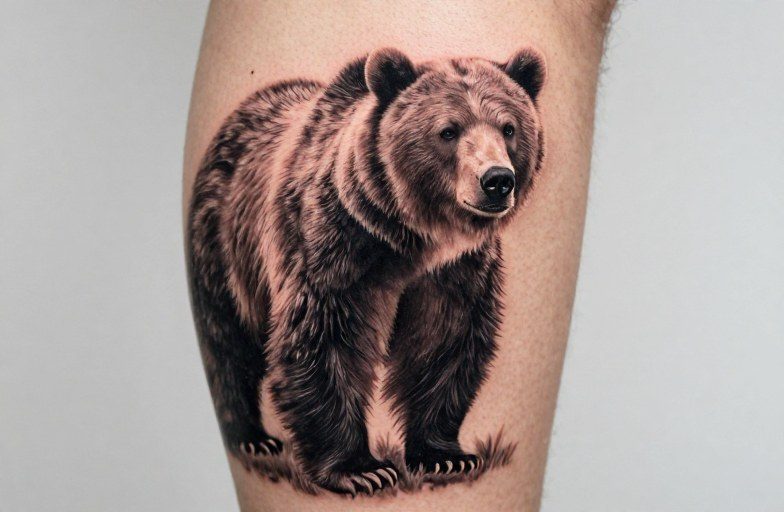
A grizzly bear tattoo carries weight. It stands for raw physical power, fierce independence, and the ability to survive, and thrive, alone. People who choose this image usually aren’t looking for cute or decorative. They want something that says they can handle isolation, protect what’s theirs, and come back after being knocked down.
History & Cultural Roots
The grizzly’s footprint stretches across Indigenous North American traditions, Pacific Northwest carving, and frontier-era American iconography. Unlike the black bear, which appears more often in Eastern woodland stories, the grizzly dominates the visual language of the American West and Pacific Coast.
Indigenous Representation
Coastal Salish, Tlingit, and Haida peoples often linked the grizzly to warriors, healing, and spiritual authority. In these traditions, the bear wasn’t a mascot, it was a relative, a teacher, sometimes a crest animal passed down through clans. The famous formline designs of the Pacific Northwest, with their ovoid shapes and split-U forms, remain some of the most visually striking bear tattoos being done today. If you’re drawn to this style, working with an artist who understands the rules of formline design matters; the shapes aren’t arbitrary, and getting them wrong reads as disrespectful, not just inaccurate.
American Frontier Symbolism
Later, the grizzly became a symbol of the untamed continent itself, something too big and too wild to be fully conquered. That legacy still lives in how people choose this image: less domesticated pet, more force of nature.
Mythology & Folklore
Bear mythology runs deep, though the grizzly specifically occupies a narrower lane than the generic “bear” of European fairy tales.
Native Stories of Transformation
Many tribes carry stories of humans who become bears, or bears who were once human. The grizzly in these tales often acts as a bridge between the human and animal worlds, carrying knowledge of both. This duality, human intelligence inside animal power, makes the grizzly a compelling choice for people who feel caught between civilization and something wilder in themselves.
Modern Archetypes
Popular culture has its own mythology: the grizzly as the ultimate solo survivor, the animal that doesn’t need the pack. That archetype resonates with veterans, people who’ve rebuilt their lives alone, and anyone who prizes self-sufficiency over social performance. It’s worth noting that real grizzlies are actually fairly social animals, especially mothers with cubs. The tattoo’s meaning draws more from human projection than zoological fact, but that’s how symbolism works.
Color vs Black and Grey
The choice between color and black and grey changes the emotional temperature of the piece significantly.
Color Realism
A full-color grizzly, especially in the realistic style, demands space. The brown tones need room to breathe; a small color bear on a forearm often ends up looking like a muddy blob inside five years. If you’re going color, think shoulder, thigh, or back. The best color grizzly work leans into the texture: wet fur around the muzzle, the honey-gold tipping on the shoulders, the dark claws catching light. These details require a large canvas and an artist who specializes in animal realism.
Black and Grey
Black and grey handles aging better and suits more placements. A grizzly rendered in deep blacks and soft grey wash can work at smaller sizes without losing readability. The style also shifts the tone from “nature documentary” to something more symbolic and severe. Tribal and neo-traditional approaches almost always live in black and grey, and they age cleaner than color work with heavy saturation.
Design Tips & Pairings
Placement and surrounding imagery define whether a grizzly tattoo feels cohesive or like a random stock image.
What Works Around the Bear
- Mountains and forest silhouettes: ground the bear in habitat without competing for attention
- Salmon or river imagery: references the grizzly’s actual ecology and adds narrative detail
- Geometric frames or mandala backgrounds: popular but risky; the bear’s organic shape fights rigid geometry unless the artist really knows how to bridge the two
- Skulls or battle damage: overdone and often reads as trying too hard; the bear itself carries enough weight
Placement Reality
The chest and upper arm are classic for a reason: the bear’s broad shoulders mirror human anatomy, and the image reads correctly when the person is standing face-forward. Thigh pieces work well for larger designs with environment included. Ribs and sternum are painful and tend to distort the bear’s face as the body moves; if you want a bear head there, keep it simple and bold. Hands and feet are poor choices for detailed grizzly work, the ink falls out faster, and the image rarely ages well enough to justify the space.
Symbolism & Core Meaning
Strip away the cultural layers, and a few core meanings keep surfacing.
Strength Without Aggression
The grizzly doesn’t posture. It doesn’t need to. That quiet confidence, knowing you can handle what comes without broadcasting it, draws a lot of people to this image. It’s the difference between a wolf pack’s coordinated threat and a bear’s solitary presence. One is social power; the other is self-contained.
Seasonal Cycles
Bears hibernate. They fatten, sleep, emerge lean and hungry, rebuild. For people who’ve been through depressive cycles, burnout, or recovery, that rhythm resonates. The grizzly becomes a marker of return, not permanent triumph, but the capacity to come back.
Boundary and Protection
Mother grizzlies are famously dangerous. The tattoo sometimes functions as a warning: there are lines, and crossing them has consequences. People with children, or people who’ve had to defend something vulnerable, often gravitate toward this aspect of the symbol.
How It Ages on Skin
Animal portraits are unforgiving over time. The grizzly’s defining features, small eyes, broad muzzle, heavy fur texture, need to be planned with aging in mind.
Line Weight and Contrast
Fine fur detail disappears. What stays readable is the big shape: the silhouette, the eye placement, the negative space of the muzzle. Smart artists build the tattoo around these anchor points, using the detailed fur as secondary texture that can fade without destroying the image. A grizzly with a strong black outline around the head and shoulders will still look like a bear in fifteen years. One built entirely from soft grey fur texture may become an unrecognizable smear.
Skin Tone Considerations
On darker skin, the grey wash that creates fur depth needs to be punched harder to stay visible. Some artists default to too-light grey, which heals ashier and disappears. The solution is often bolder black, less mid-tone grey, and more reliance on solid saturation and negative space to create the illusion of texture. This isn’t a limitation, it’s a different approach that can produce stunning, graphic results.
The Takeaway
A grizzly bear tattoo works when the person wearing it actually connects to what the image represents: self-sufficiency, quiet power, the ability to endure alone and return changed. It fails when chosen for surface toughness or because it looks cool on someone else. The best grizzly tattoos are large enough to let the animal breathe, bold enough to age into something still readable, and personal enough that the meaning doesn’t need explaining. If you’re considering one, spend time finding an artist whose animal work you can examine healed, not just fresh. The difference between a bear that lasts and one that doesn’t is usually visible in their portfolio if you know what to look for.
Frequently Asked Questions
Does a grizzly bear tattoo always mean aggression or violence?
Not really. Most people choose it for resilience and self-reliance rather than aggression. The bear’s power is usually read as protective or enduring, not hostile.
What’s the best size for a grizzly bear portrait?
Bigger than you might think. A head alone needs at least palm-sized space to keep the features readable as it ages. Full body pieces with environment work best on thighs, backs, or chests.
Can a grizzly tattoo be done in a minimalist style?
Yes, but it’s challenging. The bear’s silhouette is distinctive enough to work simplified, but you lose the texture that makes it specifically grizzly rather than generic bear. Bold line work helps.
How do I respect Indigenous bear imagery without appropriating it?
Research the specific style you’re drawn to. Pacific Northwest formline has strict rules and clan associations. If you’re not from that culture, consider whether the design belongs to you, or work with an artist who can create original animal work inspired by rather than copying traditional forms.