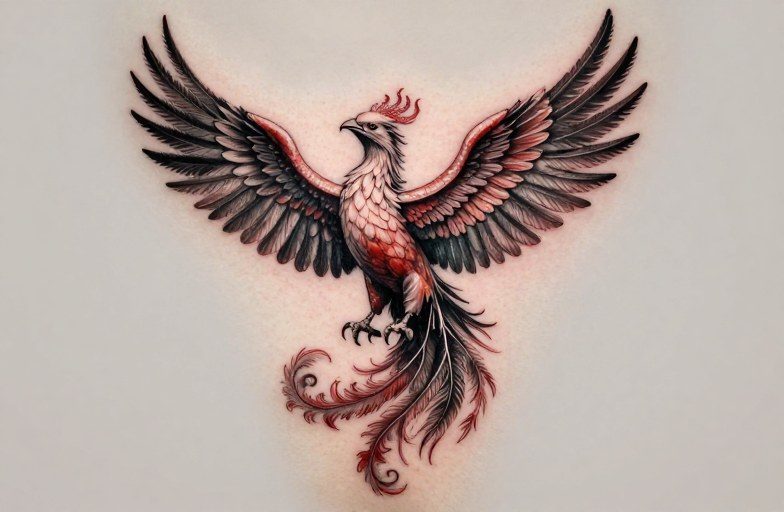
A realistic phoenix tattoo renders the mythological bird as though it could exist, burning plumage captured in photographic detail, embers catching light on individual barbs of feathers, smoke curling from the wingtips. Unlike traditional or neo-traditional phoenix designs that rely on bold outlines and stylized flames, the realistic approach demands mastery of smooth gradients, temperature shifts in color, and anatomical believability. The result lives or dies on whether the fire looks hot and the feathers look weight-bearing, not merely decorative.
Aftercare Notes
The First Two Weeks
Realistic phoenix work typically involves heavy saturation in the red-to-orange spectrum, plus dense black or dark gray for smoke and shadow contrast. These pigments require extra attention during healing. Red inks, particularly the organic reds common in fire effects, are notorious for patchy settling. The first wash happens at your artist’s recommended interval, usually 4-6 hours after the session, never immediate. Use fragrance-free soap, pat dry with clean paper towel, then apply a thin layer of recommended aftercare balm. For the first 72 hours, avoid letting the tattoo dry out completely; the gradient work in flame transitions will scab unevenly if the surface cracks.
Loose clothing is non-negotiable. A phoenix spanning a shoulder or ribs will rub against fabric with every movement. Sleep on the opposite side. If the piece wraps onto your chest or back, consider a clean cotton sheet barrier taped loosely to keep bedding contact minimal. Swimming, saunas, and direct sun exposure remain off-limits for three to four weeks minimum, UV degradation hits red pigments fastest, and premature exposure can permanently dull the fire tones to a muddy brown.
Long-Term Color Preservation
Realistic phoenix tattoos depend on bold temperature shifts, cool shadow grays against hot orange cores. After full healing, SPF 50+ becomes part of your routine for life. Not “when you remember.” Every exposure to unfiltered sun breaks down the molecular structure of red and yellow inks faster than darker pigments. A phoenix that looked incandescent at six months can read as flat and rust-colored at five years without protection. Moisturize the skin regularly; dry, ashy skin diffuses light and mutes contrast.
How It Ages
Line-Heavy vs. Soft-Edge Approaches
Two schools divide realistic phoenix execution. One leans on fine linework to define feather structure and flame edges, think etched detail, almost illustrative realism. The other abandons hard lines entirely, building form through soft airbrush-style gradients and color temperature alone. The aging trajectory differs sharply. Linework-based pieces hold readable structure longer but risk the “coloring book” effect as surrounding pigment fades; the lines remain while the fills soften. Pure gradient approaches look more photographic initially but depend entirely on contrast maintenance. Without crisp edges, a blurred orange mass can become indistinguishable from generic “fire blob” in ten to fifteen years.
Most accomplished artists hybridize: strategic fine lines in high-detail zones like the head and primary wing feathers, soft gradients in body and flame plume areas. Ask to see healed photos from two-plus years out, not just fresh work. Fresh realistic phoenix tattoos photograph spectacularly; the test is whether the ember glow still reads after the initial healing inflammation subsides.
Placement and Aging Speed
Inner bicep, ribs, and thighs, common phoenix placements, experience friction and stretching that accelerates blur. The upper back, outer thigh, and calf offer more stable skin with less daily movement. A phoenix chest piece spreading across pectorals will distort with muscle development or weight fluctuation; the bird’s wingspan literally expands or contracts. Plan accordingly if your body composition changes.
Choosing the Right Artist
Portfolio Red Flags and Green Lights
Look for demonstrated fire rendering, not just “does realistic animals.” Fire is its own technical challenge, translucent, luminous, non-solid. An artist who nails fur texture may still produce flames that look like orange cotton candy. Request to see healed fire work specifically. Green light: smooth transitions from yellow core through orange to red outer edge without banding or striping. Red flag: every flame element identical in shape, suggesting stencil reuse rather than organic composition.
Phoenix-specific anatomy matters too. The bird needs to look structurally capable of flight despite the impossible fire elements. Wing bone placement, shoulder musculature, and tail balance should feel borrowed from a real raptor. Artists who specialize in bird realism, eagles, hawks, ravens, often transition to phoenix work more successfully than those coming from portrait or pet tattoo backgrounds.
Consultation Questions
- “Do you build fire from reference or imagination?” Reference-based artists produce more believable flame behavior.
- “What’s your approach to the smoke element?” Smoke separates amateur from professional realistic phoenix work; it should read as atmospheric, not gray spaghetti.
- “How do you handle the beak and eye for expression without anthropomorphizing?” The bird should feel alive, not human-masked.
Who It Suits
Realistic phoenix tattoos demand commitment. The detail level requires substantial skin real estate to resolve, minimum palm-sized, ideally significantly larger. A tiny realistic phoenix becomes a smear of warm tones within years. You need tolerance for long sessions; a full back piece or substantial thigh work might run 15-25 hours across multiple appointments. Pain tolerance varies by placement, but ribs, sternum, and inner arm are consistently rough for the extended sits this style requires.
Skin tone affects color choices significantly. On deeper skin, the brightest yellows may need to be adjusted toward gold and amber to avoid ashy healing; the contrast between flame and shadow gets built through value shifts rather than relying on pale highlights. Experienced artists adjust their pigment palette rather than forcing a one-formula-fits-all approach. If an artist shows you identical color schemes across all skin tones in their portfolio, look elsewhere.
Cost & Sessions
Hourly vs. Project Pricing
Realistic phoenix work is almost exclusively priced by the hour, ranging from $150-$400+ depending on city, artist reputation, and wait time. Project rates appear occasionally for smaller, contained pieces, but the unpredictable nature of detailed fire and feather rendering makes hourly safer for both parties. A substantial realistic phoenix, full thigh, back panel, or rib-to-hip side piece, typically needs 3-6 sessions minimum, sometimes 8-10 for back-spanning work with environmental elements like smoke backgrounds or ash particles.
Budget for touch-ups. Not because the artist failed, because red pigments, dense saturation, and the sheer scale of these pieces guarantee some areas will settle unevenly. Many artists include a complimentary touch-up within 6-12 months; confirm this upfront. After that, maintenance refreshers every 5-8 years keep the piece photographic.
Deposit and Scheduling Reality
Quality realistic phoenix artists often book 3-12 months out. Deposits are standard, typically $200-$500, applied to final session. Cancellations with short notice usually forfeit this. Plan your calendar before committing; starting a multi-session piece before a beach vacation or physically demanding job change is poor timing.
Common Mistakes to Avoid
Design-Level Errors
Overloading the composition ranks first. A phoenix rising needs negative space, smoke, sky, ash fall, to breathe. Cramming every inch with flame detail produces visual noise, not intensity. The bird itself should remain the focal point; surrounding fire supports, not competes. Similarly, symmetrical wing spreads read as static and artificial. Asymmetry in wing position, flame direction, and feather damage creates motion and life.
Color temperature mistakes destroy believability. Real fire burns hottest at the core (white-yellow) and cools toward the edges (orange, red, then smoke). Reversing this, red core with yellow edges, reads immediately wrong to any viewer, even if they can’t articulate why. The phoenix body should integrate with flame, not sit as a separate bird pasted onto generic fire.
Technical and Planning Missteps
- Choosing an artist based on Instagram filters and fresh photos rather than healed, unedited work.
- Underestimating scale, realistic detail collapses below certain sizes; trust your artist’s minimum recommendation.
- Ignoring aftercare because “it’s just a tattoo I’ve had before”, the color density here exceeds standard black-and-gray healing demands.
- Adding text, banners, or clocks because “it needs meaning”, these elements age poorly and clash with photographic realism.
Final Word
A realistic phoenix tattoo, done well, is among the most technically demanding pieces in contemporary tattooing. It asks the artist to render the impossible with the tools of documentary photography, light, texture, atmospheric perspective. It asks the wearer to commit time, money, and skin to a process that cannot be rushed. The result, when both parties hold up their end, transcends the mythological source material: not a symbol of rebirth rendered literally, but a bird that seems to have burned its way into existence through sheer force of pigment and patience. Choose your artist with the same care they’d use building your flame gradients. The difference between a phoenix that looks alive and one that looks like clip art is about a hundred hours of combined experience, and you can see every one of them in the finished skin.
Frequently Asked Questions
Can a realistic phoenix tattoo work in black and gray instead of color?
Yes, but it shifts the challenge. Without color temperature, the artist must build fire believability through value contrast alone, white-hot cores against deep black smoke. The result reads more ashen and dramatic than incandescent. Skin tone matters more here; on very pale skin, the white highlights can heal pinkish and disappear.
How do I keep the red ink from turning pink or orange over time?
Red pigment fading is partially inevitable, but you can slow it dramatically. Consistent SPF 50+ application, avoiding tanning beds entirely, and staying hydrated all help. Some artists also layer a thin “red booster” pass during touch-ups to refresh saturation without full rework.
Should the phoenix face forward or in profile for maximum realism?
Three-quarter view offers the best compromise. Straight-on bird faces flatten easily and can read cartoonish; pure profile limits the fire interaction and wing drama. A slight turn shows both eye expression and wing spread depth while allowing flames to wrap the beak and chest naturally.
Is it possible to cover an old tribal tattoo with a realistic phoenix?
Often yes, but the old black must be incorporated strategically. Dark tribal lines can become shadowed areas beneath feathers or smoke density. The phoenix body gets positioned where cover is densest. Laser lightening first expands options significantly; attempting pure cover without it risks muddy, restricted color.

Leave a Reply