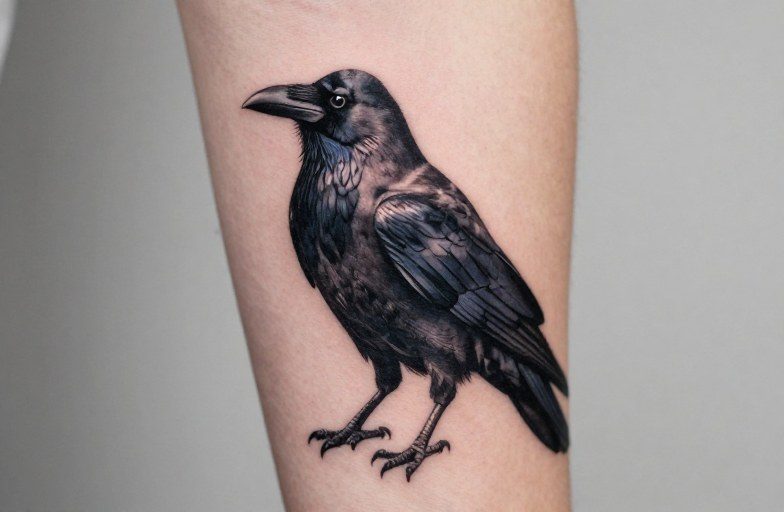
A raven tattoo most commonly represents death, transformation, and the boundary between worlds. The bird’s black plumage and scavenger nature link it to endings, but its problem-solving intelligence and complex social behavior also make it a symbol of wisdom and survival. Depending on design choices, a raven can read as ominous, protective, or quietly watchful.
Symbolism & Core Meaning
The raven’s symbolic weight comes from its actual biology and centuries of human projection. Unlike the crow, which shares many traits, the raven carries a heavier, more solitary presence in most cultural frameworks.
Death and the Threshold
Ravens feed on carrion. That biological fact made them unavoidable witnesses to battlefields, plagues, and unattended deaths. European folklore often linked them to the recently departed, and some traditions held that a raven near a home predicted loss. In tattooing, this translates to memorial pieces, grief processing, or acknowledgment of mortality without sentimentality. A raven perched on a skull or grave marker reads immediately; one in flight with a key or lantern suggests passage rather than ending.
Intelligence and Adaptation
Ravens use tools, remember human faces, and teach their young about threats. Tattoo clients drawn to this aspect often pair the bird with geometric elements, books, or eyes, symbols of perception and learning. The design shifts from macabre to cerebral, though the black ink keeps it grounded.
Mythology & Folklore
Cultural associations vary significantly, and responsible tattooing means knowing which resonance you’re invoking.
Norse and Celtic Threads
Odin’s two ravens, Huginn and Muninn (Thought and Memory), flew across the world each day and reported back. Norse-inspired raven tattoos often show paired birds, sometimes with Valknut symbols or runic borders. Celtic tradition sometimes linked ravens to the Morrigan, a war goddess who appeared in raven form. These connections remain active in contemporary pagan and Heathen communities, so cultural context matters if the design draws directly on sacred symbols.
Pacific Northwest and Indigenous Associations
Raven is a central creator figure in many Pacific Northwest Coast traditions, stealing light, releasing rivers, shaping the landscape. This is not generic “Native American” symbolism but specific to nations including the Haida, Tlingit, and Tsimshian. Raven tattoos in this style (formline, ovoid shapes, split designs) should be approached with the same care as any culturally specific imagery: research, respect, and ideally engagement with artists from those traditions.
Design Tips & Pairings
Placement and companion elements change how a raven tattoo functions visually and symbolically.
- Forearm or calf: Long bones suit the raven’s wingspan. A side-profile raven with extended wing reads as movement; perched with folded wings reads as stillness and watchfulness.
- Chest or back: Larger surfaces allow for environmental context, moon, bare branches, atmospheric fog. These elements soften the bird’s silhouette and add narrative without clutter.
- Hand or neck: High-visibility placements with a dark bird carry immediate associations. Consider whether you want that intensity daily.
Common pairings include:
- Skulls or hourglasses (memento mori, time’s passage)
- Keys or open doors (transition, access to hidden knowledge)
- Compasses or maps (guidance, wandering)
- Geometric mandalas or sacred geometry (intelligence, pattern-seeking)
- Red accents (blood, life force, contrast against black)
Line weight matters. Fine lines in feathers blur faster; bolder outlines with selective shading hold definition longer. Discuss with your artist whether you want illustrative detail or graphic boldness.
Common Variations & Styles
The raven adapts to multiple tattoo languages without losing recognition.
Realistic and Neo-Traditional
Realistic ravens require an artist skilled in black-and-grey feather rendering, layering graphite-smooth tones to create iridescence where there is only black ink. Neo-traditional approaches use heavier outlines, limited but saturated color palettes, and stylized proportions. Both demand technical competence; bad realism looks muddy, bad neo-traditional looks cartoonish.
Minimalist and Silhouette
A single solid black raven shape, perhaps with one extended wing, works at small sizes and in subtle placements. The negative space becomes as important as the ink. These age well because there’s no fine detail to lose, though blowout in small silhouettes can turn crisp edges into soft blobs over time.
Literary and Gothic References
Poe’s “The Raven” generates specific requests: the bird atop a bust of Pallas, the word “Nevermore” in period typography, chamber door imagery. These read as literary tribute rather than pure symbolism, which is a valid choice if the reference resonates personally.
How It Ages on Skin
Black ink dominates most raven designs, which affects longevity in specific ways.
Black holds better than color, but heavy saturation creates its own problems. Large solid black areas can heal with uneven texture, especially on areas that move or stretch (inner bicep, ribs, stomach). Over decades, dense black may develop a blue-green cast as the ink settles and skin changes.
Feather detail is particularly vulnerable. Fine lines separating individual barbs blur within five to ten years depending on sun exposure, skin type, and placement. Artists often build in “aging insurance” by using slightly heavier lines than the reference image suggests, or by designing feathers that read as texture blocks rather than hair-by-hair illustration.
White ink highlights in raven tattoos (catchlights in eyes, feather sheen) frequently fade to skin-tone or yellow within a few years. Some artists now skip white entirely, using negative space or very light grey instead.
Similar & Related Symbols
Clients sometimes arrive wanting a raven but leave with a crow, or vice versa. The visual difference is real, ravens are larger, have heavier beaks, shaggier throat feathers, and wedge-shaped tails in flight, but symbolic overlap is substantial.
- Crow: More associated with trickster energy, urban adaptability, and communal behavior. Slightly less gravitas, more mischief.
- Vulture: Purification, patience, ecological necessity. Less mythologically loaded, more starkly biological.
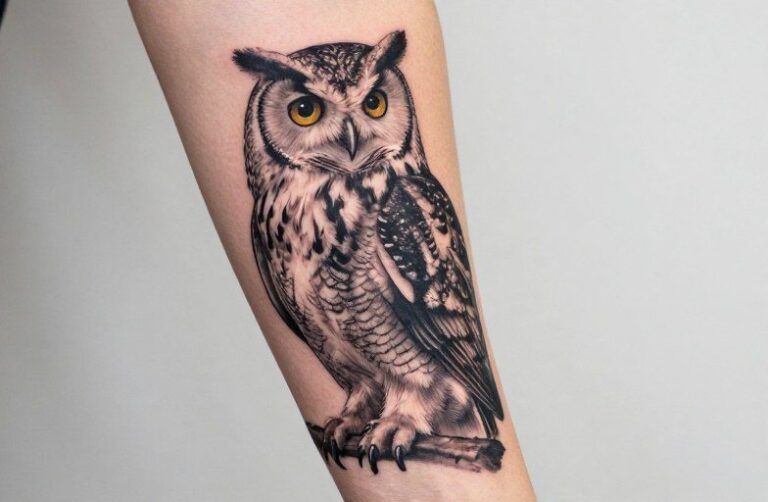
- Owl: Wisdom too, but nocturnal, silent, associated with hunting rather than scavenging. Different emotional temperature.
- Wolf: Pack loyalty, wildness, predator rather than witness. Often paired with ravens in nature (they follow wolf packs), making them a natural companion choice.
A raven with a wolf creates a predator-scavenger partnership image. A raven with a crow suggests duality or kinship. A raven alone emphasizes solitude.
Final Thoughts
The raven tattoo endures because it refuses single definition. Death-bringer, truth-seeker, memory-keeper, trickster, the bird accommodates contradictions without collapsing into vagueness. What matters is specificity in your own design: which raven, in what posture, with what companions, placed where the aging of ink and skin will honor rather than distort the intention. The best raven tattoos don’t borrow meaning from folklore wholesale; they use it as starting point for something particular to the person wearing it.
Frequently Asked Questions
What’s the difference between a raven and crow tattoo meaning?
Ravens carry heavier associations with death, prophecy, and solitary wisdom due to their larger size and mythological prominence. Crows lean toward trickster energy, adaptability, and communal intelligence. Visually, ravens have thicker beaks and wedge-shaped tails; getting the anatomy right matters if the symbolism is specific to you.
Do raven tattoos only work in black ink?
Black dominates for biological accuracy and symbolic weight, but red accents for blood or life force, and occasional blue-purple for iridescence, appear regularly. Full-color ravens are rare because they read as unnatural, the bird’s power is partly in its darkness.
Where on the body does a raven tattoo age best?
Outer forearms, calves, and upper backs age well due to stable skin and moderate sun exposure. Hands, feet, ribs, and stomachs see more distortion from movement, stretching, and friction. Feather detail especially suffers in high-wear areas.
Is it cultural appropriation to get a Norse or Celtic raven tattoo?
Norse and Celtic raven imagery exists in a complex space. European heritage claims are common, but Heathen and pagan practitioners often treat these symbols as living religious significance. Research matters, know if you’re referencing mythology, claiming spiritual affiliation, or simply appreciating aesthetic. When in doubt, consult practitioners from those communities.