A snowy owl tattoo works best when you understand what the bird actually does, not just what it looks like. The white plumage is striking, but the meaning comes from behavior: hours of stillness, sudden precision, survival in places that kill quickly. People choose this species for patience that outlasts discomfort, for sight that functions in darkness and glare alike, for self-sufficiency that does not perform loneliness. The bird is not mystical. Every feather, every feathered foot, is engineered for a specific environment. That physical reality gives the tattoo its weight.
Symbolism and Core Meaning
Before you commit to a design, know which thread you want to emphasize. The snowy owl carries several consistent meanings in tattoo work.
Silence and Observation
Snowy owls hunt in daylight across flat tundra, unlike most nocturnal owls. They sit for hours, motionless, watching. This visible patience translates naturally to tattoo meaning: the watcher, the one who speaks last, the strategist. People in analysis, investigation, or high-stakes decision-making often connect with this trait. The flat facial disc funnels sound with precision; visually, that rounded, almost expressionless face becomes a mask of calm. Your artist can emphasize this through eye placement and head angle.
Arctic Resilience
Snowy owls breed farther north than any other owl, enduring months of darkness and prey scarcity. In tattoo form, this connects to personal endurance: recovery from illness, outlasting professional hardship, surviving isolation. The white camouflage that hides them against snow becomes symbolic: the ability to protect oneself through stillness rather than confrontation. This is not about toughness. It is about persistence without display.
Independence and Self-Reliance
Outside breeding season, snowy owls live alone. They do not flock, do not call frequently, do not depend on group strategies to hunt. For people who have built solitary lives by choice or necessity, this resonates without the aggression of lone-wolf imagery. The owl’s independence is quiet, not defiant.
Design Tips and Pairings
Placement and companion elements change how a snowy owl reads on skin. These combinations carry established visual language in tattooing.
Complementary Elements
- Full moon or night sky: Creates dramatic contrast, though snowy owls are diurnal. The white bird against black background maximizes graphic impact. Your artist must plan the negative space carefully from the first stencil.
- Barren branches or Arctic rock: Grounds the bird in its actual habitat. Dead, twisted branches echo the owl’s patient posture without cluttering the composition. Avoid green leaves or flowers; they place the bird in the wrong ecosystem.
- Geometric frames or mandala patterns: The nearly circular face and symmetrical features lend themselves to structured surrounds. This pairs with the bird’s perceived stillness but risks trending toward generic spirituality if not personalized.
- Prey items: Lemmings or ptarmigan, rendered small in talons or as secondary elements, show the hunter’s reality. This is specific and uncommon; it signals that you studied the species rather than choosing a generic owl.
Placement Considerations
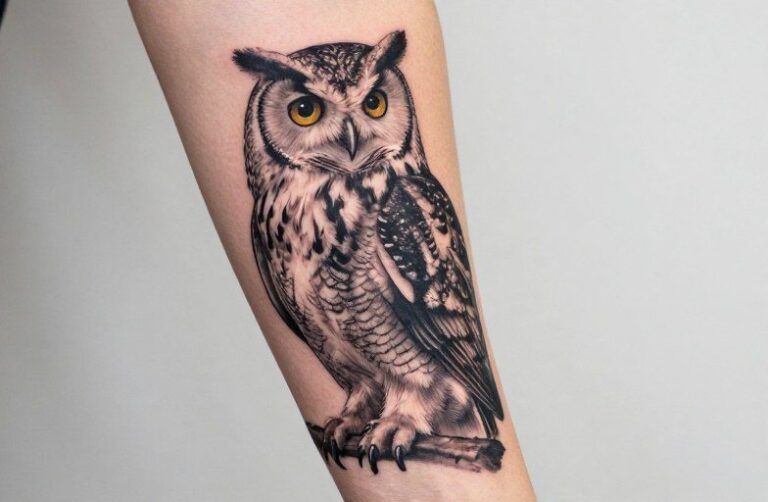
The round head and broad wings suit certain areas better than others. Thighs and outer upper arms provide flat space for wingspan to read clearly. Shoulder blades work for perched, vertical compositions. Forearms demand simplification; too much feather detail at that scale muddles into grey wash within years. Chest pieces allow the face to dominate, with wings wrapping slightly onto shoulders. Avoid narrow vertical spaces like the calf side; the bird’s proportions need width to register as owl rather than generic raptor. Ribs work only if the design emphasizes the vertical body and folded wings, not spread flight.
Common Variations and Styles
How you render the snowy owl changes its emotional impact and its aging process. Each style demands different maintenance expectations.
Realistic and Neo-Traditional
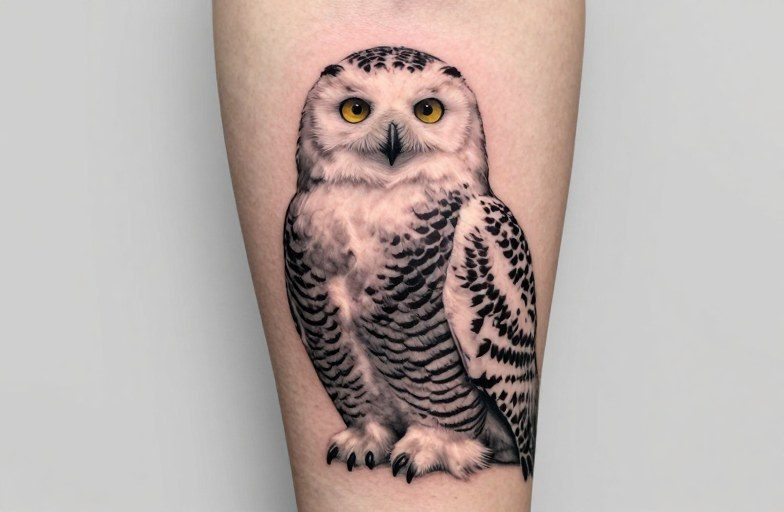
Photorealistic snowy owls require a specialist. White ink on pale skin, yellow eyes with reflective catchlights, individual barbs visible in feathers: this approach ages poorly if overdone. Heavy white highlights flake and fade faster than darker pigments. Neo-traditional simplifies the form: bold black outlines, limited saturated palette, stylized feather groupings rather than individual rendering. The face stays recognizable; the body gains graphic punch. Both styles need palm-sized minimum; smaller, and eye detail collapses into indistinguishable dark spots.
Minimalist and Line Work
Single-needle outlines of the silhouette, round head, slight shoulder hump, no facial features, read as modern and clean. The yellow eye becomes optional; some designs omit it entirely, letting the shape carry recognition. This ages well if lines are bold enough, think 3RL minimum, not hair-fine. Negative space inside the silhouette suggests white plumage without fighting skin tone. Geometric deconstruction, breaking the owl into triangles and parallel lines, trends periodically but dates faster than organic approaches. Consider whether you want this tattoo to look current in fifteen years.
Japanese and Decorative Styles
The snowy owl does not appear in traditional Japanese tattoo canon, but some artists adapt the form into flowing compositions with wind bars, snowflakes, or abstracted background patterns. This requires an artist comfortable improvising outside established reference. The round face and lack of ear tufts actually make the snowy owl harder to render recognizably in Japanese style than great horned or eagle owl species. Discuss sketches carefully before committing.
Color and Black and Grey Strategy
The snowy owl presents a genuine technical challenge: how do you tattoo white on pale skin?
Working With White Ink
White ink alone on untanned skin creates subtle, almost invisible results. Most skilled artists build the bird’s body through negative space, leaving skin untouched, then shade around it with soft greys to create the illusion of white feathers catching shadow. This demands expert planning from the stencil stage; the untouched skin must be preserved from the start, not left out as an afterthought. On darker skin tones, this approach shifts. The negative space reads differently, and artists may use pale grey or very light blue-grey to suggest coloration without relying on white ink that will yellow or disappear entirely.
Black and Grey Approach
The majority of successful snowy owl tattoos use black and grey wash with strategic skin breaks. Dark backgrounds push the un-inked owl forward visually. Feather texture gets suggested through whip-shading and fine line groupings rather than individual hair strokes. The yellow eye, when included, becomes the single color focal point, often the only saturation in an otherwise monochrome piece. This limited palette ages gracefully. Full color realism on a white bird tends to muddy as pigments settle and spread slightly over years. If you want color, limit it to the eye and perhaps a pale blue shadow in the facial disc.
Similar and Related Symbols
Collectors sometimes arrive wanting an owl but leave with something adjacent, or combine symbols for personal specificity.
Other Owl Species
Great horned owls carry more aggressive, protective energy; ear tufts read as horns, the face pattern resembles a fingerprint. Barn owls suggest ghostliness, heart-shaped faces, agricultural settings. Screech owls are smaller, more vulnerable, often rendered with red or grey morph coloring. The snowy owl’s distinction is its environment: no other owl claims the Arctic so completely. If you want cold, silence, and extreme survival, this species is the accurate choice.
Non-Owl Comparisons
- Raven or crow: Trickster energy, transformation, death messenger. More active, less patient than the owl.
- Wolf: Pack animal, social survival, vocal. The snowy owl’s solitary hunt contrasts sharply.
- Polar bear: Shared Arctic habitat, brute strength versus precision. Pairing the two creates an ecosystem narrative.
- Arctic fox: Similar camouflage, smaller scale, more playful or cunning associations.
Personal and Modern Meanings
Contemporary tattooing allows private significance to coexist with traditional symbolism. The snowy owl accumulates modern associations that were not available decades ago.
Pop Culture Resonance
Hedwig from the Harry Potter series introduced a generation to the species as companion rather than wild hunter. Many people’s first emotional connection to snowy owls came through that fictional bond, and tattoos honoring that relationship are valid personal statements. Wildlife photographers and documentary viewers arrive with different visual references: the owl in flight, wings spanning nearly five feet, dropping silently onto prey. These action images contrast with the traditional perched, watching pose. Know which image moves you before you design.
Gender and Identity
The snowy owl shows minimal sexual dimorphism. Females are slightly larger with more dark barring; males become whiter with age. This ambiguity appeals to some non-binary collectors. The bird’s role as both nurturing parent and lethal predator resists simple gender coding. In Indigenous Arctic cultures, the owl carries specific spiritual associations that vary by nation and community; contemporary collectors with heritage connections should seek these meanings through direct consultation rather than assumption or internet research.
Practical Considerations
White ink and heavy negative space require experienced artists. Ask to see healed photos, not just fresh work. White highlights often need touch-ups at eighteen to twenty-four months. The yellow eye, if done with bright cadmium or similar pigments, may fade to a duller mustard; discuss pigment choices with your artist. Snowy owl tattoos typically take three to six hours depending on size and complexity; a full realistic back piece might require multiple sessions. Budget accordingly, and do not rush the artist through negative-space planning to save time.
What to Remember
A snowy owl tattoo succeeds when the design respects the bird’s essential qualities: roundness, stillness, white against dark, patience that reads as power rather than passivity. Choose your style based on maintenance expectations, not just immediate visual impact. Realism demands ongoing care; minimalism requires precise line weight to age well. Work with an artist who has handled white ink and negative space successfully, and ask for healed photos specifically. The snowy owl is not a generic symbol of wisdom. It is a specific animal that survives through exact adaptation to extreme conditions. Your tattoo should carry that specificity, not dissolve into another decorative bird.
Frequently Asked Questions
How do I find an artist experienced with white ink and negative space?
Ask to see healed photos from one to two years after completion, not just fresh work. Fresh white ink looks bright; healed white ink reveals whether the artist planned negative space correctly. Look for portfolios with healed snowy owls, polar bears, or similar pale subjects. Ask directly how they handle skin tone variations in white ink work.
Will a snowy owl tattoo work on darker skin?
Yes, but the approach changes. White ink alone often disappears or yellows on melanin-rich skin. Skilled artists use pale grey, blue-grey, or strategic negative space with darker surrounding shading to create the illusion of white plumage. Consult an artist with specific experience in your skin tone range.
How much does a snowy owl tattoo typically cost?
Expect three to six hours minimum for a quality piece with proper detail. At standard rates, this ranges widely by region and artist reputation, from several hundred to over a thousand dollars. Complex back pieces or full sleeves require multiple sessions. Do not prioritize price over an artist’s experience with this specific technical challenge.
How do I avoid a generic or trendy design?
Study the actual species: diurnal hunting behavior, specific prey, Arctic habitat, minimal sexual dimorphism. Avoid moon-and-stars clichés unless you understand the contradiction of nocturnal framing for a daylight hunter. Consider specific poses from wildlife photography rather than tattoo flash. Add personal elements that reference your own reason for choosing this bird, not just accepted symbolism.