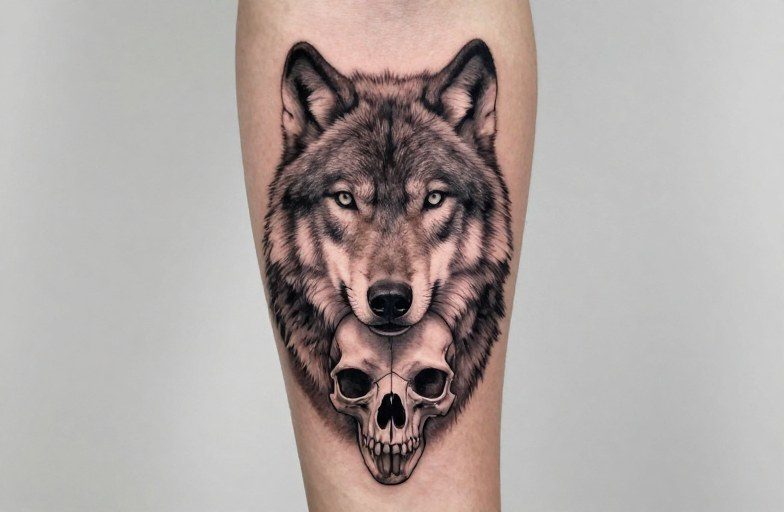
A wolf and skull tattoo most commonly represents the intersection of raw survival instinct and human mortality. The wolf brings pack loyalty, fierce independence, and untamed nature; the skull adds memento mori awareness, death acceptance, or the idea that something primal survives beyond the physical. Together, they often signal a person who has faced loss, respects danger, or identifies with living fiercely within finite time.
Religious and Spiritual Angles
Norse and Pagan Connections
Wolves carry heavy weight in Norse tradition: Fenrir’s destructive power, Odin’s companions Geri and Freki devouring the slain. Pairing a wolf with a skull in this context often reads as Valhalla imagery, death as passage rather than ending. Some trace the skull here to battlefield remains, the wolf as psychopomp guiding souls. The combination surfaces frequently among people drawn to heathen reconstructionism or Norse ancestry, though not everyone with this tattoo practices those beliefs. The historical record is patchy here; much of what people tattoo is modern interpretation of fragmented sources, not continuous ancient practice.
Christian and Folk Interpretations
In Christian-adjacent folk symbolism, the wolf sometimes represents threat or deception, the wolf in sheep’s clothing, while the skull functions as traditional memento mori. The pairing can create tension: sin and judgment, or the soul’s vulnerability before death. Less commonly, some interpret the wolf as the faithful guardian, drawing on rare positive medieval wolf imagery, protecting what remains sacred in the skull. The meaning depends heavily on surrounding elements. Crosses, broken chains, or church architecture shift the reading significantly. Without those modifiers, the combination remains ambiguous, which many wearers prefer.
Color vs. Black and Grey
Black and Grey Realism
This dominates the wolf and skull category for good reason. Black and grey ages cleaner on most skin tones, and the high contrast between wolf fur texture and smooth skull bone reads immediately from across a room. In practice, skulls need solid black in the eye sockets and nasal cavity to hold their depth as the tattoo settles; soft grey washes on the wolf’s muzzle prevent the whole piece from becoming muddy. A detailed forearm piece typically takes four to six hours, longer for full saturation on a thigh or calf wrap. You should plan for multiple sessions if the design extends beyond the flat planes of the outer arm or thigh.
Strategic Color Use
When color appears, it usually functions as accent rather than full render. Amber eyes in the wolf draw focus and create living presence against dead bone. Blood spatter in crimson or rust, a single moon in pale yellow, or blue ice crystals on the skull: these touches pop without overwhelming the core contrast. Full color throughout risks the tattoo dating quickly; the wolf’s natural grey-brown palette does not translate to skin as vividly as, say, a tropical bird. Watercolor backgrounds behind a black and grey central image have become common, though they require touch-ups sooner than traditional approaches. If you want color, limit it to one or two elements that carry specific meaning for you.
Common Variations and Styles
The wolf and skull combination adapts across nearly every major tattoo style, each carrying distinct connotations:
- Neo-traditional: Bold outlines, limited but saturated color palette, the wolf often snarling with exaggerated fur flow, skull positioned below or integrated into the chest. Reads as classic Americana toughness.
- Realism: Photographic detail, often showing the wolf’s actual teeth meeting or emerging from the skull’s orbital socket. Requires an artist with animal-specific experience; fur texture separates competent work from poor work quickly.
- Geometric and dotwork: The skull rendered in mandala patterns, the wolf’s silhouette formed from negative space or constellation lines. Appeals to people wanting spiritual or mathematical symbolism over aggression.
- Japanese-influenced: The wolf, not traditional in Japanese tattooing but increasingly adopted, paired with skulls in sukajan jacket style, surrounded by wind bars or maple leaves. Often larger scale, suited for thighs or back panels.
- Trash polka: The skull splattered or half-erased, wolf emerging from abstract black and red brushstrokes. German origin, high impact, polarizing. You will likely love or hate this style; there is little middle ground.
Single Composition vs. Separate Elements
Some designs merge the wolf and skull into one impossible anatomy: the skull forming from the wolf’s chest fur, or the wolf’s open mouth containing the skull like a held object. Others keep them distinct but overlapping, a skull in the foreground, wolf howling behind. The merged approach reads more mystical or psychological; separate elements read more narrative, like a scene. Neither is objectively better. The merged version suits people who want the tattoo to function as a single emblem; the separated version works for those who imagine a specific story or moment.
Design Tips and Pairings
Placement Reality
The wolf and skull demands space. The skull’s recognizability requires minimum three to four inches height to read as bone rather than generic circle; the wolf’s head needs similar scale to show expression. Popular placements include:
- Outer thigh: Flat canvas, easy to heal, shows well in shorts. The wrap-around potential lets the wolf emerge from behind the skull as the leg turns.
- Upper arm and shoulder cap: Classic location, the skull can sit on the deltoid with the wolf’s neck extending toward the chest. Beware the armpit ditch; detail there blurs faster from movement and friction.
- Forearm: Highly visible, which matters for employment contexts. The inner forearm offers softer skin for smooth grey shading; the outer forearm holds line work better long-term.
- Back, between shoulder blades: Central, symmetrical compositions work here. The skull as focal point, wolf heads flanking in mirrored snarl.
Ribs and hands generally disappoint for this subject. The former distort with breathing, the latter lack space for the detail that makes the combination meaningful. If you are committed to a hand tattoo, consider a simplified wolf silhouette with minimal skull detail rather than the full rendered version.
Complementary Elements
Moon phases behind the pair add cyclical time, death and rebirth. Pine forests or mountain silhouettes ground the wolf in its habitat. Broken chains or shackles suggest liberation through mortality awareness. Daggers or arrows piercing the skull introduce conflict: who killed, who was killed. Avoid overcrowding; the two main elements already carry enough weight that busy backgrounds compete rather than enhance. You should discuss background density with your artist during the consultation phase, not after the stencil is applied. A common mistake is adding too many secondary symbols to ensure the meaning is obvious; the best wolf and skull tattoos trust the central pairing to do the work.
Similar and Related Symbols
Understanding adjacent imagery helps clarify what the wolf and skull specifically offers:
- Raven and skull: More explicitly death-focused, less survival instinct, more scavenger and battlefield cleanup. Often linked to plague imagery or melancholy literary associations.
- Bear and skull: Similar predator-mortal combination, but the bear carries hibernation and rebirth more than wolf’s pack dynamics. Heavier, more solitary energy.
- Wolf alone: Removes mortality entirely; becomes about loyalty, wilderness, or lone wolf identity. Less confrontational with death.
- Skull alone: Generic memento mori, pirate aesthetic, or sugar skull cultural reference. The wolf specifically animates it with living ferocity.
- Wolf with moon, no skull: Howling, spiritual, frequently associated with feminine-coded symbolism in contemporary tattoo culture. The skull changes the emotional register, adding confrontation and finality.
The wolf and skull occupies a specific niche: not purely about death, not purely about nature, but the moment where predator consciousness meets its own end. That tension is what draws people to it repeatedly, despite the combination being visually common in shops.
Who Chooses This Tattoo
Observed Patterns
This design crosses gender more than some aggressive imagery. Geometric or dotwork variations tend to attract people who want symbolic or decorative rather than narrative tattoos; neo-traditional or realism approaches appeal to those wanting immediate visual impact. The core subject itself, stripped of stylistic framing, appeals broadly. Age skews slightly older than pure wolf tattoos, late twenties upward rather than early twenties. The skull component suggests someone who has processed enough life to want mortality visible, not just wilderness romanticism. This is observation from shop consultation patterns, not hard data; your reasons need not match any demographic trend.
Personal Contexts
Common motivations include memorial work, the wolf representing a protective spirit, the skull the person lost. Recovery from serious illness or injury: facing death, choosing ferocity. Professional familiarity with mortality from military or first responder background. Or simply aesthetic attraction to the contrast between organic fur and structural bone. The tattoo rarely functions as pure aggression when well-executed; the skull undercuts that with vulnerability. If you are considering this design, ask yourself whether you want the skull to dominate or the wolf. That ratio reveals more about your intent than any symbolic explanation you could give an artist.
The Takeaway
The wolf and skull tattoo works because it refuses easy resolution. Living predator, dead remains, neither cancels the other. Design it with enough space for both elements to breathe. Choose black and grey for longevity unless you have specific color intent that justifies the maintenance. Place it where the composition’s flow matches your body’s movement, not where it is easiest to hide or show off. The meaning holds whether you approach from Norse reconstruction, personal loss, or pure aesthetic preference, but it holds best when you know which of those is yours. Consult an artist who has rendered animal portraits specifically, not just skulls. The fur texture is where this combination lives or dies. Bring reference images of wolves in motion, not static poses; the skull is already still, and the wolf needs to counter that energy. Be patient with the process. This is not a small tattoo, and rushing the design or the healing will show for years.
Frequently Asked Questions
Does a wolf and skull tattoo always mean death or darkness?
Not necessarily. The skull is memento mori, a reminder of mortality, but the wolf adds living ferocity and survival instinct. Many people choose this combination to represent facing hardship rather than being consumed by it. The meaning depends heavily on your personal context and any surrounding elements in the design.
Is black and grey better than color for this combination?
Black and grey ages more reliably and keeps the contrast between fur texture and bone structure sharp. Color works best as strategic accent: amber eyes, a single moon, blood spatter. Full color throughout risks faster dating and less clarity as the tattoo ages. Discuss your specific skin tone with your artist, as color saturation varies significantly.
How large does this tattoo need to be?
The skull needs minimum three to four inches height to read as bone rather than generic circle. The wolf’s head requires similar scale to show expression and fur detail. Smaller than this, the design collapses into visual noise. This combination generally suits medium to large placements: thigh, upper arm, forearm, or back.
What style works best for a first tattoo?
Neo-traditional or black and grey realism are forgiving for first-timers because they age predictably and the bold structure holds up even if your aftercare is imperfect. Geometric and trash polka styles are more polarizing and harder to modify later. Choose based on your long-term aesthetic preference, not current trend.
Can this design work as a memorial tattoo?
Yes, frequently. The wolf often represents a protective spirit or the wearer’s own resilience, while the skull acknowledges the person lost. Complementary elements like dates, names, or specific flowers can personalize this without overcrowding. Be cautious with too many additions; the central pairing already carries significant emotional weight.

Leave a Reply