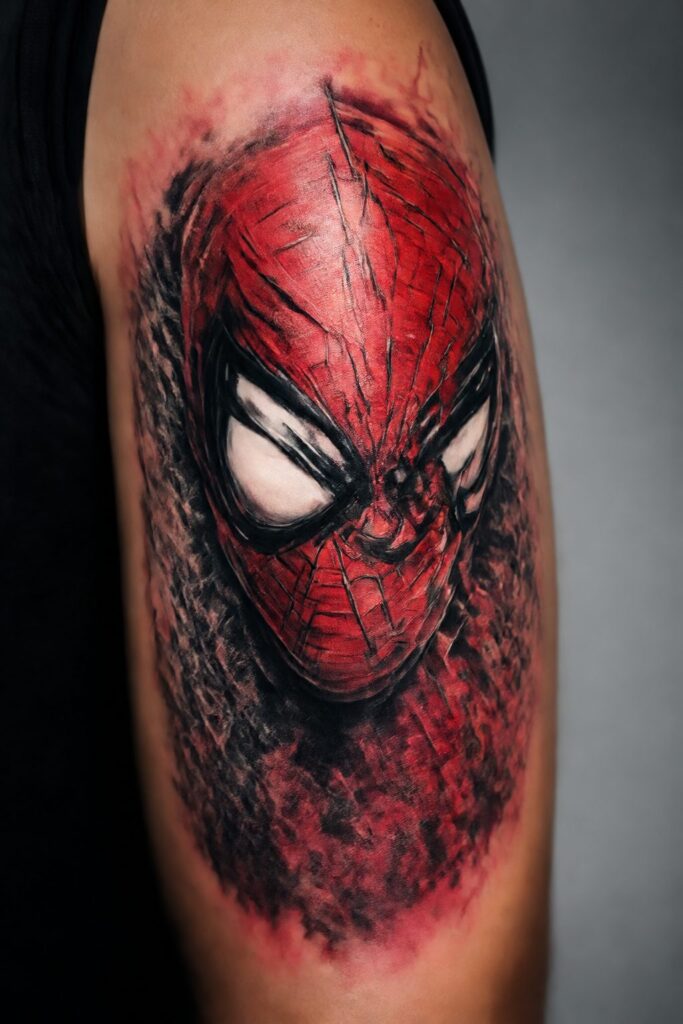
A Spider Man tattoo most directly signals the famous line: with great power comes great responsibility. Beyond the quote, it marks someone who identifies with the outsider hero, the kid who got knocked down and kept standing, who uses whatever edge they have to protect others rather than exploit it. The design appeals to people who grew up with the character and carry that attachment into adulthood without shame.
Similar & Related Symbols
Comic Book Counterparts
Batman tattoos lean into darkness, trauma, and brooding vigilance. Superman emphasizes immigrant identity and unwavering moral certainty. Spider Man occupies messier territory: poverty, teenage awkwardness, constant failure, and still showing up. The X-Men share the outsider-science-accident DNA, but Spider Man’s solo struggle against ordinary life pressures, rent, relationships, school, resonates more individually. Deadpool parodies the same archetype; Spider Man embodies it sincerely.
Broader Spider Imagery
Traditional spider tattoos carry gothic, trickster, or feminine-creative associations across Native American, African, and Greek contexts. The Spider Man design hijacks that arachnid symbolism and re-routes it through pop culture. You get some visual overlap with web patterns, but the meaning diverges sharply. A black widow tattoo warns; a Spider Man tattoo confesses.
Mythology & Folklore
The Character’s Comic Origins
Stan Lee and Steve Ditko created Spider Man in 1962, deliberately breaking the superhero template. Teenagers had been sidekicks; now one headlined. The radioactive spider bite, dated science even then, established transformation through chance rather than birthright or wealth. This democratized heroism: anyone could be bitten. The tattoo inherits that mythology of accidental transformation into something more.
Web Motifs in Older Traditions
Spider webs appear in sailor tattoos marking time served, in prison ink suggesting entrapment, and in various cultures as creation symbols. Spider Man’s web-shooters and trapped-in-web visual language unconsciously echo these. The difference is agency: his webs are tools he builds, not traps he suffers. That distinction matters for tattoo meaning.
Symbolism & Core Meaning
Responsibility and Guilt
Peter Parker’s origin story hinges on failing to stop a criminal who later kills his uncle. The tattoo often marks personal failures that reshaped someone’s moral compass, not dramatic tragedies necessarily, but moments where inaction cost something. It’s a private memorial to learning the hard way that choices have consequences beyond yourself.
Resilience Through Humor
Unlike grim heroes, Spider Man quips through beatings. The tattoo can represent coping through deflection, using humor as armor during genuine struggle. This resonates with people who’ve learned to perform competence while internally scrambling. The mask becomes metaphor: smiling face, exhausted eyes.
- Mask on/mask off: dual identity, public versus private self
- Web patterns: connection, entanglement, constructed safety
- Spider silhouette: small thing with disproportionate impact
- Red and blue palette: classic, optimistic, deliberately uncool
Personal & Modern Meanings
Geek Culture Reclamation
Twenty years ago, this tattoo might have drawn ridicule. Now it participates in mainstream pop-culture tattooing alongside Star Wars, anime, and gaming imagery. The meaning shifted from hidden shame to open affiliation. Wearing it signals comfort with your own history, your childhood attachments, your specific generational references.
Parent-Child Connection
Significant numbers of people get this tattoo after sharing Spider Man with their children, movies, games, comics across generations. It becomes documentation of that bond, frozen at a particular age or film. The 2002 Raimi trilogy, the 2018 animated film, the MCU iteration: each era produces its own wave of parental tattoos marking shared experience.
Common Variations & Styles
Classic Comic Aesthetic
Thick black outlines, limited color palette, Ben-Day dot textures mimicking old printing. This style ages cleanly because the bold lines hold definition. Shading stays minimal; color sits flat. The look is immediately readable from distance, which matters for forearm and calf placements where people actually see it. Touch-ups stay straightforward for decades.
Realistic Portrait Work
Some choose photorealistic renditions of specific actors, Tobey Maguire, Andrew Garfield, Tom Holland, or the animated Miles Morales. These demand larger skin real estate: upper arm, thigh, back panel. The risk is datedness; today’s definitive portrayal becomes tomorrow’s nostalgic oddity. Skin texture also challenges smooth rendering of the suit’s fabric sheen. Black and grey realism avoids the color-matching problem but loses the iconic red.
- Minimalist line work: spider silhouette or web corner, small, fast, subtle
- Japanese-inspired: spider integrated with traditional wind bars, waves, or flowers
- Trash polka / abstract: splattered red and black, deconstructed mask elements
- Negative space web: skin left uninked to form web pattern against dark background
Placement Practicalities
The curved surfaces of shoulders and thighs suit the web’s radial geometry better than flat back panels. Hands and fingers tempt for web-shooter reference but blur quickly with movement and sun exposure. The ribcage accommodates large dramatic poses but stretches during breathing and weight fluctuation. Consider how the suit’s red reads against your skin tone; on very dark skin, the blue may need to carry more visual weight.
Who Chooses This Tattoo
There’s no single demographic. You see it on software engineers and construction workers, parents and teenagers, first-timers and heavily covered collectors. What unites them is specific attachment rather than general superhero appreciation. Someone with a Batman tattoo might admire the aesthetic; Spider Man people usually have stories, the comic their older cousin gave them, the Halloween costume that fell apart, the movie they watched during a difficult winter.
The tattoo functions as membership badge in a particular cultural moment. It says you were there for something, that it mattered, that you refuse to perform indifference toward the things that shaped you. In a culture that increasingly monetizes nostalgia, this tattoo commits to it permanently.
Before You Decide
Copyright imagery carries practical considerations. Independent artists can render original compositions referencing the character without reproducing trademarked poses exactly, but many clients want recognizable specifics. Discuss with your artist whether they’re comfortable with the legal gray area; some shops avoid corporate IP entirely.
Color saturation determines longevity. The bright red of Spider Man’s suit fades faster than black or blue on most people. Plan for more frequent touch-ups than a blackwork piece would require, or commit to a black and grey interpretation from the start. Web details below a certain size, fine lines under two millimeters, may spread and muddy within five to ten years depending on placement and skin type.
Most importantly, sit with the image for a year if you haven’t already. Pop-culture tattoos chosen impulsively often read as immature later; the same design entered with deliberation becomes personal history. The difference isn’t the image, it’s the intention behind it.
Frequently Asked Questions
Does a Spider Man tattoo age badly compared to other color tattoos?
The bright red pigment commonly fades faster than black or blue, especially on sun-exposed areas. Bold outlines and limited color palettes from classic comic styles actually age better than photorealistic color portraits. Plan for touch-ups every few years if you want the red to stay vivid.
Can I get a Spider Man tattoo if I work in a professional setting?
Placement controls visibility, not the subject. A small web corner on the inner forearm or a masked silhouette on the upper arm stays hidden under standard business sleeves. Large full-color pieces on the hands or neck present the same professional challenges regardless of subject matter.
What’s the difference between a comic-style and realistic Spider Man tattoo in terms of cost and time?
Classic comic style with bold lines and flat color typically requires less session time than photorealistic portraiture, which demands careful blending and multiple passes for skin texture and fabric sheen. Realistic work also needs larger size to render detail properly, increasing overall commitment.
Is there a way to make the design more personal without losing recognizability?
Many people integrate personal elements into the composition, birth dates worked into web patterns, hometown skylines in the background, or specific comic panel layouts that reference meaningful issues. Keep the mask or spider emblem central for immediate recognition while surrounding it with private references.
Related Tattoo Meanings
One response to “Spider Man Tattoo Meaning: Heroism, Responsibility & Geek Pride”
[…] Spider Man Tattoo Meaning: Heroism, Responsibility Geek Pride […]

Leave a Reply