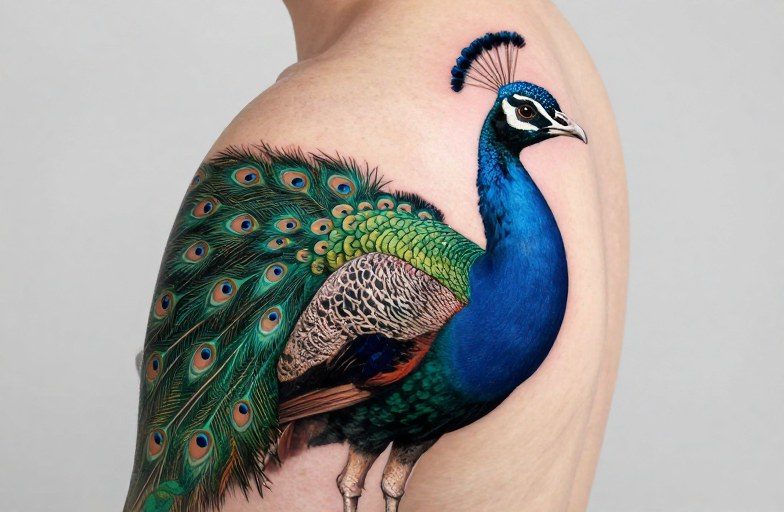
A peacock tattoo most commonly signals pride, beauty, and self-display, the bird’s famous fan of feathers is literally an advertisement of health and genetic fitness. But the symbol carries a shadow side too: vanity, arrogance, the danger of showing off without substance. Beyond that surface reading, peacock imagery often connects to renewal (the bird molts and regrows its train annually), protection (the eye-spots on feathers have long been seen as watchful symbols), and spiritual awakening across Hindu, Buddhist, and Christian traditions.
Who Chooses This Tattoo
People drawn to peacock imagery tend to fall into clear camps, and the placement they choose usually telegraphs which camp they’re in.
The Bold and the Reserved
Full peacock displays, tail fanned, colors blazing, attract clients who want to be seen. These pieces dominate the upper back, thigh, or ribcage, areas large enough to let the feather train arc across skin. The person wearing it usually wants the tattoo to work hard: to start conversations, to frame their body, to announce something before they speak. Conversely, single feathers tucked behind the ear, along the collarbone, or trailing down the forearm draw quieter personalities. One feather carries the same symbolic DNA without the billboard effect. The choice between full bird and isolated feather is often the choice between public declaration and private reminder.
Gender and the Shifting Audience
Peacock tattoos skewed heavily feminine for decades, especially the watercolor and mandala-adjacent styles popular in the 2010s. That’s changing. More men now request peacocks in traditional or neo-traditional execution, bold outlines, limited color, the bird rendered as gamecock-tough rather than decorative. The symbol itself hasn’t shifted; the social permission to wear it has.
History & Cultural Roots
Peacock symbolism runs deep in several traditions, though pinning down exact origins requires some care.
South Asian and Mediterranean Threads
In Hindu tradition, the peacock is often linked to Saraswati and Kartikeya, associated with wisdom, war, and the destruction of ego. Some trace it to ancient Greek accounts of the bird as sacred to Hera, where the eye-spots were said to represent the eyes of her hundred-eyed servant Argus, set into the tail after his death. Christian iconography adopted the peacock as a resurrection symbol, some medieval sources claimed the bird’s flesh did not decay, making it an emblem of immortality. These threads don’t always connect cleanly; what matters is that the bird accumulated meaning across cultures rather than emerging from a single source.
The “Eyes” and Their Protective Reading
The ocelli on peacock feathers, those round, eye-like markings, have been commonly associated with warding off evil across Middle Eastern and Mediterranean folk belief. This protective reading still surfaces in tattoo requests today, especially when clients want the feather oriented downward to “watch” the space below it.
Color vs Black and Grey
This choice fundamentally changes what the tattoo communicates, and how it ages.
What Color Actually Does Here
Peacock color is iridescent in nature, structural color, not pigment, which means no tattoo can truly replicate it. That said, saturated teals, emerald greens, and sapphire blues can approximate the effect on fresh skin. The problem is longevity. Blues and greens are notoriously fugitive; they fade faster than reds and blacks, and the fine detail work that makes peacock feathers read as layered often blurs together as the color mutes. A color peacock tattoo looks stunning for two to four years, then settles into a softer, less defined version of itself. Plan for touch-ups if you want the original impact maintained.
Black and Grey as Alternative Strategy
Black and grey peacocks rely on contrast and texture rather than hue. The eye-spots become graphic elements, almost geometric. This approach ages more predictably, black holds, grey washes hold their value relationships, and suits clients who want the symbolism without the maintenance burden. The trade-off is immediate recognition: a black peacock reads as “peacock” from across a room only if the silhouette is strong. A color peacock reads from farther away because the color itself is the signal.
Design Tips & Pairings
Peacock imagery works best when the design accounts for how the body moves and how the eye travels across skin.
- Flow with anatomy: The natural arc of a fanned tail follows the curve of a shoulder blade, the sweep of a hip, or the dome of a thigh. Fighting this curve makes the bird look pinned on rather than grown from the body.
- Background or no background: Peacocks in open skin (no background fill) read lighter and more decorative. Adding dark foliage, geometric frames, or ornamental borders grounds the image and shifts it toward traditional tattoo weight. Decide early; adding background later usually means reworking the whole piece.
- Common pairings: Peacocks pair naturally with florals (lotus, roses, cherry blossom), ornamental frames, and geometric mandala elements. They also work well in contrast, paired with skulls, snakes, or decay imagery to undercut the beauty with mortality. The juxtaposition is old but effective.
- Scale matters: A peacock feather below a certain size loses its identifying detail. The eye-spot needs enough room to show the concentric rings; below about three inches, it becomes a generic teardrop with a dot.
Symbolism & Core Meaning
Beyond the obvious vanity reading, peacock symbolism has several stable cores that show up across different clients and contexts.
Renewal and Cyclical Beauty
Peacocks molt their entire tail annually and regrow it, often longer and fuller than before. This biological fact makes the bird a ready symbol for personal reinvention, recovery, or the willingness to shed what no longer serves. Clients choosing peacocks after divorce, sobriety, or major career shifts often gravitate toward this reading without knowing the biology behind it.
Showmanship as Survival Strategy
The display isn’t arbitrary, it’s costly signaling. A peacock dragging a heavy, visible train is advertising that it can survive despite the handicap. Translated to tattoo meaning, this becomes a badge of thriving under visibility, under pressure, under scrutiny. For performers, public speakers, or anyone whose livelihood depends on being watched, this reading resonates more than simple “pride.”
Personal & Modern Meanings
Contemporary peacock tattoos often layer personal narrative onto traditional symbolism in ways that would be unrecognizable fifty years ago.
Some clients use the peacock as a marker of neurodivergence or nonconformity, the bird’s flamboyance read as refusal to tone down. Others connect it to specific life phases: the peacock as “post-ugly-duckling,” the phase after awkwardness where self-presentation becomes joyful rather than anxious. The LGBTQ+ resonance is real and growing, especially the reclamation of “pride” from its biblical warning context into something celebratory and defiant.
Social media has also changed how these tattoos function. A peacock tattoo photographs well, symmetrical, colorful, immediately legible. Clients sometimes choose it partly for how it will present online, which is neither criticism nor praise, just a new variable in the decision.
Before You Decide
Peacock tattoos demand specific technical considerations. The fine line work in feather barbs, the color saturation required for impact, and the large scale most designs need all raise the stakes. This is not a budget tattoo if done well; the good ones require time, skin real estate, and an artist with experience in ornamental or avian work.
Ask to see healed photos, not just fresh work. Peacock feathers are a common portfolio piece because they look spectacular on day one; the healed version tells you whether the artist understands how those blues settle and how those fine lines hold. If an artist can’t show you a healed peacock from six months or a year back, you’re buying on promise rather than proof.
Consider placement with clothing in mind. A peacock on the upper back disappears under most professional dress; one on the forearm or neck does not. The symbol carries enough “look at me” energy that you should decide consciously whether you want to control when that energy is available.
Finally, sit with the vanity aspect. The peacock doesn’t let you dodge it. If you’re uncomfortable with being seen as self-regarding, this may not be your symbol, or it may be exactly the symbol you need to wrestle with that discomfort.
Frequently Asked Questions
Does a peacock tattoo always mean vanity?
Not necessarily. While vanity is the traditional reading, most people today choose peacocks for renewal, protection, or simply aesthetic appeal. The meaning depends on what you bring to it, but you can’t fully escape the pride association, it’s built into the imagery.
How well do peacock feather tattoos age over time?
Color versions fade noticeably in blues and greens within a few years, often requiring touch-ups. Black and grey ages more stably but loses the immediate recognition that color provides. Fine detail in feather barbs tends to soften and merge over time.
What’s the best placement for a peacock tattoo?
The upper back, thigh, and hip work well for full displays because they follow natural body curves. Single feathers suit smaller areas like the forearm, collarbone, or behind the ear. Avoid locations where the design has to bend awkwardly against joint movement.
Can a peacock tattoo work for men?
Absolutely. Traditional and neo-traditional styling with bold outlines and limited color palette shifts the feel from decorative to graphic. The subject matter isn’t gendered; the execution style creates the masculine or feminine impression.

Leave a Reply