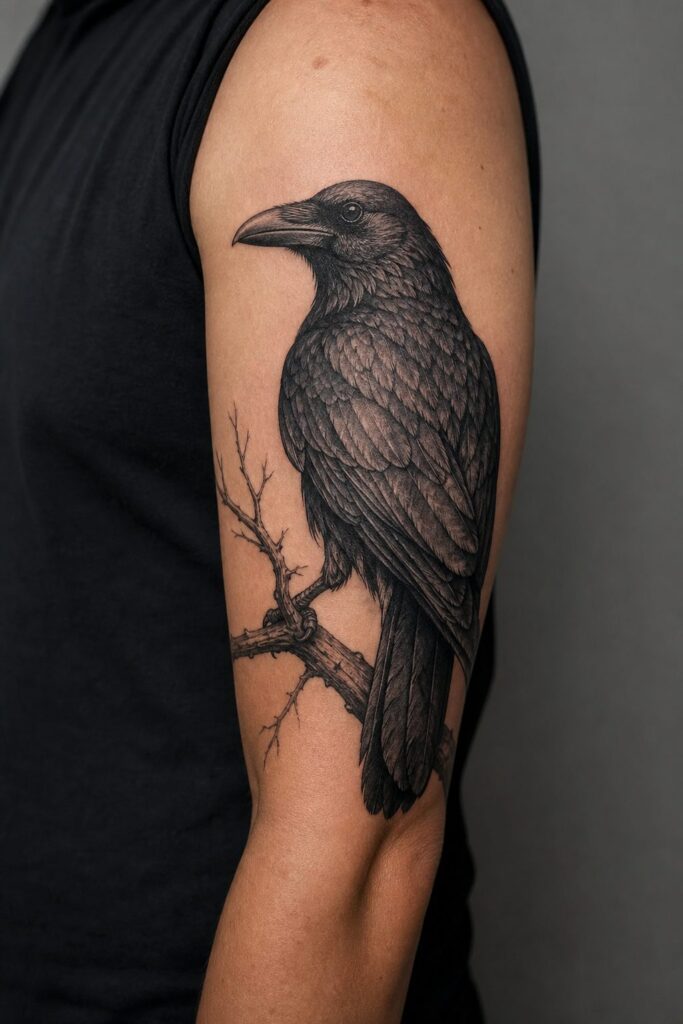
A crow tattoo most commonly signals transformation, intelligence, and the liminal space between life and death. Depending on context, single bird or murder, perched or in flight, realistic or stylized, the meaning tilts toward messenger, trickster, or guardian. The crow’s cultural baggage is heavier than most birds, which makes it both versatile and risky if you don’t know what you’re carrying.
Mythology & Folklore
Crows thread through global stories with remarkable consistency. They’re clever, they’re boundary-crossers, and they’re rarely neutral.
Norse and Celtic Roots
Odin’s ravens Huginn and Muninn, thought and memory, blur into crow territory in Scandinavian tradition. Some trace the warrior’s crow association to battlefield scavenging, where the bird became an omen of death but also a collector of souls. Celtic lore often linked crows to the Morrígan, a figure of sovereignty and battle-fate. A single crow in flight might read as messenger; three together echo her triple aspect.
Native American and East Asian Threads
Across Pacific Northwest and Plains traditions, Crow appears as a trickster figure, intelligent, self-interested, capable of stealing fire or shaping the world. The bird’s black plumage made it a natural symbol for the void or the unknown, not necessarily evil. In Japanese folklore, the three-legged crow (Yatagarasu) guides the sun; in Chinese tradition, a crow in the sun sometimes represents the yang principle. These angles rarely appear in Western tattoo shops, but they’re worth knowing if you’re drawing from specific heritage.
Color vs Black and Grey
The choice between color and monochrome changes the emotional temperature significantly.
Black and Grey Realism
Most crow tattoos live in black and grey, and for good reason. The bird’s natural coloration translates beautifully to ink, with subtle gradations in the wing feathers providing depth without needing color. Black and grey ages more predictably on skin, blues and purples, sometimes added for atmospheric effect, tend to shift or fade faster. A solid black crow with grey wash background reads as somber, timeless, slightly ominous. The contrast against lighter skin makes the silhouette immediately readable even at smaller sizes.
When Color Works
Red eyes, specifically, show up in horror-influenced designs and certain regional folk traditions where the crow serves as a psychopomp or warning. Occasionally you’ll see a crow with a single colored element, a golden key, a blood drop, a green sprig, that functions as narrative accent rather than naturalistic rendering. Full-color crows risk looking like generic birds unless the artist really understands corvid anatomy; the proportions are specific, and getting the beak or tail wrong breaks the illusion.
Similar & Related Symbols
Crow tattoos rarely stand completely alone. Understanding the adjacent symbols helps you avoid unintended combinations.
- Raven: Larger, heavier beak, different tail shape in flight. Ravens carry more explicitly Norse weight; crows feel more urban, more adaptable. Artists sometimes conflate them visually, know which bird you actually want.
- Skull: The crow-and-skull pairing is common enough to be almost a cliché, but it works when the composition integrates them rather than just stacking symbols. The crow perched on or emerging from a skull reads differently than one simply nearby.
- Clock or hourglass: Time’s passage, mortality, memento mori. The crow’s scavenger nature amplifies the decay element.
- Key or lock: Secrets, hidden knowledge, the crow as keeper or thief of wisdom.
- Tree branch, especially bare: Natural habitat, but also the gallows tree, the boundary between worlds. A crow on a leafless branch hits differently than one in flight.
These combinations aren’t bad, they’re loaded. Know the load you’re carrying.
Religious & Spiritual Angles
Crows occupy complicated positions in religious symbolism, and tattooing one can signal affiliation you didn’t intend.
Christian and Abrahamic Contexts
The crow appears negatively in some biblical passages, unclean bird, associated with desolation. But Noah’s raven (often conflated) was also the first bird sent from the ark, the one that didn’t return, perhaps finding carrion, perhaps finding land. Some Christian traditions read this as faithlessness; others as pragmatic hope. A crow tattoo in explicitly Christian communities might raise eyebrows depending on denomination and region. The raven’s more positive biblical role (fed Elijah in the wilderness) rarely transfers to crow imagery in practice.
Contemporary Spiritual Practice
Modern pagan and animist practitioners sometimes use crow imagery to signal connection to spirit work, death midwifery, or oracular practice. The crow as psychopomp, guide of souls, resurfaces in these contexts. This isn’t universal; plenty of people with crow tattoos have no spiritual practice at all. But the symbol’s availability for this use means it sometimes gets read this way, accurate or not.
How It Ages on Skin
Crow tattoos age better than some designs, worse than others. The factors are specific to the image.
Line Weight and Detail Density
Feather detail is where aging shows first. Fine individual barbs, especially in the wing tips, spread and blur over five to ten years. A crow rendered with bold outline and suggested feather texture through shading rather than line work holds longer. The eye, often a focal point, needs enough solid ink to remain readable; a tiny highlight dot disappears fast. Beak curvature, if too thin, can soften into ambiguous shape.
Placement Realities
Black crows on pale skin maintain contrast longest. On darker skin tones, the design needs more deliberate negative space or grey wash to avoid becoming a blob; a solid black silhouette without internal detail is risky. High-movement areas (inner bicep, ribs, throat) accelerate distortion. The upper outer arm, thigh, and calf provide stable canvas. Small crows, under three inches, lose detail fast; the minimum readable size depends on how much feather texture you’re insisting on.
Who Chooses This Tattoo
Certain patterns show up in consultation, though individual reasons vary enormously.
- Life transition markers: Divorce, recovery, career change, coming out. The crow’s liminal symbolism fits periods of identity reconstruction.
- Literary or musical reference: Poe’s raven, certain metal or folk traditions, Gaiman’s Morpheus and his crow companion Matthew. These are specific enough that the wearer usually volunteers the connection.
- Corvid enthusiasts: People who feed crows, who’ve been “adopted” by local birds, who follow crow research. The tattoo functions as species-specific rather than symbolic.
- Cover-up candidates: The black silhouette can swallow older, smaller tattoos effectively, though this requires enough space and enough solid ink to do the job.
The through-line isn’t morbidity, despite the death association. It’s usually intelligence acknowledged, transformation claimed, or outsider identity embraced.
Before You Decide
A few practical considerations specific to this design. Reference photos matter enormously, crows have a particular shoulder hunch, a tail length and fan shape, a head proportion that distinguishes them from ravens, grackles, and generic “black bird” clip art. Bring multiple angles. Consider the direction of flight or gaze; a crow looking left reads differently than one looking right, and a crow flying toward the viewer versus away changes the emotional register. Think about whether you want the murder, the flock, or the solitary bird; one is ominous in aggregate, the other lonely, self-contained, possibly defiant.
The crow’s symbolism is deep enough to drown in if you’re not careful. Better to know which specific strand you’re pulling than to claim “it means whatever I want.” It does, eventually, but starting with clarity makes for a better tattoo and fewer explanations you’ll regret giving.
Frequently Asked Questions
What’s the difference between a crow and raven tattoo?
Ravens are larger with heavier, more curved beaks and wedge-shaped tails in flight. Crows have slimmer proportions and fan-shaped tails. The symbolism diverges too, ravens carry more explicit Norse and biblical weight, while crows read as more urban, adaptable, and trickster-aligned.
Does a crow tattoo always mean death?
No. Death is one thread in a much larger pattern that includes intelligence, transformation, messenger work, and boundary-crossing. Context matters enormously, a crow with a key reads differently than a crow with a skull, and a flying crow carries different energy than a perched one.
How big should a crow tattoo be to age well?
Minimum three inches for any detail in the feathers, larger if you want individual barbs visible long-term. Solid black silhouettes can go smaller but risk becoming ambiguous blobs, especially on darker skin tones where internal contrast becomes essential.
What placements work best for crow tattoos?
Stable, relatively flat areas with minimal distortion, outer upper arm, thigh, calf. Avoid inner bicep and ribs if you want feather detail to stay crisp. The direction the crow faces should complement the body’s movement, not fight it.
Leave a Reply