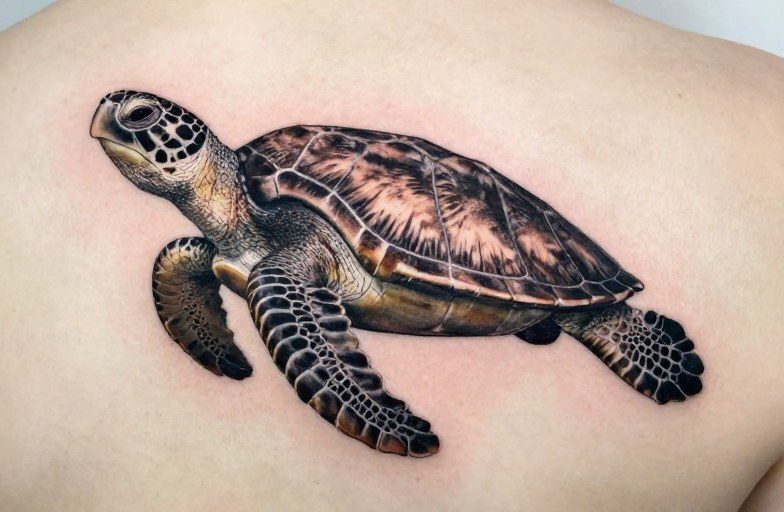
A sea turtle tattoo most commonly represents endurance, safe passage, and the wisdom of returning home. The animal’s actual biology supports this symbolism, green sea turtles migrate thousands of miles across open ocean, yet females return to the exact beach where they hatched to lay their own eggs. That combination of vast wandering and precise homecoming gives the image its emotional weight. People choose it to mark survival, a major life transition, or simply an affinity for the ocean.
Symbolism & Core Meaning
Longevity and Steady Persistence
Sea turtles live decades, some species pushing past eighty years. Their slow metabolism and unhurried movement through water read visually as patience rather than laziness. In tattoo form, this translates to an emblem of outlasting problems rather than overpowering them. The shell’s architecture, bone fused to spine, permanent and portable, adds a layer of self-protection that resonates with people who’ve had to carry their own defense mechanisms.
Navigation and Return
Magnetic field sensitivity lets sea turtles navigate featureless ocean to find specific coordinates. Tattoo clients often connect this to their own sense of internal compass, surviving displacement, finding direction after loss, or honoring a literal return to a place that matters. The hatchling-to-adult journey (roughly one in a thousand survives to maturity) also layers in fragility and luck for those who’ve beaten long odds.
Personal & Modern Meanings
Beyond the traditional symbolism, contemporary wearers attach more specific narratives. Conservation commitment shows up frequently, sea turtles are flagship species for ocean health, and the tattoo functions as permanent advocacy. Some mark scuba certification or a powerful trip. Others use it parentally: the turtle carries its home, mothers carry theirs.
Gendered and Non-Gendered Readings
The egg-laying beach return makes the symbol particularly available to women marking motherhood or the choice not to have children. That said, the image carries no inherent gender in tattoo culture. Male wearers often emphasize the navigator aspect or the warrior-like persistence through physical challenge. The design treatment matters more than the symbol itself, delicate linework reads feminine by convention, bold traditional styling reads masculine, but neither is fixed.
Design Tips & Pairings
What Works With the Turtle Form
The shell’s hexagonal pattern invites geometric framing, mandala backgrounds, compass roses integrated into the carapace, or Polynesian-style patterning that follows natural shell lines. Water elements need careful handling: too many bubbles or waves and the turtle dissolves into busy background. A single current line, negative-space water surface, or subtle blue wash behind the figure usually suffices.
- Compass or map coordinates: literalizes the navigation theme without being heavy-handed
- Coral or kelp: anchors the turtle in ecosystem, adds color opportunity
- Moon phases: references tidal connection and female cycles
- Single word or phrase: best placed on a banner that follows the shell curve or floats below the flippers
- Family initials: small, tucked into shell segments
Color vs. Black and Gray
Green sea turtle coloration, olive carapace, golden underbelly, translates beautifully to skin but requires a colorist who understands saturation limits. The yellow-green tones tend to fade toward muddy olive within five to seven years without refresh. Black and gray relies on contrast between shell texture and smooth skin, aging more gracefully but losing the species-specific recognition. Hawksbill turtles with their amber and brown patterning offer a middle path: less green to corrupt, still identifiable as tropical.
How It Ages on Skin
Sea turtle designs live or die on line weight and spacing. The shell’s natural segmentation creates numerous thin lines that blur together over time if drawn too fine. A gap of at least 2mm between shell plates prevents the “muddy shell” look common in decade-old pieces. Flipper edges need similar consideration, feathered tips look ethereal fresh but become indistinct blobs as ink spreads.
High-Detail Areas to Watch
Facial features on small turtles (under 3 inches) often disappear entirely. Scales on the flippers, if rendered too small, merge into gray fill. The solution is selective detail: crisp eye with simplified surrounding skin, suggested scale pattern rather than individually drawn plates. Background water done as whip-shaded traditional waves holds its structure better than photorealistic splash effects.
Placement affects aging significantly. Shoulder and outer upper arm, classic turtle territory, experience moderate sun exposure and movement that keeps ink from settling too densely. Ankle and foot placements, while popular for the “swimming upward” orientation, fade faster and hurt more during application due to bone proximity and thin skin.
Common Variations & Styles
Traditional American
Bold black outline, limited color palette (green, yellow, red), stylized rather than accurate anatomy. The turtle often appears with a banner, dagger, or heart in classic sailor configuration. This style ages best and reads instantly across distance. The tradeoff is species ambiguity, it could be a tortoise, could be a sea turtle, the symbolism carries regardless.
Realistic and Neo-Traditional
Photographic accuracy in shell patterning, accurate flipper proportion, often with water environment. Requires a specialist in animal portraiture. The best examples use reference of specific species (leatherback’s ridged shell looks nothing like green sea turtle hexagons) and specific lighting, turtles photographed from above show shell pattern; side views emphasize the streamlined profile.
Tribal and Polynesian-Influenced
Often linked to Pacific Island navigation traditions, though specific tribal affiliation should be handled respectfully, avoid copying sacred patterns without understanding. The turtle form simplifies well into bold black shapes, with shell segments becoming geometric units. This style emphasizes the animal’s silhouette and symbolic weight over naturalistic detail.
Minimalist and Fine Line
Single continuous line forming turtle profile, or extremely reduced geometry. Effective for small placements (wrist, behind ear, collarbone) but requires pristine execution. One wavering line destroys the entire piece. Best reserved for experienced collectors with established artists who demonstrate consistent line quality in their portfolio.
Best Placements
The turtle’s horizontal orientation suits certain body areas naturally. Shoulder cap allows the classic swimming pose with head toward chest or back. The curve of the shell mirrors the deltoid’s roundness. Upper back, centered or offset, provides flat canvas for larger work with environment.
- Forearm: elongated upward swim, visible to wearer, easy to show or cover
- Ribcage: follows the body’s curve, painful but private, scales well to full torso pieces
- Thigh: large surface for detailed shell work, less sun damage than lower leg
- Ankle: small, swimming “up” the leg toward heart, common for first tattoos
- Scapula: protected from sun, good for horizontal compositions with horizon line
Consider the flipper direction. Turtles swimming upward read as aspiration, escape, rising. Downward reads as descent, grounding, return. Horizontal reads as travel, ongoing journey. Most artists default to upward without asking, specify if the direction matters to your meaning.
Before You Decide
Research your artist’s animal work specifically, not just their general portfolio. Turtle shells are unforgiving, symmetry errors, wobbly lines, and incorrect segment counts show immediately. Ask to see healed photos from a year or more out, not just fresh work. The best turtle tattoos come from artists who understand that the shell is architecture, not decoration, and that the animal’s weight in water should feel palpable even in two dimensions.
Meaning matters less to longevity than technical soundness. You can attach any narrative to a well-drawn turtle. The reverse isn’t true, poorly executed symbolism ages into regret regardless of personal significance. Prioritize the craft, then layer your own story onto a form that will hold.
Frequently Asked Questions
Does a sea turtle tattoo always have to face a certain direction?
No fixed rule exists, but direction carries conventional weight. Upward suggests growth or aspiration, downward suggests grounding or return. Horizontal reads as ongoing journey. Choose based on what resonates, or let the placement determine what flows best with your body.
How much should I expect to pay for a quality sea turtle tattoo?
A palm-sized black and gray piece from a skilled artist typically runs $300, 600 in most US markets. Color work, larger scale, or highly detailed realism pushes toward $800, 1500+. Geographic location and artist demand vary significantly, portfolio quality matters more than price alone.
Can a sea turtle tattoo be covered up or modified later?
The rounded shell shape and dark central mass actually make turtles decent cover-up candidates if the original was poorly executed. A skilled artist can sometimes integrate existing work into a larger turtle composition. Light, minimalist turtles are harder to cover due to sparse ink density.
Is there any cultural appropriation concern with sea turtle tattoos?
The sea turtle itself is broadly cross-cultural, but specific tribal patterns (Hawaiian, Maori, Samoan) carry sacred significance and should not be borrowed without understanding. A naturalistic turtle or geometric pattern you develop with your artist avoids this issue entirely.

Leave a Reply