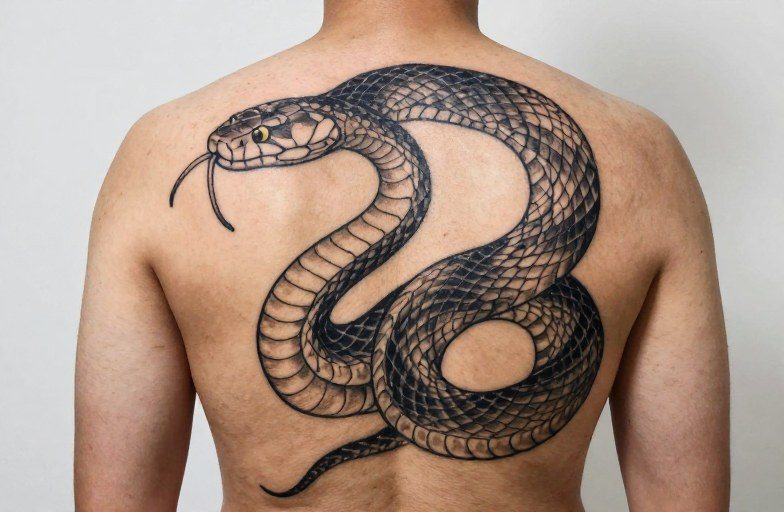
A Japanese snake tattoo across the back typically signals protection, transformation, and the cyclical nature of life and death. In irezumi tradition, the snake (hebi) guards against misfortune, heals from poison, and sheds its skin as a visceral metaphor for rebirth. On the back, tattooing’s largest canvas, the snake gains room to coil, strike, or intertwine with other symbols, turning the whole torso into a narrative field.
Symbolism & Core Meaning
Protection and Warding
Snakes in Japanese folklore often appear as guardians of shrines and treasure. A coiled snake across the upper back can function as a shield, the head positioned between the shoulder blades to watch what the wearer cannot see. This placement isn’t accidental; the back’s vulnerability makes the protective symbolism land harder. Some pair the snake with a dagger or sword to reinforce this guardian role, though the snake alone carries sufficient weight for most designs.
Transformation and Mortality
The shedding cycle gives the snake its most resonant meaning. Unlike the phoenix’s dramatic combustion, snake rebirth is slow, uncomfortable, and visible, old skin splitting at the mouth, the new surface raw and vulnerable. That physical reality translates to personal change: recovery from addiction, surviving violence, leaving a former identity behind. The back placement amplifies this because the wearer cannot see the tattoo without mirrors, creating a separation between the self and the symbol of change.
Best Placements
Full Back Composition
The classic Japanese approach treats the entire back as a single scroll. A snake here typically descends from the neck, coils through the center, and exits toward the waist or wraps around the ribs. This demands serious commitment, forty to sixty hours minimum for full color and background. The spine becomes the snake’s path, with scales following vertebrae to create movement that shifts when the wearer turns. Line work here must be precise; the back’s flat planes show wobbles that curved areas might hide.
Upper Back and Shoulder Caps
Snake heads emerging from the neck line, with bodies trailing across the deltoids, suit those who want coverage without the full back investment. This framing works well with sleeve transitions, the snake’s body continuing down the arm. The shoulder’s roundness gives the head dimension; good artists use this to create the hooded cobra effect or the open-mouthed strike. Shading here requires careful saturation, too dark and the snake flattens, too light and it reads as unfinished against surrounding work.
Who Chooses This Tattoo
The people drawn to Japanese snake back pieces often arrive after significant life disruption, not decoration. You see this among those who’ve rebuilt after institutional time, military service, or profound personal loss. The snake’s capacity for both danger and healing appeals to contradictions, people who’ve caused harm and seek balance, or those who’ve survived it and want the mark of endurance.
There’s also a practical cohort: experienced collectors completing Japanese bodysuits who need the back filled to finish the narrative. For them, the snake solves compositional problems, its flexibility lets it fill awkward spaces between existing back pieces, thread through clouds, or emerge from waves. The snake doesn’t demand center stage; it can support a larger dragon or foo dog composition while adding its own symbolic layer.
Similar & Related Symbols
Dragon and Snake Pairings
Japanese tradition often opposes these creatures. Dragons command water and sky; snakes occupy earth and shadow. A back piece featuring both creates tension, the dragon ascending the upper back, the snake coiled below, or intertwined in combat. Some trace this pairing to the tale of Yamata no Orochi, the eight-headed serpent, though the visual language predates specific literary references. The contrast matters more than the origin: dragon as ambition and public power, snake as hidden knowledge and private transformation.
Oni and Protective Pairings
Snakes wrapped around oni (demons) or skulls shift the meaning toward conquered darkness rather than pure protection. The snake’s healing association balances the oni’s destructive energy. These combinations work best on broader backs where the figures have room to interact without crowding. Red ink dominates these pairings, snake bellies, oni skin, skull accents, creating visual heat that demands careful tonal planning against green or black scales.
How It Ages on Skin
Scale Detail and Time
Individual scale outlines blur faster than bold shapes. On the back, where sun exposure varies by lifestyle, expect fine line work to soften within five to eight years. The solution isn’t avoiding detail but planning for its evolution: slightly heavier line weights than you’d use on a forearm, scales grouped in larger patterned sections rather than hundreds of tiny isolated shapes. Solid black fill in the snake’s core body holds decades; the red or gold accents on the belly and eyes typically need refresh first.
Back-Specific Considerations
Skin here behaves differently than arms or legs. The back stretches with weight fluctuation, compresses when seated, and develops texture changes that affect ink retention. Lower back pieces near the waistband suffer friction and fading; upper back work near the neck endures less mechanical wear but more sun if the wearer has short hair. Moisturizing matters specifically for back tattoos because they’re harder to self-monitor, most people notice arm fading early, but back deterioration surprises them at the pool or in photos.
Common Variations & Styles
Traditional Irezumi Approach
Full color, bold outlines, extensive background (wind bars, waves, cherry blossoms). The snake typically appears in naturalistic greens and browns, occasionally albino white for supernatural emphasis. Background elements aren’t filler; they establish the snake’s environment and emotional temperature. Stormy waves suggest chaos survived; calm water with floating petals implies achieved peace. This style demands the most time and the most skin, but it ages with the dignity that comes from deliberate density.
Modern Interpretations
Some artists now render Japanese snakes with reduced color palettes, black and grey with single red accents, or entirely monochrome with white ink highlights. These read as contemporary while maintaining the symbolic vocabulary. Negative space techniques let the skin itself form scale patterns, though this requires excellent skin tone consistency and risks uneven aging. The neo-Japanese approach often isolates the snake against minimal background, focusing attention on the creature’s form rather than narrative scene-building.
What to Remember
The Japanese snake back tattoo rewards patience in every phase: finding an artist who understands irezumi structure, sitting through sessions that span months, and accepting that the meaning will likely shift as you live with it. The back’s visibility is controlled, shown or hidden by choice, making this both private and performative depending on context. Budget for completion, not just initiation; half-finished back pieces read as abandoned intention, and the snake especially suffers from interruption because its coiled form requires continuous flow to read correctly.
Choose your artist by their healed back work, not fresh photos. Snake scales reveal technical flaws over time in ways that bold shapes don’t. Ask to see pieces two to five years old. The right back piece should feel inevitable once finished, like it emerged from your structure rather than being imposed upon it. That’s the snake’s own logic, after all: the old skin left behind, the new one already belonging.
Frequently Asked Questions
Does a Japanese snake back tattoo have to be part of a full bodysuit?
No. Many people choose a standalone back piece or upper back design that never extends further. The snake works independently, though full bodysuit collectors often use it to connect existing work.
How painful is getting a snake tattoo on the back compared to other placements?
The upper back near the shoulder blades rates moderate, muscle padding helps. The spine itself, lower back near kidneys, and rib wrap areas hurt significantly more. Sessions typically run 3-4 hours before the body demands a break.
Can a Japanese snake back tattoo include non-Japanese elements?
Mixing traditions risks visual incoherence unless handled deliberately. Some artists successfully blend snakes with realistic portraiture or geometric patterns, but this requires a unifying style rather than collage approach. Discuss integration strategy before committing.
How do I find an artist who specializes in this specific style?
Look for portfolios showing completed Japanese back pieces with healed photos, not just fresh work. Attend conventions where irezumi specialists guest. Expect to travel; fewer than twenty artists in the US execute this at master level, and most book six months to two years ahead.
Related Tattoo Meanings
One response to “Snake Japanese Meaning Back Tattoo: Symbolism & Placement Guide”
[…] Snake Japanese Meaning Back Tattoo: Symbolism Placement Guide […]
Leave a Reply