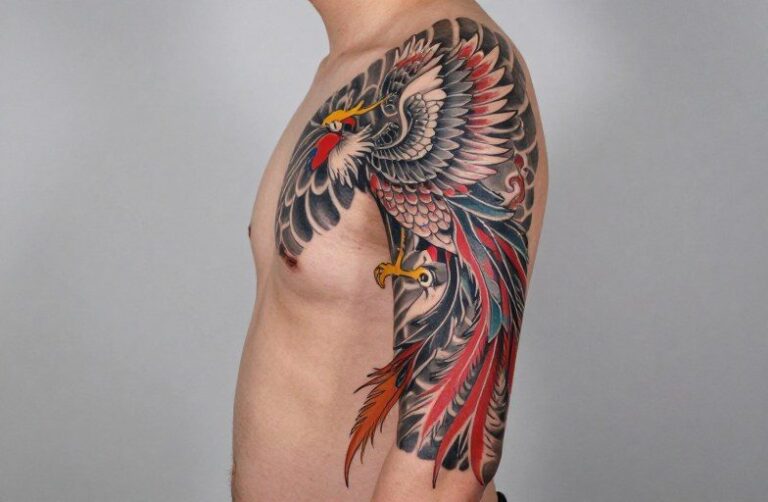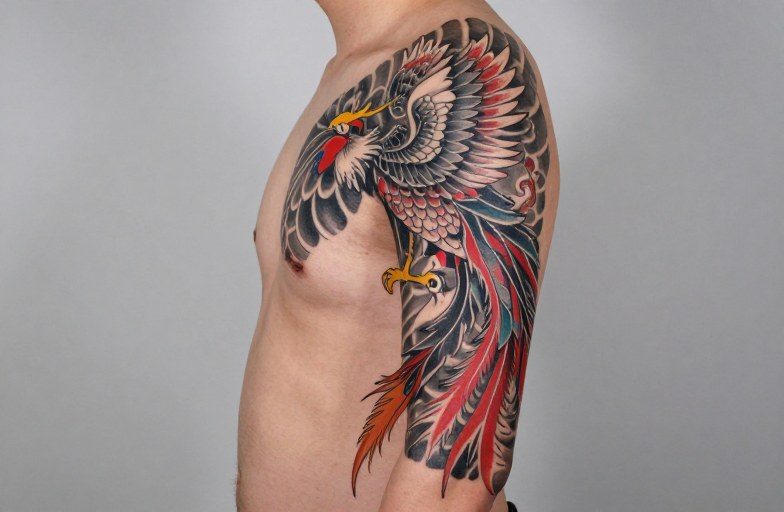
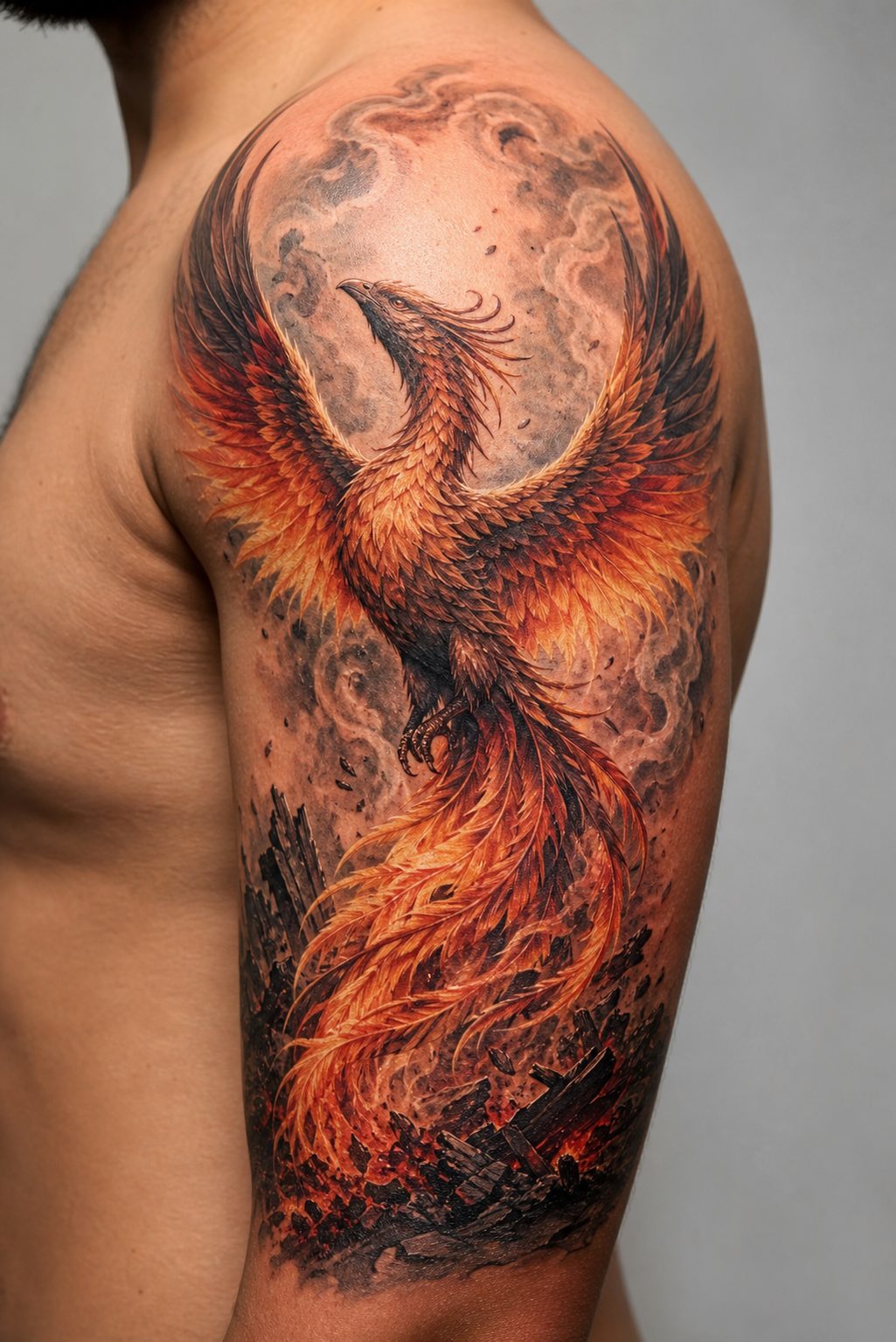
The phoenix rising from ashes tattoo represents survival through total destruction and the deliberate choice to rebuild. It speaks to people who have lost everything, addiction, divorce, death, bankruptcy, illness, and emerged changed but intact. The image carries weight because it doesn’t pretend the fire was painless; it insists that rising from it is possible.
Symbolism & Core Meaning
Unlike symbols borrowed from pop culture, the phoenix carries millennia of accumulated meaning across Greek, Egyptian, and Chinese traditions. The bird doesn’t just survive; it combusts completely, then generates new life from its own remains. That distinction matters. A phoenix tattoo isn’t about toughness or weathering storms, it’s about the specific moment after the worst has already happened, when starting over feels impossible and you do it anyway.
The Ashes as Necessary Ground
The ashes in the image aren’t decorative background. They represent the actual losses: the marriage that ended, the years lost to something destructive, the body that changed, the faith that burned. Without the ashes, the rise is cheap. Good tattoo designs often show the bird still trailing smoke, still surrounded by gray, because the destruction isn’t erased, it’s incorporated. The phoenix carries its history in its wings.
Fire as Transformation, Not Punishment
Religious traditions sometimes frame fire as judgment. In the phoenix myth, fire is the mechanism of renewal. This reframing appeals to people who don’t want their suffering explained as deserved or meaningless. The tattoo claims: what burned me also made me capable of something I couldn’t have been before.
Who Chooses This Tattoo
Certain life events reliably precede this choice. People marking sobriety anniversaries, one year, five, ten, often select the phoenix because the date represents a death and rebirth they live daily. Cancer survivors sometimes choose it after treatment ends, though many wait years, until the fear of recurrence has settled into something they can carry without it carrying them. The tattoo also appears after leaving fundamentalist communities, abusive relationships, or careers that consumed identity.
Timing Matters
There’s a pattern in when people get this done. Too soon, and the ashes still burn; the tattoo becomes a performance of healing rather than its mark. Most who choose it meaningfully have already done the work, therapy, relocation, body changes, whatever their particular fire required. The tattoo arrives as punctuation, not promise. Artists notice this: the client who knows exactly why they want it, versus the one still figuring out if they’re allowed to have survived.
How It Ages on Skin
The phoenix design presents specific technical challenges that affect how it looks at five, ten, twenty years. The bird’s wings spread wide, which means the tattoo often crosses multiple body planes, shoulder to chest, ribs to hip, where skin stretches and moves differently. Ink in high-motion areas (inner bicep, sternum, ribs) blurs faster than on stable surfaces like the outer thigh or upper back.
Color Fading Reality
- Red and orange pigments, common in flame elements, fade fastest under sun exposure; without touchups, a vivid fire becomes muddled brown within seven to ten years
- Black linework in the bird’s outline and feather details holds structure longer, making strong line foundations essential
- White highlights, often used for ash effects or feather sheen, disappear almost entirely as skin regenerates
- Yellows and golds in the reborn phoenix shift toward greenish tones as they age
Experienced artists compensate by designing with darker value ranges and planning for color loss. A phoenix that relies on bright fire for its impact will disappoint; one built on solid black silhouette with color as accent ages with dignity.
Placement for Longevity
The upper back, from shoulder blade to shoulder blade, offers the flattest canvas for a symmetrical spread-wing composition. The outer thigh accommodates vertical rising poses with less distortion from muscle movement. Chest pieces work but require the artist to account for pectoral flex; a bird that looks balanced with arms down can distort awkwardly with arms raised. Avoid the stomach and sides for large phoenix work unless you’re committed to significant future maintenance.
Common Variations & Styles
The phoenix adapts across tattoo traditions, though some styles serve the subject better than others.
Traditional Japanese (Hō-ō)
The Japanese phoenix, hō-ō, carries different formal conventions: longer tail feathers, paulownia leaves, specific directional flow. It’s often paired with dragons in back pieces representing balance. This style uses bold outlines and flat color areas that age exceptionally well. The hō-ō doesn’t typically include ashes; the rebirth is implicit in the living form. For someone with Japanese heritage or connection to that tradition, this variation carries cultural specificity the Western phoenix lacks.
Black and Gray Realism
Photorealistic phoenixes render individual feathers with fine detail and use smoke and ash for atmospheric depth. These require large scale to work, too small, and the detail becomes muddy within years. The style suits people who want the image to feel witnessed rather than symbolic. Drawbacks: realism demands reference, and most phoenix “reference” is other tattoos, creating recursive degradation. Strong artists build from composite bird photography (eagles, peacocks, golden pheasants) rather than copying existing tattoo flash.
Geometric and Abstract Approaches
Some designs fracture the bird into polygonal shapes, or reduce it to a flame silhouette with a single eye visible. These read more as design than narrative, which some prefer. The geometric style ages well because it relies on line weight and pattern rather than subtle color gradation. Abstract phoenixes work particularly well as cover-ups, their fragmented forms accommodating existing ink underneath.
Similar & Related Symbols
People considering phoenixes sometimes also weigh these alternatives, each with different connotations:
- Ouroboros: cyclical renewal without the destruction-rebirth sequence; more about eternal return than specific recovery
- Lotus from mud: similar emergence-from-filth narrative, often linked to Buddhist or Hindu practice; less aggressive, more cultivated
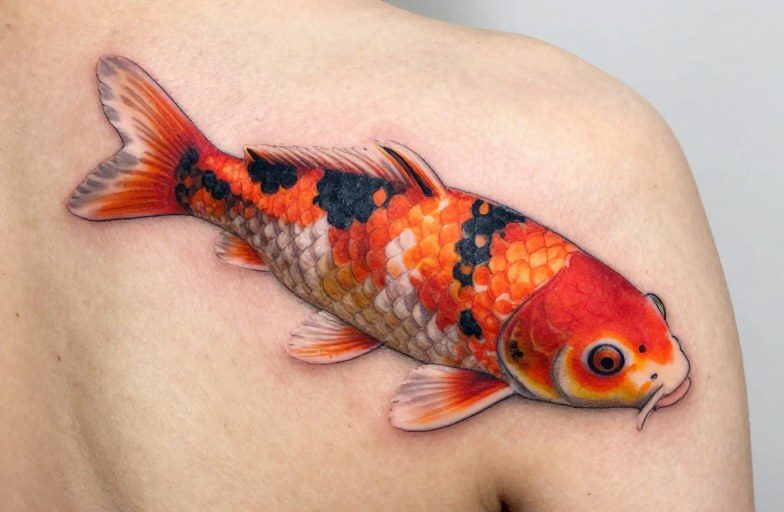
- Koi becoming dragon: perseverance rewarded, but linear rather than cyclical, no return from death
- Butterfly metamorphosis: transformation without the trauma emphasis; can feel too gentle for some experiences
- Broken chain or snapped handcuff: liberation specifically, without the rebirth component
The phoenix occupies unique territory: it acknowledges death, requires total loss, and insists on return. No other common tattoo symbol carries all three.
Personal & Modern Meanings
Contemporary wearers stretch the symbol beyond individual survival. Some mark collective losses, pandemic death, community displacement, climate grief, with phoenix imagery that claims destruction as shared rather than solitary. Others use it to mark transitions that aren’t traumatic but are absolute: coming out, gender confirmation, leaving a country forever. The ashes become metaphorical, but the structure holds.
What It Doesn’t Mean
Not every phoenix tattoo carries weight. The image has become common enough that some wear it generically, attracted to the aesthetic of fire and wings without the narrative underneath. This isn’t failure, tattoos don’t require justification, but it does separate the symbol from its power. The most affecting phoenix tattoos I’ve seen were preceded by long consultation, the person explaining exactly which fire, exactly which rising. The image became specific through their attachment, not through any design innovation.
The Takeaway
The phoenix rising from ashes endures because it doesn’t lie about what survival costs. The bird is not unburned. The new life doesn’t erase the old death. What the tattoo offers is structure: a way to mark that something ended completely, and something else began from that ending, and both belong to the same person. For the right person at the right time, that’s not decoration. That’s recognition.
Frequently Asked Questions
Does a phoenix tattoo need to include actual flames to be recognizable?
No. The silhouette alone, spread wings, long tail, often with crest feathers, reads as phoenix to most viewers. Some of the most effective designs use only smoke and ember suggestions rather than explicit fire, letting the bird’s posture carry the meaning.
How large does a phoenix tattoo need to be to work?
Minimum six to eight inches for any detail in the wings and feathers. Smaller scales force the artist to simplify dramatically, often losing the bird’s distinctive anatomy. Chest and back pieces typically run ten to fourteen inches across for full spread-wing compositions.
Is it culturally appropriative to get a Japanese-style hō-ō without Japanese heritage?
This varies by context. The hō-ō is a mythical creature with cross-cultural analogues, but specific Japanese compositional rules, pairing conventions (especially with dragons), and religious associations carry cultural weight. Working with an artist educated in Japanese tattoo tradition, rather than copying imagery from Pinterest, makes a significant difference.
Can a phoenix tattoo work as a cover-up for older ink?
Often yes, particularly the spread-wing composition that uses dark wing feathers and body to mask underlying work. The flame and ash elements can also incorporate older tattoo remnants as texture. Success depends on the existing ink’s age, color, and saturation, consultation with an experienced cover-up artist is essential.