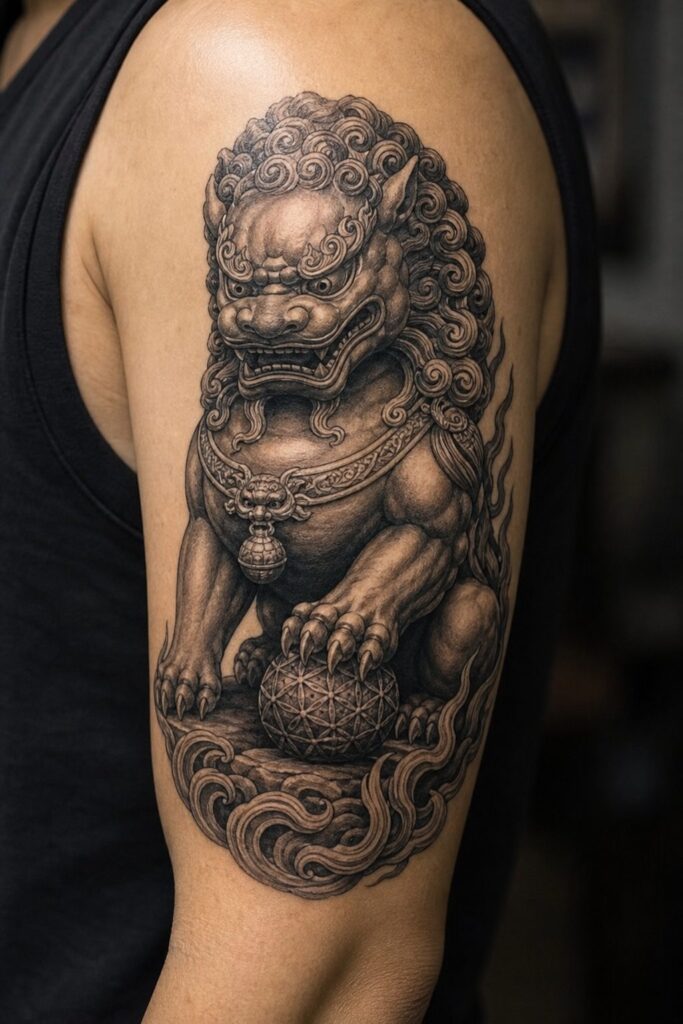
Foo dogs, properly called guardian lions or shi in Chinese, are protective symbols originating in Imperial China, later adopted into Japanese culture as komainu. In tattoo form, they typically represent protection, warding off harmful influences, and attracting prosperity. The meaning shifts based on whether the pair is shown with mouth open (breathing in life, warding off evil) or closed (keeping good spirits in), though many Western designs simplify this into a single powerful figure.
Symbolism & Core Meaning
The guardian lion carries layered significance that goes beyond generic “strength” imagery. Understanding these layers helps you choose details that actually resonate rather than defaulting to a generic template.
Open Mouth vs. Closed Mouth
Traditional pairs feature one lion with mouth open, one closed. The open mouth vocalizes the Sanskrit syllable “ah,” the first sound of creation; the closed mouth finishes with “um,” representing completion. Together they encompass all existence. Solo foo dog tattoos often favor the open-mouthed version for its aggressive protective stance, though some collectors prefer the closed mouth for its sense of containment and internal power. This choice matters more than most people realize, it’s the difference between active defense and steady guardianship.
What They Guard
Originally placed at temple and palace entrances, foo dogs protected physical spaces from spiritual intrusion. In tattoo form, this translates to personal protection: shielding the wearer from bad luck, malicious people, or self-destructive patterns. The sphere or cub beneath the paw (often a pearl symbolizing wisdom and power, or a young lion representing the cycle of protection) adds another dimension. Some wearers choose the cub version to signify protection of family or creative projects.
Color vs Black and Grey
This decision shapes the tattoo’s visual impact and its aging trajectory more than most foo dog designs.
Color Approaches
Traditional Chinese and Japanese color palettes lean heavily on gold, vermillion, and jade green for the mane and ornamental elements. These colors pop dramatically against skin but require maintenance. Gold ink particularly tends to fade toward a mustard or brownish tone within five to seven years. Solid red backgrounds, common in Japanese temple-inspired pieces, age better than metallic pigments but can blur at edges if overworked. Color works best for larger pieces where the pigment has room to breathe and the artist can build saturation gradually.
Black and Grey Strategy
Black and grey foo dogs rely on texture contrast: smooth skin against heavy black manes, whip-shaded fur against solid stone-like bases. This approach ages more predictably. The mane’s dense black holds up well; the real challenge is maintaining the carved, architectural quality of the face and paws. Without color to separate elements, line weight becomes crucial. A skilled artist uses thick outline for the overall silhouette, medium weight for facial features, and fine lines for ornamental details that will soften naturally over time.
Common Variations & Styles
Foo dog tattoos have been filtered through several cultural and stylistic lenses. Each carries different visual weight and technical demands.
Japanese Irezumi Interpretation
The Japanese komainu version differs subtly from Chinese shi: more angular, often with a horn, typically paired with peonies or flame motifs. In irezumi context, foo dogs appear in large back pieces or full sleeves, integrated with waves, wind bars, or cherry blossoms. The scale allows for full mane development and detailed paw work. These pieces demand an artist fluent in Japanese composition, negative space placement, background element flow, and the balance between organic and architectural forms.
Neo-Traditional and Illustrative Styles
Neo-traditional foo dogs exaggerate the mane into flowing, almost liquid shapes, often incorporating jewel tones and decorative patterns. Illustrative versions might render the lion more realistically, borrowing from actual lion anatomy while keeping the stylized elements. These approaches work well for medium-sized pieces where pure traditional density would feel cramped. The trade-off: ornamental details that look crisp fresh may blur together at smaller scales, so sizing becomes critical.
Best Placements
Foo dogs are inherently frontal, symmetrical creatures. Placement should respect this or deliberately subvert it with clear intention.
Front-Facing Power Positions
The chest, sternum, and upper back centerline honor the guardian’s traditional role as an entrance protector. Chest placement allows the open-mouthed roar to sit directly over the heart. Sternum pieces work for smaller, single-foo designs but hurt significantly, the bone proximity and thin skin make sessions grueling. Upper back centerline accommodates full pairs with space for background elements.
Arms and Legs
Thighs and outer calves offer flat, muscular planes that suit the foo dog’s weight. The thigh’s curve can emphasize the coiled, ready stance many designs employ. Upper arms work for single lions in three-quarter view, though the cylindrical shape fights the frontal symmetry. Forearms risk the face distorting when viewed from angles; if you choose this, size it large enough that the features remain legible from multiple perspectives.
How It Ages on Skin
Foo dogs present specific aging challenges due to their hybrid nature, part animal, part architectural carving, part ornamental object.
The Mane Problem
The mane’s dense, swirling lines are the first to soften. In black and grey, this can actually improve the tattoo’s depth as edges blur into atmospheric texture. In color, especially with multiple hues packed tightly, the mane becomes a muddy mass. The solution: larger scale with more negative space between color fields, or committing to black and grey with strategic highlights.
Facial Read
The face must remain readable at distance for the tattoo to succeed. Eyes, nose bridge, and mouth opening need sufficient size and contrast. Small foo dogs, under five inches in any dimension, often lose the carved-stone quality that makes the design compelling. The best-aged foo dogs I’ve seen stay bold in the face, letting ornamental details soften into suggestion rather than demanding crispness forever.
History & Cultural Roots
Guardian lions arrived in China often linked to Buddhist influence traveling along the Silk Road, with no native lion population to model from. Artists based early depictions on verbal descriptions and imported art, resulting in the stylized, almost mythical appearance. Imperial China restricted stone lion placement to elite households and temples, making them markers of status and sacred protection simultaneously.
Japan adopted and modified the form through Korean transmission, with komainu appearing at Shinto shrines and Buddhist temples by the Heian period. The form simplified, more dog-like, sometimes single-horned, and paired with specific shrine architecture. Understanding this lineage matters for respectful placement: treating the foo dog as purely decorative fantasy erases its function as an active spiritual guardian in living religious traditions.
What to Remember
A foo dog tattoo succeeds when it carries weight, visual weight through solid black and confident line, symbolic weight through understanding what the open mouth or closed mouth means to you, and cultural weight through acknowledging its origins rather than treating it as exotic decoration. Choose scale that lets the face breathe. Decide if you’re drawn to the Chinese or Japanese lineage, or whether your artist can synthesize both authentically. Most importantly, remember that this figure’s entire purpose is protection; the tattoo should feel like something standing watch, not merely something being watched.
Frequently Asked Questions
What’s the difference between a foo dog and a komainu tattoo?
Foo dog refers to the Chinese guardian lion (shi), while komainu is the Japanese adaptation. Visually, komainu tend to be more angular, sometimes horned, and often paired with peonies or flame motifs. Chinese versions typically feature more flowing manes and may include the pearl of wisdom under the paw. The cultural context differs too, komainu are specifically Shinto and Buddhist shrine protectors.
Can a foo dog tattoo be bad luck if done wrong?
There’s no supernatural risk, but cultural insensitivity carries real social weight. Avoid placing sacred elements purely for aesthetics without understanding their function. Pairing foo dogs with inappropriate imagery (skulls in certain configurations, disrespectful placement) can read as ignorance to those familiar with the tradition. Research your artist’s familiarity with East Asian iconography.
How big should a foo dog tattoo be to age well?
Minimum five inches in the largest dimension for single figures, larger for pairs. The facial features, eyes, nose, mouth opening, need room to stay distinct as lines soften. Manes can tolerate some blurring; faces cannot. Chest and back pieces have the real estate for proper development; arms and legs require careful scaling to avoid cramming.
Do foo dog tattoos always need to be in pairs?
Traditional temple guardians appear in pairs, but tattoo adaptations commonly use single figures. Solo designs work well when the composition emphasizes the guardian’s complete protective stance rather than feeling like half a set. If you want pairs, chest or back placements allow proper spacing; squeezing two onto a forearm usually fails visually.

Leave a Reply