A panther tattoo most commonly signals quiet power, patience, and the ability to strike with precision. Beyond the obvious strength, it carries connotations of stealth, independence, and a certain outlaw sensibility that dates back to mid-century American tattooing. The meaning shifts noticeably depending on whether the cat is shown crawling, snarling, or paired with specific elements like daggers or roses.
Color vs Black and Grey
Traditional Bold Color
The classic crawling panther, legs extended, claws out, mouth open, originated in the 1950s and 60s as a staple of American traditional tattooing. These pieces rely on heavy black outlines, saturated greens and blues for the body, and bright red for the tongue or mouth interior. The color isn’t naturalistic; it’s graphic and immediate. On skin, this approach ages well because the thick lines hold their structure even as pigment diffuses slightly over decades. The high contrast reads clearly from across a room, which was the original point, sailors and soldiers wanted something that punched through uniform sleeves or rolled-up pant legs.
Black and Grey Realism
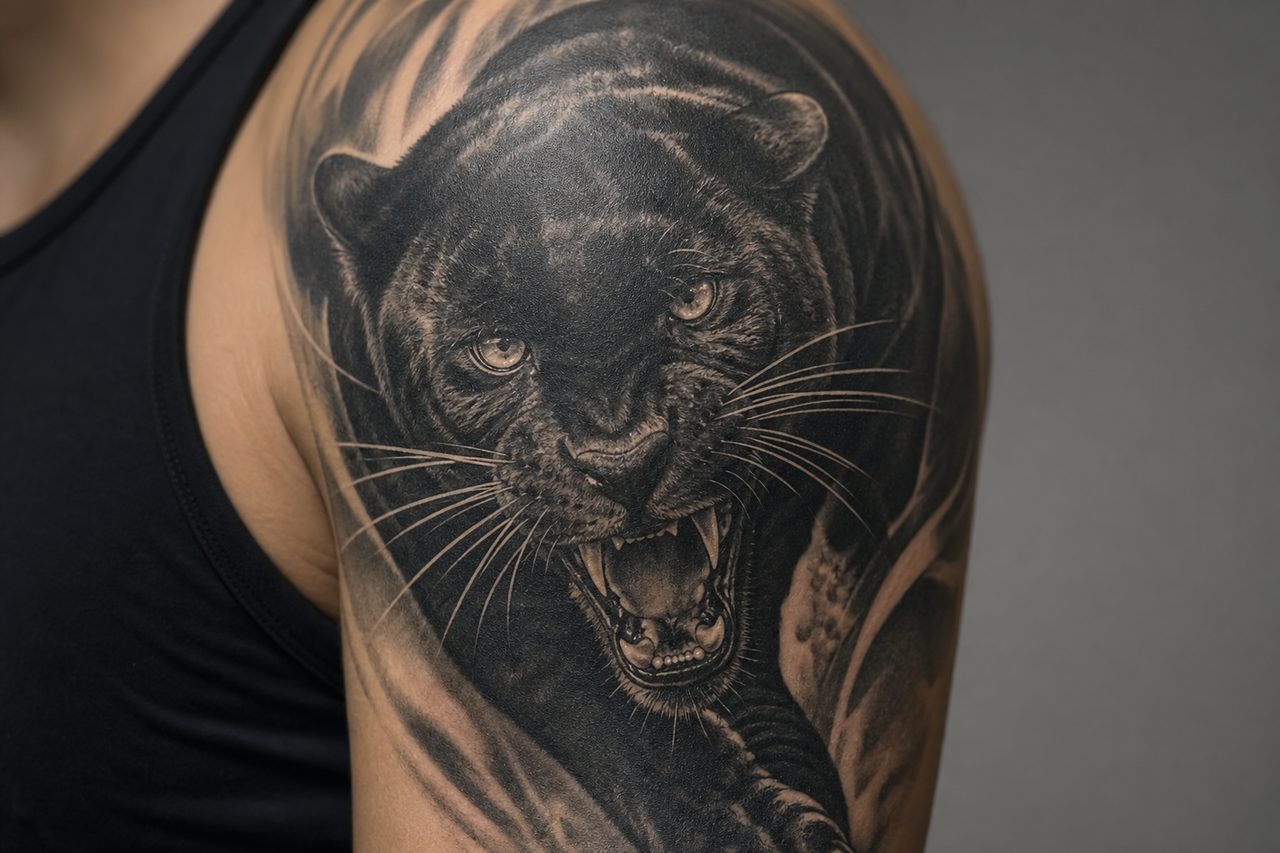
Photorealistic black panthers emerged later, influenced by Chicano black-and-grey traditions and wildlife photography. These pieces demand more skin real estate to render properly, think shoulder cap, outer thigh, or full back. The challenge here is contrast: a black panther in black ink requires negative space, subtle grey gradations, and sometimes white highlights to avoid becoming a muddy silhouette. Over time, the softer greys can fade faster than solid blacks, so placement matters. Areas with less sun exposure (upper arm, ribcage under clothing) preserve the subtle tonal work better than constantly exposed forearms or calves.
Who Chooses This Tattoo
The panther attracts a specific temperament more than a specific demographic. People drawn to it often identify with controlled aggression, someone who doesn’t start conflicts but finishes them. In shop consultations, this usually surfaces as a rejection of louder predator imagery: lions read as too noble, tigers too obvious, wolves too pack-oriented. The panther occupies a loner niche.
- Recovering from hardship: The panther’s association with surviving darkness resonates with people who’ve navigated prolonged difficulties rather than single dramatic events.
- Subcultural alignment: Punk, metal, and certain outlaw motorcycle communities adopted the crawling panther as an anti-establishment emblem in the 1970s and 80s, and that lineage still attracts people who identify with those scenes.
- Physical practitioners: Fighters, dancers, and climbers sometimes gravitate toward the panther for its combination of muscular power and fluid movement, body awareness as symbolic content.
Women choosing panther tattoos sometimes face weird pushback about “feminine” imagery, which is nonsense. The design adapts easily to any body; the crawling pose wraps naturally around curves, and the snarling head works powerfully on sternums, thighs, or upper backs.
Mythology & Folklore
European Medieval Beliefs
Medieval bestiaries described the panther as a gentle beast whose sweet breath drew all animals to it, except the dragon, which hid in fear. This made it a symbol of Christ in some allegorical traditions, an association almost nobody recognizes today. The breath-as-attraction element rarely surfaces in modern tattoo symbolism, but the underlying tension between deadly capability and unexpected gentleness still echoes in contemporary meanings.
Global Panther Figures
In some Central and South American traditions, the jaguar, often conflated with the black panther in tattoo imagery, occupied shamanic roles, associated with night vision and crossing between worlds. African folklore features leopard and panther spirits as guardians of the threshold between village and wilderness. These connections are commonly referenced in tattoo consultations, though actual indigenous practitioners would distinguish carefully between specific big cats and their distinct cultural weights. Tattoo imagery tends to collapse these distinctions into a generalized “mysterious black cat” archetype.
Design Tips & Pairings
Complementary Elements
The crawling panther pairs naturally with daggers (conflict, protection), roses (beauty and danger intertwined), and skulls (memento mori with teeth). Less common but effective: jungle foliage framing the cat, moon phases above or below, or geometric elements that contrast the organic form. The key is avoiding visual clutter, the panther’s silhouette is already busy with extended limbs and curved spine.
Placement Logic
The traditional crawling pose was designed specifically to wrap around limbs: forearm to hand, calf to ankle, bicep to shoulder. The curve of the spine follows the muscle contour. For the snarling head alone, the chest plate, outer thigh, or upper back provide enough flat surface for the facial structure to read correctly. Small panther heads on wrists or behind ears tend to blur over time; the features require more space than people sometimes expect. A palm-sized minimum preserves the eye shape and jaw definition.
- Line weight: Traditional American panther designs need bold outlines, think 7-14 needle groupings. Fine-line versions exist but age poorly; the black fills into itself without boundary definition.
- Directional flow: Crawling panthers should move toward the viewer’s center, not away. Head-down compositions on forearms, for instance, read as retreating rather than prowling.
- Background handling: Solid color panthers often work better without background elements. Black and grey versions can integrate atmospheric shading or minimal environment more successfully.
History & Cultural Roots
The panther’s tattoo prominence traces directly to 20th-century American military and maritime culture. Sailor Jerry Collins and his contemporaries popularized the crawling panther as flash art in Honolulu during the 1940s and 50s. The design traveled with servicemen back to mainland ports, embedding itself in working-class tattoo vernacular. Its popularity peaked again during the 1970s black power and civil rights movements, when the Black Panther Party’s imagery, though politically distinct, amplified the cat’s cultural visibility and lent it additional resonance around resistance and self-determination.
By the 1990s, the panther had become somewhat clichéd in traditional shops, a “walk-in special” that serious collectors sometimes dismissed. Its recent revival reflects broader renewed interest in American traditional aesthetics rather than any new symbolic development. The meaning remains remarkably stable across decades: power, patience, solitary capability.
Similar & Related Symbols
People considering panthers often weigh related predators. The distinction matters for final meaning:
- Tiger: More explicitly Asian in tattoo tradition, associated with ferocity and elemental balance in Japanese irezumi. Reads as more outwardly aggressive than the panther’s contained threat.
- Jaguar: Specifically Mesoamerican symbolic weight, often rendered with more naturalistic detail and open rosette patterning rather than solid black. Appeals to people with actual Latin American heritage connections rather than generalized “exotic” interest.
- Leopard: Similar to panther in Western tattooing, sometimes distinguished by visible spotted patterning even in darker renderings. Carries slightly less countercultural baggage, more pure “wildness” association.
- Black cat: Smaller scale, more domesticated witchcraft and superstition associations. Shares the darkness element but lacks muscular power symbolism.
- Wolf: Pack animal, loyalty and family. Direct contrast to panther’s solitary nature. People choosing between them often reveal whether they prioritize belonging or self-sufficiency.
Serpents occupy similar symbolic territory, hidden threat, patience, striking speed, but lack the mammalian warmth that draws some to big cats. Bears offer comparable solitary power but read as slower, more hibernatory, less lethal elegance.
The Takeaway
The panther tattoo endures because its meaning is specific without being rigid. It accommodates personal interpretation without collapsing into pure abstraction. Someone wearing it might emphasize the survival aspect, the silent patience, the countercultural lineage, or simply the graphic punch of a well-executed traditional design. The image doesn’t require explanation, which is part of its utility as body art, it communicates before language engages. For placement, prioritize line longevity over trend; for meaning, let the cat’s actual behavior inform your connection rather than forcing symbolic overlay. The best panther tattoos carry weight because the wearer recognizes something accurate in the animal’s nature, not because they’ve been sold a prefabricated narrative about empowerment.
Frequently Asked Questions
Does a panther tattoo always represent aggression?
Not necessarily. The panther’s primary symbolic weight is controlled power, patience and precision rather than random violence. Many people choose it for the stealth and survival aspects, not dominance.
How well does a black panther tattoo age compared to other designs?
Solid black panther heads age reasonably well if the original ink saturation was thorough, but subtle grey realism fades faster and can blur into indistinct dark patches. Bold traditional outlines with color hold structure longest.
What’s the difference between a panther and jaguar tattoo meaning?
In tattoo practice, they’re often visually identical solid black cats, but jaguar specifically carries Mesoamerican cultural weight that panther lacks. Panther draws more from American traditional tattoo history and generalized Western symbolism.
Can a panther tattoo work as a cover-up?
The crawling panther’s extended shape and heavy black fill make it excellent for covering older tattoos, especially on limbs. The traditional design was partly popularized for this practical purpose in mid-century shops.