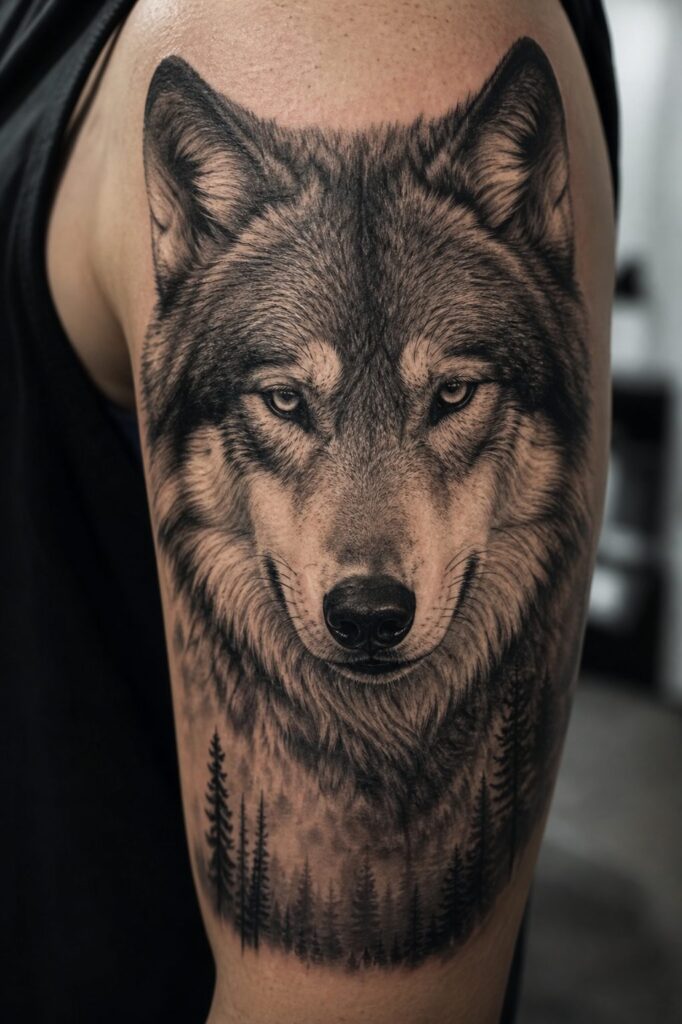
A realistic wolf tattoo reproduces the animal’s actual appearance, fur direction, eye reflectivity, muscle tension under coat, without stylized simplification. The goal is photographic accuracy: individual whisker pores, the wet gleam of a nose, the way light catches guard hairs against a darker undercoat. Done well, it reads as three-dimensional, as if the wolf exists on the other side of the skin rather than sitting on top of it.
Key Characteristics & Motifs
What “Realistic” Actually Means Here
Realism in wolf tattoos isn’t about making the animal look friendly or symbolic. It’s about technical accuracy: correct skull proportions, accurate canine tooth length, pelage patterns that match a specific subspecies if the reference is precise. Gray wolves (Canis lupus) have broader foreheads and coarser fur than red wolves or Ethiopian wolves. A good piece will account for this if the client cares about biological fidelity.
The eyes carry most of the weight. Wolves have round pupils, not vertical slits, and their amber or pale yellow irises show distinct striations. A realistic rendering builds these in layers: base color, striation detail, then a reflective catchlight that suggests moisture and curvature. Without that catchlight, the eye looks flat and dead.
- Fur texture: single-needle or tight three-needle grouping for fine guard hairs; larger mags for dense undercoat
- Ear positioning: forward for alertness, flattened for aggression, relaxed for neutrality, each changes the emotional read
- Snout length: proportionally longer than most domestic dogs; a common error that breaks realism
- Background treatment: snow, forest, moonlight, or negative space, each requires different value ranges
Common Compositional Approaches
Portrait orientation dominates: wolf facing three-quarter view, one eye visible, head and shoulders filling the frame. Full-body running poses work better on larger surfaces like ribs or thighs where leg extension reads naturally. Howling wolves are popular but harder to execute convincingly because the neck stretch distorts familiar proportions and the open mouth exposes teeth that must be anatomically correct.
Some collectors opt for a wolf emerging from shadow, half the face in darkness, half catching light. This demands smooth gradation work and a artist confident in black-and-gray value control.
Origins & History
Realistic animal portraiture in tattooing developed alongside photographic reference availability. Before cheap cameras and internet image libraries, tattooers worked from flash sheets and memory; wolves looked generic and dog-like. The shift toward photographic accuracy accelerated in the 1990s with color realism’s rise, though wolf subjects remained heavily weighted toward tribal and Celtic stylization until the 2000s.
The style is often linked to wildlife art traditions, Roger Tory Peterson’s field guide illustrations, the Hudson River School’s dramatic fauna, even taxidermy reference photography. Some trace it to the black-and-gray Chicano realism that proved skin could hold subtle tonal gradation. What matters practically: the techniques now used for realistic wolves descend directly from portrait tattooing of human faces, adapted for fur texture.
How It Ages
The Fur Problem
Fine detail is the first casualty of time. Single-needle hair lines that look crisp at six months soften into indistinct texture by year five. The solution most experienced artists use: build fur impressionistically rather than literally. Suggest clumps and direction changes with bolder value shifts rather than hundreds of individual strokes. A wolf that reads as “furry” from conversational distance will age better than one that required a magnifying glass to appreciate at day one.
Color vs. Black and Gray
Black-and-gray wolf tattoos hold their value structure longer. Color realism, amber eyes, pink tongue, brown and cream fur, relies on pigments that shift differently. Yellows and light oranges tend to fade or warm toward a generic peach. Blues and grays in shadowed fur hold better. If you want color, concentrate it in the eyes and nose; keep the coat in black and gray with minimal warm undertones.
Placement affects aging significantly. A wolf on the outer upper arm, shielded from sun and friction, preserves detail longer than one on the top of the hand or the side of the neck. The thicker skin of the thigh takes saturation well but can blur fine lines as it moves and compresses.
Modern Variations
Double Exposure and Integrated Scenery
Contemporary collectors increasingly request wolves containing secondary imagery within their silhouettes, forest treelines, mountain ranges, star fields. This requires the artist to maintain the wolf’s readable form while the interior negative space carries a separate scene. The technique works best when the interior imagery shares value ranges with the corresponding exterior section; a bright moon inside a dark neck ruff creates visual confusion.
Neo-Traditional Hybrids
Some artists merge realistic wolf faces with stylized decorative elements: ornamental frames, geometric backgrounds, limited color palettes borrowed from Japanese tattooing. The wolf itself remains photorealistic while the surrounding treatment provides stylistic contrast. This approach suits collectors who want accuracy without the full solemnity of pure wildlife realism.
Linework & Technique
Needle Groupings and Their Effects
Realistic fur demands varied needle configurations. Single needles (1RL) establish whiskers and fine guard hairs. Three-round liners (3RL) build texture density. Curved magnums, 7CM, 9CM, 13CM, lay in smooth tonal gradations for undercoat and shadow. Flat magnums create harder edges where fur meets background. The best wolf tattoos switch between these constantly, sometimes within the same square inch.
- Stipple shading: creates soft, atmospheric texture for distant fur or fog backgrounds
- Whip shading: produces directional hair strokes with organic variation
- Smooth shading (pendulum motion): essential for the polished look of nose leather and eye moisture
- Color packing: required for solid amber eyes; multiple thin passes prevent muddiness
Reference Photography and Its Limits
Working from a single photograph risks a flat, static result. Strong artists composite multiple references: one for lighting, another for pose, a third for fur detail. They also understand that translating a 2D photo onto curved, mobile skin requires adjustment, compressing values, exaggerating certain contrasts, simplifying busy areas that would blur at tattoo scale.
Choosing the Right Artist
Not every realism specialist handles animals well. Human portrait skills transfer partially: eye construction, skin tone gradation, understanding of light on form. But fur texture, wet nose rendering, and the particular bone structure of canids require specific experience. Review portfolios for healed results, not just fresh photography. Fresh work hides the softness that develops as swelling subsides and ink settles.
Ask directly about their reference process. An artist who works only from client-provided photos without adaptation is a red flag. You want someone who studies wildlife photography, understands wolf anatomy, and can explain why they’re adjusting your reference. Geographic style matters too: European realism often runs darker and more contrast-heavy; American realism tends toward smoother mid-tones. Neither is superior, but know which you prefer.
Budget realistically. A palm-sized realistic wolf head takes 4-6 hours minimum. A full sleeve with integrated scenery might require 20-30 hours across multiple sessions. The hourly rate for skilled realism is typically higher than traditional or neo-traditional work because of the technical demand and slower pace.
Before You Decide
Consider the emotional register you want. Realistic wolves carry inherent intensity, they’re predators, not pets, and accurate rendering preserves that wildness. A calm, alert wolf reads differently than a snarling one, but both maintain distance. If you want companionable or domestic warmth, realistic style may fight your intent.
Think about scale. Realism needs room to breathe. A wolf head smaller than your palm loses the detail that defines the style; it becomes a fuzzy brown shape. Commit to the size the technique requires, or choose a different style entirely.
Finally, plan for touch-ups. Even excellent realistic wolf tattoos benefit from a refresh at 5-7 years to restore lost highlights and sharpen softened edges. This isn’t failure, it’s maintenance, like keeping a painting framed properly. Go into the process with that expectation and you’ll be satisfied long-term.
Frequently Asked Questions
How much does a realistic wolf tattoo typically cost?
A palm-sized black-and-gray wolf head runs $400-$800 at most reputable shops, while larger color pieces with full backgrounds can reach $2,000-$4,000. Realism commands higher hourly rates due to slower, more meticulous work. Budget for quality rather than hunting bargains.
What’s the best body placement for a realistic wolf?
The outer upper arm, thigh, and calf offer flat, stable surfaces that preserve detail and heal predictably. The ribs work for larger compositions but hurt more and move during breathing. Avoid hands, feet, and fingers where detail blurs fastest.
Can a realistic wolf tattoo be covered up later if I change my mind?
Dense black-and-gray realism is among the harder styles to cover because of the deep saturation and large surface area. A skilled cover-up artist can work with it, but your options narrow significantly. Consider this a permanent choice, not a temporary one.
How do I tell if an artist’s portfolio shows healed work or fresh tattoos?
Fresh tattoos look slightly swollen, with reddened skin and exaggerated contrast. Healed work shows settled ink against normal skin tone, often photographed in natural light. Ask the artist directly, they should distinguish between fresh and healed pieces without hesitation.


Leave a Reply